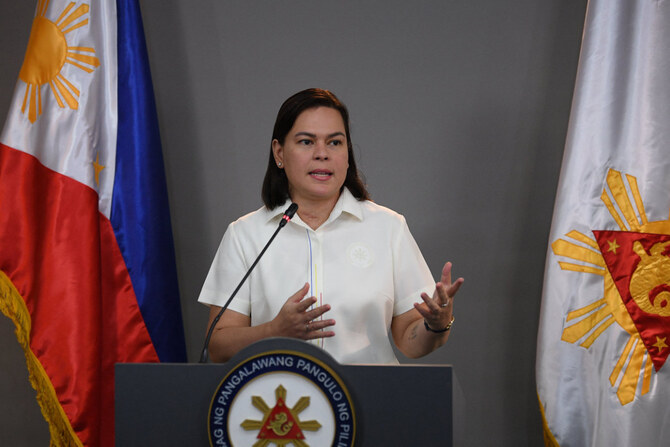
MANILA: Philippine Vice President Sara Duterte will no longer sit on the National Security Council after President Ferdinand Marcos Jr. signed an order removing her office from the agency, following a bitter split between the two former allies last year.
Marcos said the reorganization of the National Security Council (NSC) was needed to “ensure that its council members uphold and protect national security and sovereignty.”
The vice president’s office did not immediately respond to a request for comment.
“At the moment, the VP is not considered relevant to the responsibilities of membership in the NSC,” Lucas P. Bersamin, Executive Secretary to the President, said in a statement.
The council’s reorganization was also aimed at guaranteeing a resilient national security institution that was able to adapt to new challenges, according to the order, which was signed on Dec. 30 and released on Friday.
The changes have also excluded former presidents from council membership and empowered Marcos to appoint “other government officials and private citizens” as needed.
Sara Duterte, the daughter of former President Rodrigo Duterte, is currently facing impeachment complaints accusing her of graft, incompetence and amassing ill-gotten wealth while in office. She has denied the allegations.
Duterte has said she had contracted an assassin to kill the president, his wife and cousin who is the speaker of the House of Representatives if she herself were killed. She later claimed her remarks had been taken out of context.

Marcos drops estranged VP Duterte from Philippine security council
https://arab.news/9rr8b
Marcos drops estranged VP Duterte from Philippine security council
Nigerian gunmen free kidnapped Muslim religious travelers
- Kidnappings for ransom are common in the west African country
JOS, Nigeria: Gunmen have released a group of people they kidnapped in central Nigeria who were traveling for a Muslim religious event, the brother of one of the victims told AFP Saturday.
On December 21, unidentified attackers abducted 28 people, including women and children, in Plateau state while they were traveling to a Malud gathering to mark the birth of the Prophet Muhammad.
Kidnappings for ransom are common in the west African country. But the abduction in Plateau state came after a spate of mass kidnappings in November that drew international scrutiny over the country’s grim security situation.
“Yesterday at night, an official of the State Security Service called and told us that our people have been rescued,” said Ibrahim Musa, a brother of one of the victims.
Musa told AFP he and others “are eagerly waiting to receive our people” once they’re handed over by security forces to their families.
The Plateau abduction occurred on the same day authorities secured the release of 130 schoolchildren — the last batch of more than 250 snatched from their Catholic boarding school in north-central Niger state.
It was unclear how the Plateau travelers were freed. Paying ransoms is technically illegal in Nigeria, though the government is often suspected of doing so.
Neither the police nor the State Security Service — also known as the Department of State Services (DSS) — immediately responded to a request for comment.
US President Donald Trump has latched onto the insecurity in Nigeria, focusing on the killing of Christians and putting Abuja under diplomatic pressure.
In late December the US launched strikes on what it and the Nigerian government said were militants linked to the Daesh group.
Nigeria’s myriad armed conflicts kill people across religious lines, and some experts have warned Trump’s focus on Christian victims may inflame communal tensions.


