

Marcos appoints new chief minister in Philippines’ only Muslim region

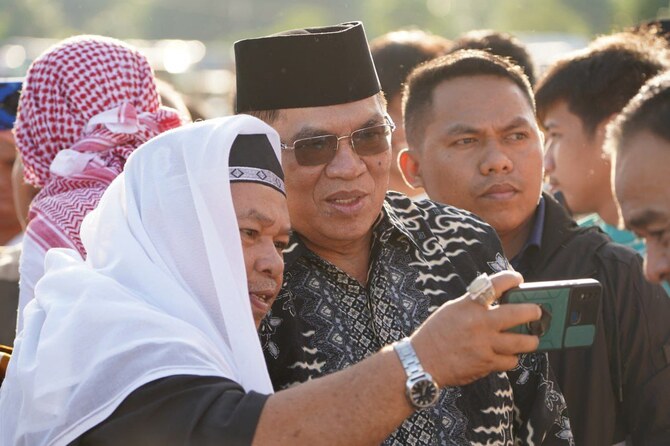
In this file photo, Abdulraof Macacua poses for a photo at an Eid Al-Fitr celebration in Sultan Mastura, Maguindanao on April 22, 2023. (Governor Abdulraof A. Macacua via Facebook)
Short Url
Updated 10 March 2025
Follow

Marcos appoints new chief minister in Philippines’ only Muslim region

  • Abdulraof Macacua is the governor of Maguindanao del Norte and senior MILF leader
  • New leader appointed only 7 months before Bangsamoro’s first parliamentary elections

Manila: President Ferdinand Marcos Jr. has appointed a new interim chief minister to oversee the only Muslim-majority territory in the Philippines, as the region prepares for its first parliamentary elections in October.

Bangsamoro was at the heart of a four-decades-long separatist struggle until 2014, when the Philippine government struck a permanent ceasefire agreement with the Moro Islamic Liberation Front, paving the way for peace and autonomy in the region home to the biggest Muslim population in the predominantly Catholic country.

The Bangsamoro Autonomous Region in Muslim Mindanao was formed in 2019 as part of the region’s transition to autonomy, which will culminate in October this year, when it will elect its legislature and executive.

Until then, BARMM’s leadership is currently under a transition authority appointed by the Philippine president.

Marcos has appointed Abdulraof Macacua, the governor of Maguindanao del Norte — a province within the Bangsamoro region — to replace Murad Ebrahim, who had served as BARMM’s chief minister since 2019.

The change in leadership was confirmed on Sunday by Presidential Communications Office Undersecretary Claire Castro.

“This transition comes at a crucial time as the Bangsamoro region prepares for a significant milestone — its first parliamentary elections in October this year,” Presidential Peace Adviser Carlito G. Galvez, Jr. said in a statement on Monday.

“For the continuity and success of the Bangsamoro peace agreement, we place our trust in Interim Chief Minister Macacua as he takes the helm of governance.”

Macacua’s appointment was welcomed by Yshmael “Mang” I. Sali, the governor of Bangsamoro’s Tawi-Tawi province.

“We stand firmly behind the new leadership as we work together toward the goals of the Bangsamoro Government for the benefit of all its constituents,” Sali said.

Macacua, 67, has been a member of the Bangsamoro Transition Authority since 2019. Also known as Sammy Gambar, he was a senior MILF leader and had served as chief of staff of MILF’s armed wing.

Rikard Jalkebro, an expert on Muslim Mindanao and associate professor at the Anwar Gargash Diplomatic Academy in Abu Dhabi, said the “unexpected” change in BARMM’s leadership “carries significant political, governance and security” implications.

“It signals that (the palace) is not happy (or) confident that things are moving in the right direction,” Jalkebro told Arab News.

The last-minute leadership change may create uncertainties for ongoing governance programs, development initiatives and election preparations.

“Ebrahim was leading the BARMM transition with policies aligned with the peace process. Will Macacua continue these policies, or will he introduce new priorities that alter the region’s political and economic trajectory?” he said.

Though Macacua is also part of MILF, his appointment may also “indicate internal rifts within the organization,” according to Jalkebro.

As such, how the MILF and other Bangsamoro stakeholders react to the latest development in the coming months “will be critical” in determining “whether this shift strengthens or destabilizes” the transition process.

“The transition from a rebel movement to a formal political entity is delicate, and any perception of unfair political maneuvers could create tensions, particularly among grassroots MILF supporters,” Jalkebro said.

“The long-term effect will hinge on whether Macacua can maintain stability, ensure a fair election, and uphold BARMM’s autonomy without undue national government interference. This moment is a critical test for the future of Bangsamoro self-governance.”


India accelerates free trade agreements against backdrop of US tariffs

Updated 21 December 2025
Follow

India accelerates free trade agreements against backdrop of US tariffs

  • India signed a CEPA with Oman on Thursday and a CETA with the UK in July 
  • Delhi is also in advanced talks for trade pacts with the EU, New Zealand, Chile 

NEW DELHI: India has accelerated discussions to finalize free trade agreements with several nations, as New Delhi seeks to offset the impact of steep US import tariffs and widen export destinations amid uncertainties in global trade. 

India signed a Comprehensive Economic Partnership Agreement with Oman on Thursday, which allows India to export most of its goods without paying tariffs, covering 98 percent of the total value of India’s exports to the Gulf nation. 

The deal comes less than five months after a multibillion-dollar trade agreement with the UK, which cut tariffs on goods from cars to alcohol, and as Indian trade negotiators are in advanced talks with New Zealand, the EU and Chile for similar partnerships. 

They are part of India’s “ongoing efforts to expand its trade network and liberalize its trade,” said Anupam Manur, professor of economics at the Takshashila Institution. 

“The renewed efforts to sign bilateral FTAs are partly an after-effect of New Delhi realizing the importance of diversifying trade partners, especially after India’s biggest export market, the US, levied tariff rates of up to 50 percent on India.” 

Indian exporters have been hit hard by the hefty tariffs that went into effect in August. 

Months of negotiations with Washington have not clarified when a trade deal to bring down the tariffs would be signed, while the levies have weighed on sectors such as textiles, auto components, metals and labor-intensive manufacturing. 

The FTAs with other nations will “help partially in mitigating the effects of US tariffs,” Manur said. 

In particular, Oman can “act as a gateway to other Gulf countries and even parts of Eastern Europe, Central Asia, and Africa,” and the free trade deal will most likely benefit “labor-intensive sectors in India,” he added. 

The chances of concluding a deal with Washington “will prove to be difficult,” said Arun Kumar, a retired economics professor at the Jawaharlal Nehru University.

“With the US, the chances of coming to (an agreement) are a bit difficult, because they want to get our agriculture market open, which we cannot do. They want us to reduce trade with Russia. That’s also difficult for India to do,” he told Arab News.  

US President Donald Trump has threatened sanctions over India’s historic ties with Moscow and its imports of Russian oil, which Washington says help fund Moscow’s ongoing war with Ukraine.

“President Trump is constantly creating new problems, like with H-1B visa and so on now. So some difficulty or the other is expected. That’s why India is trying to build relationships with other nations,” Kumar said, referring to increased vetting and delays under the Trump administration for foreign workers, who include a large number of Indian nationals. 

“Substituting for the US market is going to be tough. So certainly, I think India should do what it can do in terms of promoting trade with other countries.” 

India has free trade agreements with more than 10 countries, including comprehensive economic partnership agreements with South Korea, Japan, and the UAE.

It is in talks with the EU to conclude an FTA, amid new negotiations launched this year for trade agreements, including with New Zealand and Chile.  

India’s approach to trade partnerships has been “totally transformed,” Commerce and Industry Minister Piyush Goyal said in a press briefing following the signing of the CEPA with Oman, which Indian officials aim to enter into force in three months. 

“Now we don’t do FTAs with other developing nations; our focus is on the developed world, with whom we don’t compete,” he said. “We complement and therefore open up huge opportunities for our industry, for our manufactured goods, for our services.”