



BEIRUT: Israel conducted heavy airstrikes in south Lebanon on Thursday, hitting targets north of the Litani River in violation of a US-brokered truce.
Following the strikes in the Nabatieh region, Lebanese President Joseph Aoun held urgent talks with high-level foreign contacts to halt the Israeli violations.
The airstrikes killed one person, reportedly a senior Hezbollah military leader, and led to multiple injuries, sparking panic in schools, universities and among residents.
Aoun followed up on security developments with army chief Gen. Rodolphe Haikal, receiving reports on the areas struck by the Israeli bombardment.
The Ministry of Health said that the initial death toll of the Israeli airstrikes on the outskirts of Nabatieh was one, with eight injured.
A source familiar with Aoun’s communications told Arab News: “The president’s contacts primarily involved the US and French sides, as they are sponsors of the ceasefire agreement and key members of the committee overseeing its implementation.”
The president reportedly called on the US and France “to pressure Israel to halt its attacks,” but the talks “did not yield any concrete guarantees.”
Israeli jets launched about 19 airstrikes on the area between Kfar Tebnit, Jabal Ali Taher, Nabatieh Al-Fawqa and Kafr Rumman, forming what resembled a ring of fire.
Containing valleys, hills and forests, the area is located about 4 km from the city of Nabatieh, which itself is 56 km from Beirut.
The unprecedented Israeli attack on the region, untouched since the ceasefire agreement between Israel and Hezbollah took effect on Nov. 27, specifically targeted the Ali Taher area, considered a Hezbollah-controlled security zone.
Hezbollah reportedly lost one of its top military commanders, Abu Hussein Shahrour, who, according to reporters in the region, “was one of the party’s key fighters and played a pivotal role in the 1997 Sajd operation against the Israeli occupation.”
According to Israeli media, a “senior source” in the Israeli army said the military “attacked a significant target in southern Lebanon, consisting of underground infrastructure.”
Israeli army spokesperson Avichay Adraee said the target “was used to manage the fire and defense systems of the Hezbollah terrorist organization.”
According to Adraee, the airstrikes “targeted personnel, combat equipment and wells. The site in question was part of a strategic underground project and was put out of service as a result of the strikes.”
He added that “the site and activities there are a blatant violation of the understanding between Israel and Lebanon.”
The Israeli army “will continue to act to eliminate any threat to Israel’s security and will prevent any attempt to rebuild Hezbollah’s capabilities,” Adraee said.
The Israeli army’s Northern Command said it would maintain its “offensive policy” against Hezbollah.
The airstrikes and massive explosions triggered loud bangs that echoed throughout Nabatieh and the south.
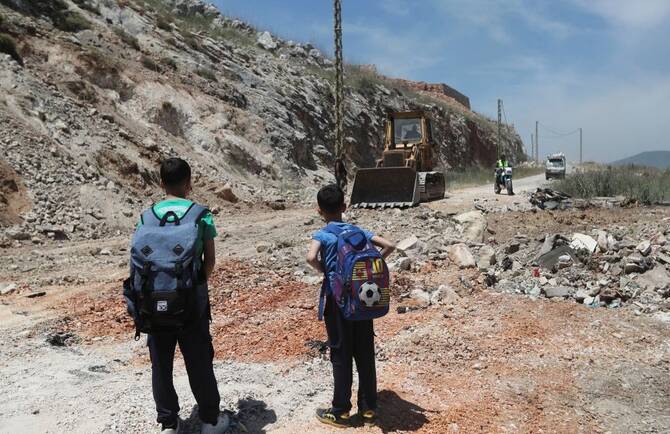
Residents near the targeted areas rushed to evacuate their children from schools, and most official departments shut down.
Later, the Israeli army opened fire with machine guns on a civilian vehicle on the Odaisseh-Kafr Kila road in the border area.
The car sustained damage. However, the female driver and her daughter escaped unharmed.
Meanwhile, in the morning, Israeli aircraft dropped leaflets on several areas in the south, resembling banknote-like papers that carried incendiary phrases against Hezbollah. These included: “Hezbollah’s dollar is haram (forbidden in Islam) and will not benefit you after it destroyed your house and displaced your family.”
Another said: “Do not miscalculate things and do not accept the yellow dollar.”
Prime Minister Nawaf Salam condemned the Israeli strikes on Nabatieh and said the government was aiming to “put an end to the Israeli violations as soon as possible.”
He added: “The government has spared no diplomatic effort to stop these actions and ensure Israel’s withdrawal from the hills it still occupies.”
Salam, accompanied by a ministerial delegation, traveled to Baalbek in the morning on a Lebanese army helicopter and inspected the border plains with Syria.
He has repeatedly called for Lebanon to ramp up its border security.
Salam called for strengthened security measures during a security meeting at Baalbek Serail, highlighting the need to “maintain stability and ensure successful municipal elections with complete transparency and integrity” throughout the governorate.
Meeting with local representatives, the premier announced progress on establishing a cannabis regulatory authority, describing it as a pathway “to transition toward a development-based economy benefiting regional residents.”
Salam was unequivocal that “neither security nor development can function through arbitrary measures.”
He highlighted the urgent need to resolve transportation challenges between Beirut and the Bekaa Valley, while advocating for Baalbek’s restoration as a premier tourist destination in Lebanon.
Salam also visited the Masnaa border crossing with Syria, receiving detailed security briefings from military personnel on site.
“The Masnaa crossing serves as a vital gateway for both the Bekaa and Lebanon as a whole. It must operate according to the highest technical and security standards rather than succumbing to disorder or discretionary practices,” Salam said.
He added that advanced scanning equipment would soon be installed “to facilitate goods movement, enhance transparency and enable properly regulated land exports of Lebanese products.”
Salam said that transforming the border crossing “from a vulnerability into a symbol of state effectiveness” represents a critical first step in broader reforms.
“This is where change begins — with Lebanon fully reclaiming control of its borders and converting them into gateways for legitimacy and order, not channels for chaos and violations.”


