

Netflix announces major revamp of app homepage

Short Url
Updated 07 May 2025
Follow

Netflix announces major revamp of app homepage

  • Redesign features enhanced personalization and improved recommendations, as well as vertical videos on mobile devices

DUBAI: Streaming giant Netflix will begin rolling out a major revamp of its TV app’s homepage next week.

The new design “is simpler, more intuitive, and better represents the breadth of entertainment on Netflix today,” the company’s chief product officer, Eunice Kim, said on Tuesday.

It includes a navigation bar at the top of the screen, rather than the current position on the left, and more-responsive recommendations while a user browses the app.

Netflix’s chief technology officer Elizabeth Stone said that in making these recommendations the service “will pull in more signals,” such as search history and the trailers watched by a user.

“And because everything will happen seamlessly in the background, you won’t even notice it happening — it will just be magically easier to find something to watch,” she added.

The overall design will be more minimalist and cleaner, providing all the relevant information about a title in one place so as to reduce “eye gymnastics” and help users make an “informed choice,” Kim said.

The mobile app is also getting an overhaul, as Netflix tests the use of the favored video format on social media: vertical viewing. The vertical feed will feature clips from movies and TV shows that users can browse and then click on to visit to a title’s home page.

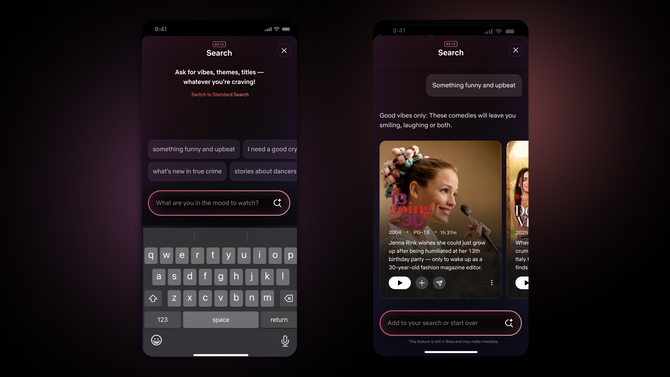
Netflix has previously used artificial intelligence technology across the platform for features such as recommendations but now, with advances in generative AI, it aims to go a step further by showcasing titles in more languages and including chatbot-like functionality.

For example, viewers can use conversational phrases such as “I want to watch something scary but not too scary” to search for content.

“Believe it or not, that search phrase will actually yield results in the new experience,” said Stone.

The company is also investing further in its content-delivery network, Open Connect, which optimizes streaming globally across differing internet speeds.

“Open Connect has given us a really strong foundation and now we’re building on that foundation as we deliver a broader and more complex variety of entertainment, including live events and games on TV,” Stone said.

“Entertaining the world is hard but technology makes it easier.”


Paris exhibition marks 200 years of Le Figaro and the enduring power of the press

Updated 17 January 2026
Follow

Paris exhibition marks 200 years of Le Figaro and the enduring power of the press

  • The exhibition celebrated the bicentennial of Le Figaro, offering visitors a rare opportunity to step inside the newspaper’s vast historical archive

PARIS: One of France’s most influential newspapers marked a major milestone this month with a landmark exhibition beneath the soaring glass nave of the Grand Palais, tracing two centuries of journalism, literature and political debate.
Titled 1826–2026: 200 years of freedom, the exhibition celebrated the bicentennial of Le Figaro, offering visitors a rare opportunity to step inside the newspaper’s vast historical archive. Held over three days in mid-January, the free exhibition drew large crowds eager to explore how the title has both chronicled and shaped modern French history.
More than 300 original items were displayed, including historic front pages, photographs, illustrations and handwritten manuscripts. Together, they charted Le Figaro’s evolution from a 19th-century satirical publication into a leading national daily, reflecting eras of revolution, war, cultural change and technological disruption.
The exhibition unfolded across a series of thematic spaces, guiding visitors through defining moments in the paper’s past — from its literary golden age to its role in political debate and its transition into the digital era. Particular attention was paid to the newspaper’s long association with prominent writers and intellectuals, underscoring the close relationship between journalism and cultural life in France.
Beyond the displays, the program extended into live journalism. Public editorial meetings, panel discussions and film screenings invited audiences to engage directly with editors, writers and media figures, turning the exhibition into a forum for debate about the future of the press and freedom of expression.
Hosted at the Grand Palais, the setting itself reinforced the exhibition’s ambition: to place journalism firmly within the country’s cultural heritage. While the exhibition has now concluded, the bicentennial celebrations continue through special publications and broadcasts, reaffirming Le Figaro’s place in France’s public life — and the enduring relevance of a free and questioning press in an age of rapid change.