

Pakistan interior minister arrives in Oman to discuss standoff with India 

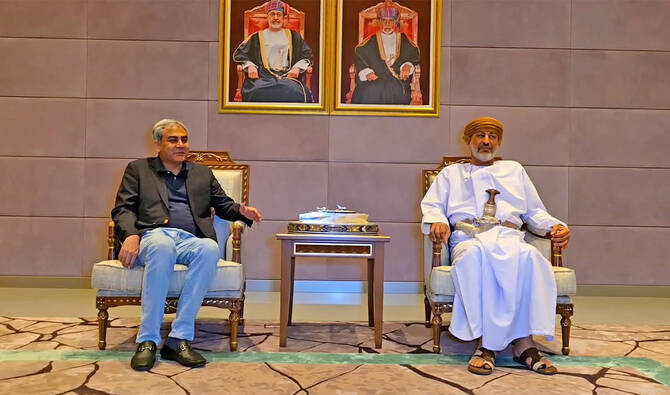
Pakistan’sInterior Minister Mohsin Naqvi (left) meets Oman’s Interior Secretary Sayyid Khalid bin Hilal bin Saud Al Busaidi in Muscat, Oman, on May 4, 2025. (Pakistan’s interior ministry)
Short Url
Updated 04 May 2025
Follow

Pakistan interior minister arrives in Oman to discuss standoff with India 

  • Mohsin Naqvi will meet Omani officials in Muscat to discuss regional situation during day-long visit 
  • New Delhi has accused Islamabad of backing perpetrators of Apr. 22 attack in Indian-administered Kashmir

ISLAMABAD: Pakistan’s Interior Minister Mohsin Naqvi arrived in Muscat on a day-long visit on Sunday, the interior ministry said, to meet high-level Omani officials and discuss the regional situation amid Islamabad’s spike in tensions with New Delhi. 

In an earlier statement, the interior ministry said Naqvi would depart for a visit to Gulf countries today in light of the regional situation. However, it did not mention which Gulf countries other than Oman he would visit. 

Naqvi’s visit takes place as fears of a military confrontation between India and Pakistan loom large after New Delhi accused Islamabad of backing the perpetrators of an Apr. 22 attack in Indian-administered Kashmir that killed 26 tourists. Pakistan denies involvement and has called for an international probe into the incident. 

“Federal Interior Minister Mohsin Naqvi has arrived in Muscat on a one-day official visit to Oman,” the interior ministry said in a statement. 

It said Naqvi was received at the airport by Oman’s Interior Secretary Sayyid Khalid bin Hilal bin Saud Al Busaidi and Pakistan’s Ambassador to Oman Syed Naveed Safdar Bokhari and other dignitaries. 

“We want to enhance cooperation with Oman in combating drug trafficking and human smuggling,” Naqvi was quoted as saying by his ministry. 

The statement said Naqvi will meet senior Omani officials to present Pakistan’s stance on the evolving regional situation following Islamabad’s surging tensions with New Delhi. 

Pakistan has increasingly engaged countries such as the US, China, Saudi Arabia, Turkiye, South Korea and other nations in recent days to present its point of view regarding its tensions with India. 

The border forces of both countries have traded fire for 10 consecutive days along the Line of Control frontier in Kashmir, which acts as a de facto border between India and Pakistan, international media reports say. 

Both countries have also traded diplomatic barbs, expelled each other’s nationals and closed a key lander border route.

Indian Prime Minister Narendra Modi this week gave the Indian military “operational freedom” to respond to the Kashmir attack. Pakistan has since then conducted war exercises and vowed that any military action from India would invite a “strong” response. 

Both nuclear-armed nations have fought two out of three wars since 1947 over the disputed Kashmir territory. India and Pakistan claim the entire region but administer only parts of it


Islamic military coalition, Pakistan to deepen cooperation to combat ‘terrorism’ — Pakistani military

Updated 10 sec ago
Follow

Islamic military coalition, Pakistan to deepen cooperation to combat ‘terrorism’ — Pakistani military

  • Islamic Military Counter Terrorism Coalition is a 43-member alliance that includes Pakistan, Saudi Arabia, Egypt, Jordan, UAE and other nations
  • The Pakistani military statement comes after a meeting between IMCTC secretary-general and the chief of Pakistani defense forces in Rawalpindi

ISLAMABAD: Pakistan and the Islamic Military Counter Terrorism Coalition (IMCTC) have reaffirmed their commitment to deepening cooperation, including intelligence sharing and capacity building, to jointly combat “terrorism” and “extremism,” the Pakistani military said on Monday.

The IMCTC is a 43-member military alliance that was formed on Saudi Arabia’s initiative in Dec. 2015 to consolidate Muslim countries’ efforts in countering “terrorism.”

A 17-member IMCTC delegation is visiting Pakistan from Feb. 2-6 to conduct a training at National University of Sciences and Technology on “Re-integration and Rehabilitation of Extremist Elements,” according to the Pakistani military.

On Monday, IMCTC Secretary-General Maj. Gen. Mohammed bin Saeed Al-Moghedi held a meeting with Chief of Pakistani Defense Forces Field Marshal Asim Munir to discuss cooperation among IMCTC member states.

“During the meeting, matters of mutual interest were discussed, with particular emphasis on regional security dynamics and enhanced cooperation in counter-terrorism efforts,” the Inter-Services Public Relations (ISPR), the Pakistani military’s media wing, said in a statement.

“Both sides reaffirmed their shared commitment to combating terrorism and extremism through collaborative strategies, intelligence sharing, and capacity building among member states.”

The IMCTC features Pakistan, Saudi Arabia, Türkiye, Afghanistan, Egypt, Jordan, Qatar, Palestine, UAE, Bangladesh and other nations. In 2017, Pakistan’s former army chief Gen. (retd) Raheel Sharif was appointed as the IMCTC commander-in-chief.

During discussions with Major General Al-Moghedi, Field Marshal Munir appreciated the role of IMCTC in fostering stability and promoting coordinated counterterrorism initiatives across the Islamic world, according to the ISPR.

The IMCTC secretary-general acknowledged Pakistan’s significant contributions and sacrifices in the fight against militancy and lauded the professionalism of Pakistan’s armed forces.

“The meeting underscored the resolve of both sides to further strengthen institutional collaboration for peace, stability, and security in the region,” the ISPR added.

Pakistan enjoys cordial ties with most Muslim countries around the world, particularly Gulf Cooperation Council countries. In Sept. 2025, Pakistan signed a landmark defense pact with Saudi Arabia according to which an act of aggression against one country will be treated as an act of aggression against both.