

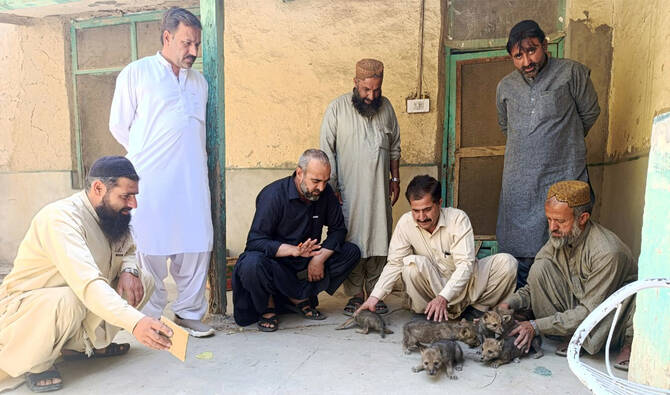
Six Indian gray wolf puppies rescued in southwest Pakistan

Wildlife officials look at the Indian gray wolf puppies rescued from Balochistan’s Zhob district, Pakistan, on May 2, 2025. (Photo Courtesy: Balochistan Wildlife Department)
Short Url
Updated 02 May 2025
Follow

Six Indian gray wolf puppies rescued in southwest Pakistan

  • The puppies were moved to a wildlife rescue center in Balochistan
  • These wolves inhabit dry grasslands of India, Pakistan and Nepal

KARACHI: Six Indian gray wolf puppies, found in the care of local residents in Pakistan’s southwestern Zhob district, were relocated to a rescue center in Balochistan province, the Wildlife Department said on Friday.
The Indian gray wolf, also known as canis lupus pallipes, is a small, slender subspecies of the gray wolf found in India, Pakistan and Nepal, particularly in dry grasslands and scrublands. It has a pale brown or reddish-gray coat with short fur suited to hot climates.

The rescue followed a video that went viral on social media, showing locals playing with the puppies in the Kakar Khorasan area of Zhob. Wildlife officials then sought assistance from the police and Levies to take the animals into their custody, which they did.

“We have transferred all six to the rescue center in Zhob where they are being cared for,” Chief Wildlife Conservator Sharifuddin Baloch told Arab News over the phone. “Once they reach an appropriate age, they will be released into the wild.”
He said initial reports suggested that one wolf puppy had died, but wildlife officials later found all the puppies alive.
Compared to other wolves, Indian gray wolves form smaller packs, are more elusive and less vocal. They prey on livestock, small mammals and occasionally wild ungulates.
Genetically distinct and among the oldest wolf lineages, the Indian gray wolf is listed as endangered in India due to habitat loss, human-wildlife conflict and persecution.


Imran Khan not a ‘national security threat,’ ex-PM’s party responds to Pakistan military

Updated 06 December 2025
Follow

Imran Khan not a ‘national security threat,’ ex-PM’s party responds to Pakistan military

  • Pakistan’s military spokesperson on Friday described Khan’s anti-army narrative as a “national security threat”
  • PTI Chairman Gohar Ali Khan says words used by military spokesperson for Khan were “not appropriate”

ISLAMABAD: Former prime minister Imran Khan’s Pakistan Tehreek-e-Insaf (PTI) party on Saturday responded to allegations by Pakistan military spokesperson Lt. Gen. Ahmed Sharif Chaudhry from a day earlier, saying that he was not a “national security threat.”

Chaudhry, who heads the military’s media wing as director general of the Inter-Services Public Relations (ISPR), spoke to journalists on Friday, in which he referred to Khan as a “mentally ill” person several times during the press interaction. Chaudhry described Khan’s anti-army narrative as a “national security threat.”

The military spokesperson was responding to Khan’s social media post this week in which he accused Chief of Defense Forces Field Marshal Asim Munir of being responsible for “the complete collapse of the constitution and rule of law in Pakistan.” 

“The people of Pakistan stand with Imran Khan, they stand with PTI,” the party’s secretary-general, Salman Akram Raja, told reporters during a news conference. 

“Imran Khan is not a national security threat. Imran Khan has kept the people of this country united.”

Raja said there were several narratives in the country, including those that created tensions along ethnic and sectarian lines, but Khan had rejected all of them and stood with one that the people of Pakistan supported. 

PTI Chairman Gohar Ali Khan, flanked by Raja, criticized the military spokesperson as well, saying his press talk on Thursday had “severely disappointed” him. 

“The words that were used [by the military spokesperson] were not appropriate,” Gohar said. “Those words were wrong.”

NATURAL OUTCOME’

Speaking to reporters earlier on Saturday, Pakistan’s Defense Minister Khawaja Asif defended the military spokesperson’s remarks against Khan.

“When this kind of language is used for individuals as well as for institutions, then a reaction is a natural outcome,” he said. 

“The same thing is happening on the Twitter accounts being run in his [Khan’s] name. If the DG ISPR has given any reaction to it, then I believe it was a very measured reaction.”

Khan, who was ousted after a parliamentary vote of confidence in April 2022, blames the country’s powerful military for removing him from power by colluding with his political opponents. Both deny the allegations. 

The former prime minister, who has been in prison since August 2023 on a slew of charges he says are politically motivated, also alleges his party was denied victory by the army and his political rivals in the 2024 general election through rigging. 

The army and the government both deny his allegations.