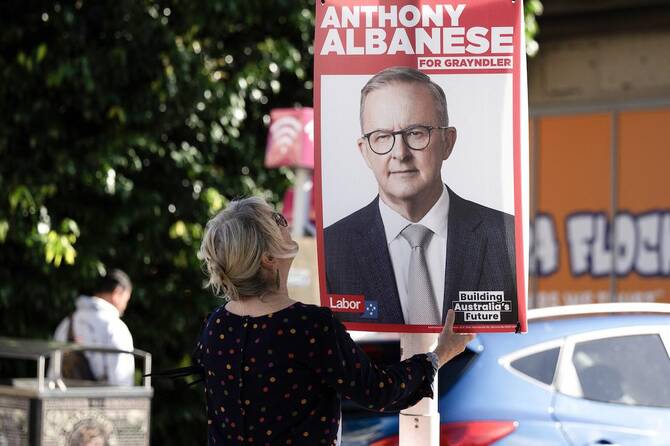
SYDNEY: Voting began on Saturday in Australia’s national election that polls show will likely favor Prime Minister Anthony Albanese’s Labour Party over the conservative opposition, as worries about Donald Trump’s volatile policies overshadowed calls for change.
Albanese said in televised comments from Melbourne that his center-left government had “built really strong foundations.” He has pledged to improve housing affordability and strengthen Australia’s universal health care system during his second term.
Opposition leader Peter Dutton also started his day in Melbourne, a key battleground, where he urged voters to choose his Liberal-National coalition “to get our country back on track.”
The election comes less than a week after Canada’s Liberal Party returned to power in a major political comeback, powered by a backlash against Trump’s tariffs and remarks on Canadian sovereignty.
Both of Australia’s major parties have focused on cost-of-living pressures but opinion polls show that global uncertainty driven by Trump’s stop-start tariffs rapidly became a top issue for voters during the campaign.
Labor has tried to cast ex-policeman Dutton, who has pledged to sharply reduce immigration and cut thousands of public service jobs, as a Trump-lite conservative, hoping some of Australians’ negative sentiment toward the US president will rub off on the opposition leader.
Dutton has sought to distance himself from comparisons with Trump adviser Elon Musk’s agency-cutting fervor but fell behind Labor after the US president placed tariffs on Australia. Dutton had led in opinion polls as recently as February.
Australia is a close US security ally and generally runs a trade deficit with the United States. Even so, it was not spared Trump’s tariffs with a 10 percent duty imposed on Australian exports.Polling booths in Australia — among the few democracies with mandatory voting — opened at 8 a.m., although a record 8 million out of 18 million eligible voters had already cast ballots before Saturday. Polls close at 6 p.m. (0800-1000 GMT depending on time zone).
Overseas, tens of thousands of Australians were expected to cast ballots at booths set up in 83 countries, Australia’s foreign affairs department said.
In the Sydney suburb of Bondi, voter Ben McCluskey said he felt upbeat about Labor winning a second term.
“I’m slightly positive. Hopefully it’s gonna be a minority government and the Greens get a balance of power,” the engineer, 41, said.
Nearby, Lucy Tonagh, a 28-year-old childcare worker, said rising living costs were front of mind for her at the ballot box.
“I feel like the cost of living and also childcare because that’s a key issue I find. There need to be more teachers,” Tonagh said.
Political strategists said Trump was not likely to be the decisive factor in the election — Albanese has run a strong campaign and Dutton made mistakes, including a short-lived proposal to ban public servants working from home. But the Trump effect, they said, has added to reservations for voters who became risk-averse.
A Newspoll published on Friday in The Australian newspaper showed Labor leading 52.5 percent-47.5 percent against the Liberal-National coalition, under Australia’s two-party preferential voting system.
Several polls suggest Labor may be forced into a minority government. Preferences among supporters of the minor parties and independents could be crucial under Australia’s ranked-choice voting system.


![]()


Australians vote in national election with their sights on Trump, living costs
Short Url
https://arab.news/rpmty
Australians vote in national election with their sights on Trump, living costs
- Labor leads in polls amid global uncertainty from Trump’s tariffs
- Albanese emphasizes stable leadership, Dutton focuses on economic challenges
- Votes for minor parties and independents could influence election outcome


Ice-cool Rybakina beats Sabalenka in tense Australian Open final
- The big-serving Kazakh fifth seed held her nerve to pull through 6-4, 4-6, 6-4
- Rybakina who was born in Moscow, adds her Melbourne triumph to her Wimbledon win in 2022
MELBOURNE: Elena Rybakina took revenge over world number one Aryna Sabalenka to win a nail-biting Australian Open final on Saturday and clinch her second Grand Slam title.
The big-serving Kazakh fifth seed held her nerve to pull through 6-4, 4-6, 6-4 at Rod Laver Arena in Melbourne in 2hrs 18mins.
It was payback after the Belarusian Sabalenka won the 2023 final between two of the hardest hitters in women’s tennis.
The ice-cool Rybakina, 26, who was born in Moscow, adds her Melbourne triumph to her Wimbledon win in 2022.
“Hard to find the words now,” said Rybakina, and then addressed her beaten opponent to add: “I know it is tough, but I hope we play many more finals together.”
Turning to some Kazakh fans in the crowd, she said: “Thank you so much to Kazakhstan. I felt the support from that corner a lot.”
It was more disappointment in a major final for Sabalenka, who won the US Open last year for the second time but lost the French Open and Melbourne title deciders.
She was into her fourth Australian Open final in a row and had been imperious until now, with tears in her eyes at the end.
“Let’s hope maybe next year will be a better year for me,” Sabalenka said ruefully.
Rybakina fights back
With the roof on because of drizzle in Melbourne, Rybakina immediately broke serve and then comfortably held for 2-0.
Rybakina faced two break points at 4-3, but found her range with her serve to send down an ace and dig herself out of trouble, leaving Sabalenka visibly frustrated.
Rybakina looked in the zone and wrapped up the set in 37 minutes on her first set point when Sabalenka fired long.
Incredibly, it was the first set Sabalenka had dropped in 2026.
The second game of the second set was tense, Rybakina saving three break points in a 10-minute arm-wrestle.
They went with serve and the seventh game was another tussle, Sabalenka holding for 4-3 after the best rally of a cagey affair.
The tension ratcheted up and the top seed quickly forged three set points at 5-4 on the Kazakh’s serve, ruthlessly levelling the match at the first chance to force a deciding set.
Sabalenka was now in the ascendancy and smacked a scorching backhand to break for a 2-0 lead, then holding for 3-0.
Rybakina, who also had not dropped a set in reaching the final, looked unusually rattled.
She reset to hold, then wrestled back the break, allowing herself the merest of smiles.
At 3-3 the title threatened to swing either way.
But a surging Rybakina won a fourth game in a row to break for 4-3, then held to put a thrilling victory within sight.
Rybakina sealed the championship with her sixth ace of the match.
The finalists were familiar foes having met 14 times previously, with Sabalenka winning eight of them.
Sabalenka came into the final as favorite but Rybakina has been one of the form players on the women’s tour in recent months.
She also defeated Sabalenka in the decider at the season-ending WTA Finals.
Rybakina beat second seed Iga Swiatek in the quarter-finals and sixth seed Jessica Pegula in the last four in Melbourne.
Rybakina switched to play under the Kazakh flag in 2018 when she was a little-known 19-year-old, citing financial reasons.
The big-serving Kazakh fifth seed held her nerve to pull through 6-4, 4-6, 6-4 at Rod Laver Arena in Melbourne in 2hrs 18mins.
It was payback after the Belarusian Sabalenka won the 2023 final between two of the hardest hitters in women’s tennis.
The ice-cool Rybakina, 26, who was born in Moscow, adds her Melbourne triumph to her Wimbledon win in 2022.
“Hard to find the words now,” said Rybakina, and then addressed her beaten opponent to add: “I know it is tough, but I hope we play many more finals together.”
Turning to some Kazakh fans in the crowd, she said: “Thank you so much to Kazakhstan. I felt the support from that corner a lot.”
It was more disappointment in a major final for Sabalenka, who won the US Open last year for the second time but lost the French Open and Melbourne title deciders.
She was into her fourth Australian Open final in a row and had been imperious until now, with tears in her eyes at the end.
“Let’s hope maybe next year will be a better year for me,” Sabalenka said ruefully.
Rybakina fights back
With the roof on because of drizzle in Melbourne, Rybakina immediately broke serve and then comfortably held for 2-0.
Rybakina faced two break points at 4-3, but found her range with her serve to send down an ace and dig herself out of trouble, leaving Sabalenka visibly frustrated.
Rybakina looked in the zone and wrapped up the set in 37 minutes on her first set point when Sabalenka fired long.
Incredibly, it was the first set Sabalenka had dropped in 2026.
The second game of the second set was tense, Rybakina saving three break points in a 10-minute arm-wrestle.
They went with serve and the seventh game was another tussle, Sabalenka holding for 4-3 after the best rally of a cagey affair.
The tension ratcheted up and the top seed quickly forged three set points at 5-4 on the Kazakh’s serve, ruthlessly levelling the match at the first chance to force a deciding set.
Sabalenka was now in the ascendancy and smacked a scorching backhand to break for a 2-0 lead, then holding for 3-0.
Rybakina, who also had not dropped a set in reaching the final, looked unusually rattled.
She reset to hold, then wrestled back the break, allowing herself the merest of smiles.
At 3-3 the title threatened to swing either way.
But a surging Rybakina won a fourth game in a row to break for 4-3, then held to put a thrilling victory within sight.
Rybakina sealed the championship with her sixth ace of the match.
The finalists were familiar foes having met 14 times previously, with Sabalenka winning eight of them.
Sabalenka came into the final as favorite but Rybakina has been one of the form players on the women’s tour in recent months.
She also defeated Sabalenka in the decider at the season-ending WTA Finals.
Rybakina beat second seed Iga Swiatek in the quarter-finals and sixth seed Jessica Pegula in the last four in Melbourne.
Rybakina switched to play under the Kazakh flag in 2018 when she was a little-known 19-year-old, citing financial reasons.
Latest updates


© 2026 SAUDI RESEARCH & PUBLISHING COMPANY, All Rights Reserved And subject to Terms of Use Agreement.