

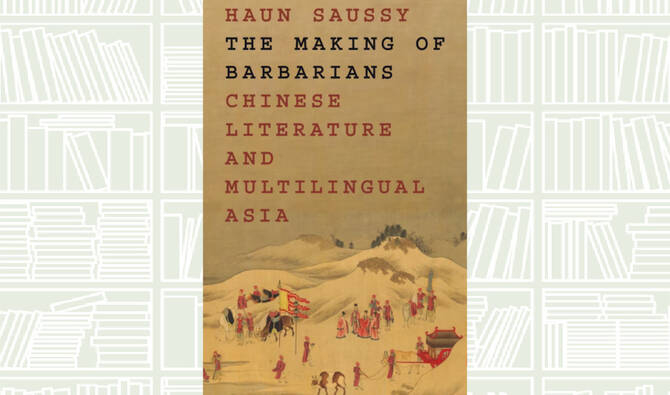
What We Are Reading Today: ‘The Making of Barbarians’ by Haun Saussy

Short Url
Updated 01 May 2025
Follow

What We Are Reading Today: ‘The Making of Barbarians’ by Haun Saussy

Debates on the canon, multiculturalism, and world literature often take Eurocentrism as the target of their critique. But literature is a universe with many centers, and one of them is China.

The Making of Barbarians offers an account of world literature in which China, as center, produces its own margins.

Here Sinologist and comparatist Haun Saussy investigates the meanings of literary translation, adaptation, and appropriation on the boundaries of China long before it came into sustained contact with the West.

When scholars talk about comparative literature in Asia, they tend to focus on translation between European languages and Chinese, Korean, and Japanese, as practiced since about 1900.

In contrast, Saussy focuses on the period before 1850, when the translation of foreign works into Chinese was rare because Chinese literary tradition overshadowed those around it.

“The Making of Barbarians” looks closely at literary works that were translated into Chinese from foreign languages or resulted from contact with alien peoples.


Book Review: ‘The Alchemist’ by Paulo Coelho

Updated 21 January 2026
Follow

Book Review: ‘The Alchemist’ by Paulo Coelho

I first picked up “The Alchemist” at a time when I felt restless; not unhappy but unsettled, with the quiet sense that I was meant for something more than routine and familiarity.

From the very first pages, Paulo Coelho’s novel felt less like a story I was reading and more like one that spoke to me gently.

The book follows Santiago, a young shepherd who dares to leave behind what is comfortable in search of a dream he cannot ignore. His journey across unfamiliar lands mirrors the internal journey many of us experience but rarely act on.

I found myself reflecting on my own hesitations, the dreams I had postponed, and the fears I had allowed to guide my decisions. 

What struck me most about “The Alchemist” was its simplicity. Coelho’s writing is clear and almost meditative, yet the ideas carry emotional weight.

The concept of a “personal legend” stayed with me long after I finished the book. It made me question whether I was truly listening to my own desires or simply following the path that felt safest. 

There were moments while reading when certain lines felt uncomfortably accurate, as if the book was holding up a mirror. It reminded me how easy it is to convince ourselves that timing is wrong, that circumstances are not ideal, or that dreams can wait. Coelho challenges that thinking, suggesting that the real risk lies in never trying at all. 

While some may find the book idealistic, I found comfort in its optimism. “The Alchemist” does not promise success without struggle, but it reframes setbacks as part of the journey rather than signs of failure. That perspective felt reassuring and grounding. 

By the time I reached the final pages, I did not feel like I had found all the answers, but I did feel more aware. “The Alchemist” encouraged me to trust my instincts, accept uncertainty and believe that ambition does not need justification.

For anyone who senses there is more waiting beyond fear and familiarity, this book has the power to gently shift how you see your own path.