

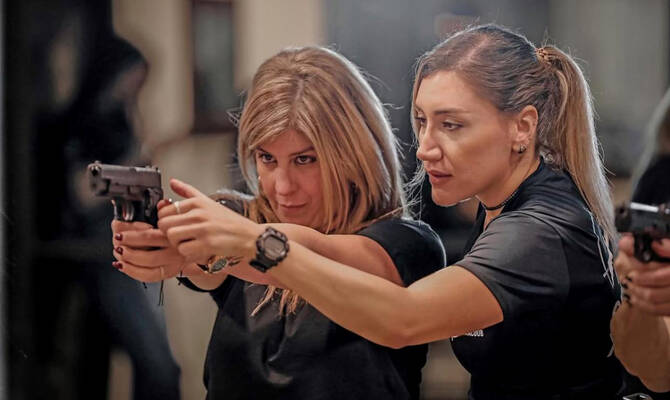

BEIRUT: The number of civilian women applying to the Ministry of Defense for licenses to possess firearms in Lebanon is on the rise.
Gun ownership in Lebanon is a phenomenon that dates back to before the civil war in the 1970s, and its complexities continue to have an impact due to the misuse of weapons and the consequences that follow.
While this phenomenon has been associated with masculinity, the participation of women in bearing arms alongside men in the military and security forces over the past two decades has broken this exclusivity. It seems to have opened the door widely for civilian women to dare to acquire firearms and even train in their use for security-related reasons.
Cynthia Yaacoub, 33, a Lebanese firearms instructor, said: “In Lebanon, we have a gun culture — and I do not mean a culture of weapon collectors — but we lack training on how and when to use firearms properly and safely, and what the consequences are of using them incorrectly, both technically and legally.”
In an interview with Arab News at the shooting range of the Lebanese General Security in Beirut, Yaacoub said: “Lebanese people from my generation — those in their 30s and 40s — are learning to shoot from YouTube, and even children have learned about guns through the game PUBG and have developed a fondness for firearms. As for those in their 50s, they are divided into two groups: one that has already experienced gun possession and used weapons during the civil war, and another that rejected firearms and still fears them and fears for their children.

Lebanese women possess a high level of focus and calmness, which enables them to master shooting more quickly. (Supplied)
“There are many reasons why Lebanese women acquire firearms,” she continued. “According to the women who request shooting training, the number one reason is self-defense. Some of them have husbands who work abroad and need to protect themselves. Others view shooting as a hobby, just like practicing any other sport. There are also women in their 50s and 60s who feel they have fulfilled their roles as mothers and now want to explore adventure and do things they did not do in their youth — so they turn to more extreme sports like horseback riding, shooting, and skydiving.”
Hanan Demian decided to learn shooting “after seeing instructor Cynthia doing it on social media. I believe this hobby enhances focus and self-confidence, and I love adventure.”
Based on over six years of training experience, Yaacoub says: “Lebanese women possess a high level of focus and calmness, which enables them to master shooting more quickly. When they leave the club, they experience a significant sense of empowerment, even if they are not carrying a weapon. They gain greater self-confidence and a sense of authority, which I also experience. Since I learned to shoot and became an instructor, no one has dared to disrespect me, despite my non-violent nature and the fact that I do not carry a gun.”
Yaacoub added: “Some husbands bring their wives with them to practice shooting. I have an entire family who trains in shooting. The clubs do not accept trainees under the age of 18.”
But is shooting not a means to master the act of killing, rather than to appreciate the value of life, particularly in Lebanon where firearms are often used for trivial reasons and many fall victim?
“Certainly, it serves as a method for all those who train in shooting to understand human value,” Yaacoub said. “They ask me, ‘how can one kill another?’ We train to shoot at a piece of paper and feel its terror, so how can one shoot at humans and animals? Part of shooting training is to educate the person to think carefully before shooting, except in the most extreme cases, where the choice is between life and death. During the training sessions I conduct in Beirut and Doha at the request of a shooting club there, we have a lawyer and a psychologist present to explain the consequences of gunfire.”
Previously, Yaacoub organized training sessions for Mother’s Day and International Women’s Day under the theme “Empowering Women.” Additionally, for Valentine’s Day, couples participated, and during Christmas, she issued vouchers that sold exceptionally well, “as people found them to be an unconventional gift compared to traditional options like perfume and gold.”
At a sports club in Beirut, Yaacoub organized training sessions for children on shooting with pellets “to teach children discipline and refined shooting skills, so they do not grow up to harm one another.”
Yaacoub also promotes training courses in Poland on social media. “I trained at an academy in Poland, which was a distinct experience. The shooting takes place outdoors, and one can earn a certification that opens up job prospects in security agencies or enhances one’s career, potentially leading to becoming a trainer. Thus far, women who learn shooting tend to view it merely as a hobby akin to kickboxing. I have yet to meet a girl who has transitioned to professionalism or expresses a desire to do so. In this regard, I miss having a female partner to train with, someone whose advice I can hear as she hears mine.”


