

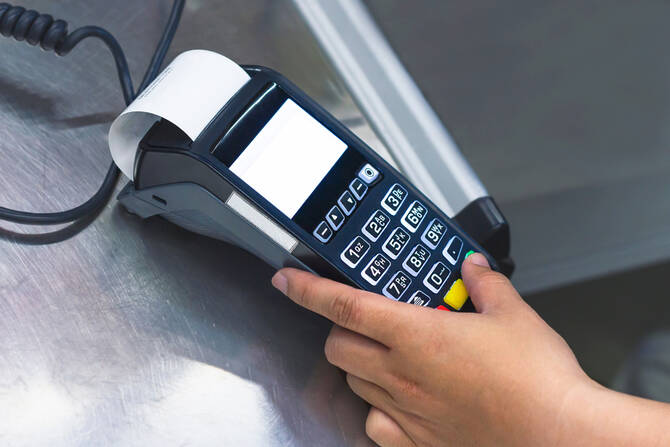
Saudi POS spending hits $3bn, fueled by jewelry sales

Spending in the leading three categories accounted for approximately 40.8 percent, or SR4.6 billion, of the week’s total value. Shutterstock
Short Url
Updated 30 April 2025
Follow

Saudi POS spending hits $3bn, fueled by jewelry sales

RIYADH: Jewelry spending in Saudi Arabia hit SR320.7 million ($85.4 million) between April 20 and 26, marking a weekly rise of 18.2 percent, according to the latest official figures.

The point-of-sale transactions bulletin issued by the Saudi Central Bank showed that this sector was one of the few that registered positive growth over the seven-day period.

The overall point-of-sale value decreased by 0.8 percent to SR11.3 billion during the week, with the number of transactions dropping 1.1 percent to 199.7 million.

Spending on electronics and electronic devices saw the second-largest increase, at 3.5 percent, to reach SR152.7 million. The number of transactions in this area increased 0.8 percent to 1 million.

Food and beverages spending followed with a 0.6 percent uptick to SR1.65 billion, accounting for the largest share of the week’s POS value.

Expenditure on education saw the biggest decrease, dipping by 17.5 percent to SR137.2 million, followed by hotels with a 13.7 percent drop to SR254.6 million.

Spending in restaurants and cafes saw a 2.1 percent fall to SR1.64 billion, although it still claimed the second-largest share of the POS value. Outlays on miscellaneous goods and services dropped 2.7 percent to SR1.34 billion.

Spending in the leading three categories accounted for approximately 40.8 percent, or SR4.6 billion, of the week’s total value.

Recreation and culture spending dropped by 7.4 percent to SR210.4 million, and expenditure on furniture decreased by 1.3 percent to SR224.9 million.

The clothing and footwear sector saw the smallest decline at 0.1 percent to SR607 million, with the number of transactions dropping by 1.9 percent to 4.6 million.

Geographically, Riyadh dominated POS transactions, representing around 36.1 percent of the total, with expenses in the capital reaching SR4.1 billion — a 0.1 percent increase from the previous week. 

Jeddah followed with a 0.5 percent decrease to SR1.7 billion; Dammam came in third at SR602.5 million, up 1.7 percent. 

Madinah experienced the most significant decrease in spending, dropping by 7.7 percent to SR421.1 million. Makkah followed with a 5.7 percent reduction to SR420.7 million.

Among Saudi cities, only Riyadh, Dammam, and Alkhobar experienced growth in transaction numbers. Riyadh reached 65.8 million transactions, reflecting a marginal uptick, while Dammam climbed to 8.5 million and Alkhobar to 4.5 million, marking modest gains compared to other regions.


Saudi stock market opens its doors to foreign investors

Updated 06 January 2026
Follow

Saudi stock market opens its doors to foreign investors

RIYADH: Foreigners will be able to invest directly in Saudi Arabia’s stock market from Feb. 1, the Kingdom’s Capital Market Authority has announced.

The CMA’s board has approved a regulatory change which will mean the capital market, across all its segments, will be accessible to investors from around the world for direct participation.

According to a statement, the approved amendments aim to expand and diversify the base of those permitted to invest in the Main Market, thereby supporting investment inflows and enhancing market liquidity.

International investors' ownership in the capital market exceeded SR590 billion ($157.32 billion) by the end of the third quarter of 2025, while international investments in the main market reached approximately SR519 billion during the same period — an annual rise of 4 percent.

“The approved amendments eliminated the concept of the Qualified Foreign Investor in the Main Market, thereby allowing all categories of foreign investors to access the market without the need to meet qualification requirements,” said the CMA, adding: “It also eliminated the regulatory framework governing swap agreements, which were used as an option to enable non-resident foreign investors to obtain economic benefits only from listed securities, and the allowance of direct investment in shares listed on the Main Market.”

In July, the CMA approved measures to simplify the procedures for opening and operating investment accounts for certain categories of investors. These included natural foreign investors residing in one of the Gulf Cooperation Council countries, as well as those who had previously resided in the Kingdom or in any GCC country. 

This step represented an interim phase leading up to the decision announced today, with the aim of increasing confidence among participants in the Main Market and supporting the local economy.

Saudi Arabia, which ‌is more than halfway ‍through an economic plan ‍to reduce its dependence on oil, ‍has been trying to attract foreign investors, including by establishing exchange-traded funds with Asian partners in Japan and Hong Kong.