

Fire blazes day after Iran port blast killed 28, injured 1,000

1 / 4
People transport an injured man along a devastated boulevard following an explosion at the Shahid Rajaee port dock southwest of Bandar Abbas in the Iranian province of Hormozgan on April 26, 2025. (IRNA/AFP)
2 / 4
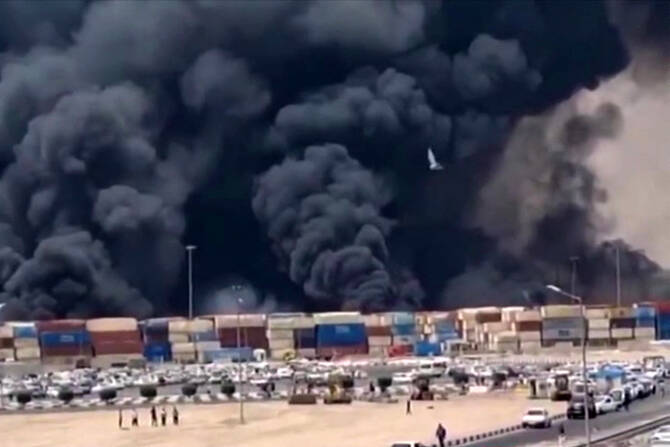
This image grab taken from footage released by the state television Islamic Republic of Iran Broadcasting News (IRIBNEWS) on April 26, 2025 shows smoke billowing following an explosion at the Shahid Rajaee port dock southwest of Bandar Abbas in the Iranian province of Hormozgan. (AFP)
3 / 4
This image grab taken from footage released by the state television Islamic Republic of Iran Broadcasting News (IRIBNEWS) on April 26, 2025 shows thick black smoke billowing following an explosion at the Shahid Rajaee port dock southwest of Bandar Abbas in the Iranian province of Hormozgan. (Photo by IRIBNEWS / AFP)
4 / 4
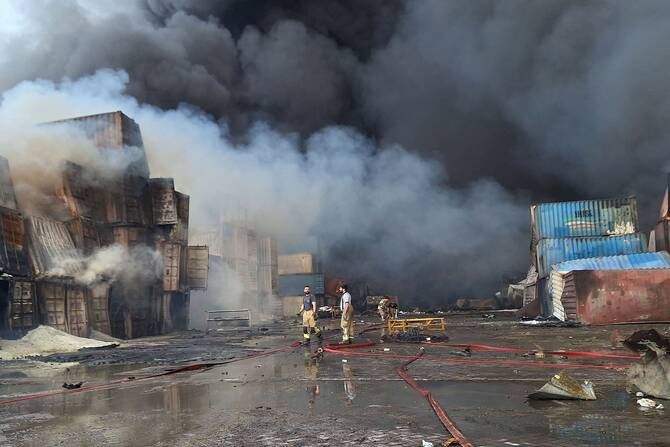
Firefighters and rescuers work at the scene of an explosion that took place a day earlier at the Shahid Rajaee port dock, southwest of Bandar Abbas in the Iranian province of Hormozgan, on April 27, 2025. (AFP)
Short Url
Updated 27 April 2025
Follow

Fire blazes day after Iran port blast killed 28, injured 1,000

  • Live footage on Sunday showed thick black smoke still visible at the scene.
  • Helicopters dumped water from the air on the raging fire hours after the initial explosion
  • The port took in a shipment of “sodium perchlorate rocket fuel” in March

TEHRAN: Fire blazed on Sunday, more than 24 hours after a massive explosion tore through Iran's largest commercial port, killing at least 28 people and leaving more than 1,000 others injured, according to the Red Crescent. 
The blast occurred Saturday at Shahid Rajaee Port in southern Iran, near the Strait of Hormuz through which a fifth of world oil output passes.
The port’s customs office said in a statement carried by state television that the explosion probably resulted from a fire that broke out at the hazardous and chemical materials storage depot.
The New York Times quoted a person with ties to Iran’s Islamic Revolutionary Guard Corps, speaking on condition of anonymity to discuss security matters, saying that what exploded was sodium perchlorate — a major ingredient in solid fuel for missiles.
Iranian news agency Tasnim, citing the provincial judiciary chief, gave an updated toll on Sunday of 25 people killed. State TV said around 800 people were injured. Live footage on Sunday showed thick black smoke still visible at the scene.

Iranian President Masoud Pezeshkian was traveling to the site of the port blast on Sunday, according to state media.

“The president is heading to the region to review the latest situation regarding the explosion at Shahid Rajaee Port in Bandar Abbas,” state TV reported. 


Firefighters battle the blaze at the scene of an explosion that took place a day earlier at the Shahid Rajaee port dock, southwest of Bandar Abbas in the Iranian province of Hormozgan, on April 27, 2025.  (AFP)

Three Chinese nationals were “lightly injured,” China’s state broadcaster CCTV reported, citing its Bandar Abbas consulate.
The explosion was so powerful that it was felt and heard about 50 kilometers (30 miles) away, Fars news agency reported.Images from IRNA showed rescuers and survivors walking along a wide boulevard carpeted with debris after the blast at Shahid Rajaee, more than 1,000 kilometers south of Tehran.
Flames engulfed a truck trailer and blood stained the side of a crushed car, while a helicopter dropped water on massive black smoke clouds billowing from behind stacked shipping containers.
Citing local emergency services, state TV reported that “hundreds have been transferred to nearby medical centers,” while the provincial blood transfusion center issued a call for donations.
Iranian President Masoud Pezeshkian expressed sympathy for the victims of the deadly blast, adding he had “issued an order to investigate the situation and the causes.”
Speaking later at the scene, Interior Minister Eskandar Momeni told state TV: “All resources from other cities and Tehran have been dispatched.”
With choking smoke and air pollution spreading throughout the area, all schools and offices in Bandar Abbas, the nearby capital of Hormozgan province, have been ordered closed on Sunday to allow authorities to focus on the emergency effort, state TV said.Mehrdad Hassanzadeh, head of the province’s crisis management authority, told state TV that “the cause of this incident was the explosion of several containers stored in the Shahid Rajaee Port wharf area.”
“The shockwave was so strong that most of the port buildings were severely damaged,” Tasnim news agency reported.
Saturday is the start of the working week in Iran, meaning the port would have been busy with employees.
The United Arab Emirates expressed “solidarity with Iran” over the explosion and Saudi Arabia sent condolences.
The state-owned National Iranian Oil Products Distribution Company said in a statement carried by local media that the explosion “has no connection” to its facilities and that “Bandar Abbas oil facilities are currently operating without interruption.”
The explosion comes several months after one of Iran’s deadliest work accidents in years.
The coal mine blast in September, caused by a gas leak, killed more than 50 people at Tabas in the east of the country.
Saturday’s explosion also came as Iranian and US delegations met in Oman for high-level talks on Tehran’s nuclear program, with both sides reporting progress.


Sudan’s prime minister takes his peace plan to the UN, but US urges humanitarian truce now

Updated 8 sec ago
Follow

Sudan’s prime minister takes his peace plan to the UN, but US urges humanitarian truce now

  • Sudan’s prime minister is proposing a wide-ranging peace initiative to end a nearly 1,000-day war with a rival paramilitary force
  • It seems unlikely the RSF would support the proposal, which would essentially give government forces a victory and take away their military power
UNITED NATIONS: Sudan’s prime minister on Monday proposed a wide-ranging peace initiative to end a nearly 1,000-day war with a rival paramilitary force, but the United States urged both sides to accept the Trump administration’s call for an immediate humanitarian truce.
Kamil Idris, who heads Sudan’s transitional civilian government, told the Security Council his plan calls for a ceasefire monitored by the United Nations, African Union and Arab League, and the withdrawal of paramilitary forces from all areas they occupy, their placement in supervised camps and their disarmament.
Sudan plunged into chaos in April 2023 when a power struggle between the military and the powerful paramilitary Rapid Support Forces exploded into open fighting, with widespread mass killings and rapes, and ethnically motivated violence. This has amounted to war crimes and crimes against humanity, according to the UN and international rights groups.
It seemed highly unlikely the RSF would support the prime minister’s proposal, which would essentially give government forces a victory and take away their military power.
In an indirect reference to the truce supported by the US and key mediators Saudi Arabia, Egypt and the United Arab Emirates, known as the Quad, Idris stressed to the UN Security Council that the government’s proposal is “homemade — not imposed on us.”
In early November, the Rapid Support Forces agreed to a humanitarian truce. At that time, a Sudanese military official told The Associated Press the army welcomed the Quad’s proposal but would only agree to a truce when the RSF completely withdraws from civilian areas and gives up their weapons — key provisions in the plan Idris put forward on Monday.
Idris said unless the paramilitary forces were confined to camps, a truce had “no chance for success.” He challenged the 15 members of the Security Council to back his proposal.
“This initiative can mark the moment when Sudan steps back from the edge and the international community — You! You! — stood on the right side of history,” the Sudanese prime minister said. He said the council should “be remembered not as a witness to collapse, but as a partner in recovery.”
US deputy ambassador Jeffrey Bartos, who spoke to the council before Idris, said the Trump administration has offered a humanitarian truce as a way forward and “We urge both belligerents to accept this plan without preconditions immediately.”
Bartos said the Trump administration strongly condemns the horrific violence across Darfur and the Kordofan region — and the atrocities committed by both the Sudanese Armed Forces and the Rapid Support Forces, who must be held accountable.
UAE Ambassador Mohamed Abushahab, a member of the Quad, said there is an immediate opportunity to implement the humanitarian truce and get aid to Sudanese civilians in desperate need.
“Lessons of history and present realities make it clear that unilateral efforts by either of the warring parties are not sustainable and will only prolong the war,” he warned.
Abushahab said a humanitarian truce must be followed by a permanent ceasefire “and a pathway toward civilian rule independent of the warring parties.”
UN Assistant Secretary-General for political affairs Khaled Khiari reflected escalating council concerns about the Sudan war, which has been fueled by the continuing supply of increasingly sophisticated weapons.
He criticized unnamed countries that refuse to stop supplying weapons, and both government and paramilitary forces for remaining unwilling to compromise or de-escalate.
“While they were able to stop fighting to preserve oil revenues, they have so far failed to do the same to protect their population,” Khiari said. “The backers of both sides must use their influence to help stop the slaughter, not to cause further devastation.”
The devastating war in Sudan has killed more than 40,000 people according to UN figures, but aid groups say the true number could be many times higher. The conflict has created the world’s largest humanitarian crisis, with over 14 million people displaced, disease outbreaks and famine spreading in parts of the country.