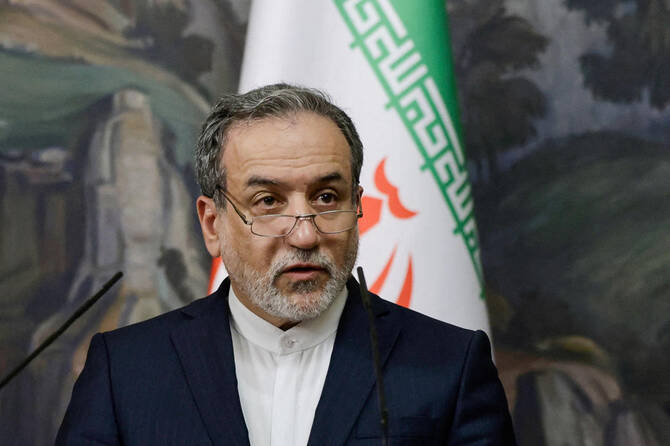
MUSCAT: Iran’s Foreign Minister Abbas Araghchi prepared for fresh nuclear talks with the United States in Oman on Friday after apparent progress in previous rounds.
Araghchi flew into Muscat ahead of Saturday’s meeting with US President Donald Trump’s special envoy Steve Witkoff, their third encounter in as many weeks.
Araghchi will lead Iran’s delegation of diplomats and technical experts in indirect discussions with the US side, foreign ministry spokesperson Esmaeil Baqaei posted on X.
Iran’s top diplomat was a negotiator of the landmark nuclear accord abandoned by Trump during his first term in 2018.
Araghchi refused to discuss the talks as he signed copies of an Arabic translation of his book, “The Power of Negotiation” at a book fair in Muscat on Friday.
The latest round will include expert-level talks on Iran’s nuclear program, with Michael Anton, who serves as the State Department’s head of policy planning, leading the technical discussions on the US side, the department said.
Iran’s Tasnim news agency reported that deputy foreign ministers Kazem Gharibabadi and Majid Takht-Ravanchi will head the Iranian technical team.
Baqaei posted that Iran’s delegation is “resolved to secure our nation’s legitimate and lawful right to use nuclear energy for peaceful purposes while taking reasonable steps to demonstrate that our program is entirely peaceful.”
“Termination of unlawful and inhumane sanctions in an objective and speedy manner is a priority that we seek to achieve,” he added.
According to Baqaei, the dialogue will again be mediated by Omani Foreign Minister Badr Albusaidi — who appeared with Araghchi at the book signing — on Saturday morning.
The meeting follows two earlier rounds of Omani-mediated negotiations in Muscat and Rome starting on April 12.
Since his return to office in January, Trump has reimposed sweeping sanctions under his policy of “maximum pressure” against Tehran.
In March, he sent a letter to Iran’s supreme leader Ayatollah Ali Khamenei calling for talks but warning of possible military action if they failed to produce a deal.
Western countries including the United States have long accused Iran of seeking to acquire nuclear weapons — an allegation Tehran has consistently denied, insisting that its program is for peaceful civilian purposes.
Baqaei earlier Friday said “progress in the negotiations requires the demonstration of goodwill, seriousness, and realism by the other side.”
Iran will treat Saturday’s talks seriously, Araghchi said in a recent interview, “and if the other party also enters seriously, there is potential for progress.”
In 2018, Trump withdrew the United States from the nuclear deal signed three years earlier between Tehran and major world powers. The agreement eased sanctions on Iran in return for curbs on its nuclear program.
After Trump’s pullout, Tehran complied with the agreement for a year before scaling back its compliance.
Iran currently enriches uranium up to 60 percent, far above the 3.67 percent limit in the 2015 deal but still below the 90 percent threshold required for weapons-grade material.
In an interview published by Time Magazine on Friday, Trump said the United States will “lead the pack” in attacking Iran if nuclear talks do not lead to a new deal.
But he expressed hope that an agreement could be reached and said he would be willing to meet Khamenei.


![]()

Iran FM Araghchi in Oman ahead of nuclear talks with US
Short Url
https://arab.news/jnmch
Iran FM Araghchi in Oman ahead of nuclear talks with US
- Abbas Araghchi will be leading a diplomatic and technical-expert delegation for indirect discussions with the US side
- President Donald Trump’s special envoy to the Middle East, Steve Witkoff, will represent the United States in the talks


Latest updates


© 2026 SAUDI RESEARCH & PUBLISHING COMPANY, All Rights Reserved And subject to Terms of Use Agreement.