

How Pope Francis touched a migrant’s heart, saying ‘we’re all the same people’

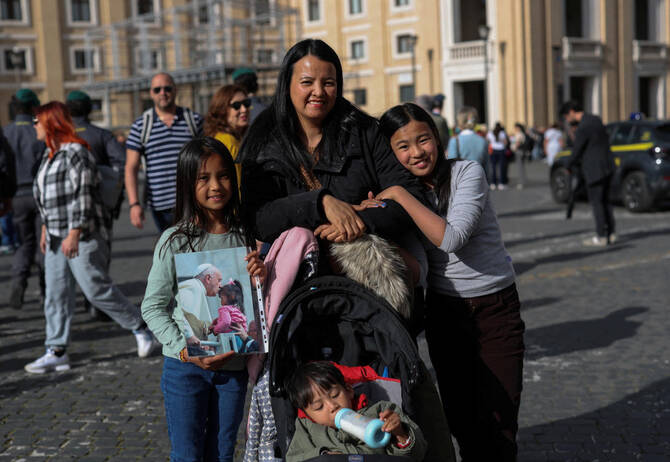
Francezka Abano, 9, holds a picture of her and Pope Francis from 2018, as she poses for a picture with her mother Diane Karla Abano, her sister Sophia, 9, and her brother John Florence, 2, in Rome, Apr. 24, 2025. (Reuters)
Short Url
Updated 25 April 2025
Follow

How Pope Francis touched a migrant’s heart, saying ‘we’re all the same people’

  • “In the eyes of Pope Francis, we are not migrants, we’re all the same people,” not Filipino or Indian or Asian, said Abano
  • Francis, himself the son of Italian immigrants in Argentina, placed the plight of migrants and refugees at the heart of his moral agenda

VATICAN CITY: Diane Karla Abano, a Filipino migrant living in Rome, has vivid memories of the day that Pope Francis touched her heart and made her feel at home, kissing her two young daughters during an audience in St. Peter’s Square in May, 2018.
“The moment that I reached out to the pope and saw his smile, I don’t know, all the hurt, all the pain that I felt, it changed into happiness and hope,” Abano said, her voice breaking and tears welling in her eyes as she showed photos of the event.
“In the eyes of Pope Francis, we are not migrants, we’re all the same people,” not Filipino or Indian or Asian, said Abano.
She was back in St. Peter’s Square this week, queuing up with tens of thousands of other mourners to pay her last respects to a man whose brief blessing proved transformative.
Francis, himself the son of Italian immigrants in Argentina, placed the plight of migrants and refugees at the heart of his moral agenda during his 12-year papacy, personally intervening to assist asylum seekers and pushing governments to do much more to help.
He repeatedly spoke out for the poor and marginalized, and criticized countries that shunned migrants.
His first trip outside Rome after he was elected pope in 2013 was to the tiny Italian island of Lampedusa to pay tribute to the thousands of people who had drowned in the Mediterranean while trying to reach Europe and a better life.
In 2016 he visited the Greek island of Lesbos and brought a dozen Syrian refugees back to Italy with him on his plane. In 2021, he flew to Cyprus and again ensured safe passage for a group of 50 asylum seekers.
Among them was Grace Enjei, who had escaped fighting in her native Cameroon in 2020 and had ended up stranded in the so-called “buffer zone” that divides the island as she sought to reach territory that falls within the European Union.
Just before the trip, Vatican officials told her that the pope had learnt of the plight of those caught in a legal limbo, and had arranged for them to be relocated to Italy.
“We were so happy, like, we were singing the whole night, we were dancing, we were celebrating actually. Something so, so, so good, like it was real good, we were so happy,” said Enjei.
Days after she arrived in Italy, Enjei was unexpectedly invited to celebrate Pope Francis’ birthday.
“He was like ‘these are the people from the buffer zone?’ and we were like, ‘Yes, yes, yes’. He said, ‘Oh, you guys are welcome, I heard about your story, and I was so touched, so I needed to do something’,” Enjei said.

BRIDGES NOT WALLS
The late pope repeatedly urged political leaders to defend migrants, saying their safety should take precedence over national security concerns.
In 2015 he became the first pope to address the US Congress, where he recalled his own migrant background and said it was natural for people to cross borders in search of better opportunities for them and their families.
“Is this not what we want for our own children?” he said. “I say this to you as the son of immigrants, knowing that so many of you are also descended from immigrants.”
In 2016 he publicly clashed with Donald Trump — who was then campaigning for his first term in the White House — over his plans to build a wall between the United States and Mexico to keep out migrants.
“A person who thinks only about building walls, wherever they may be, and not building bridges, is not Christian,” Francis told reporters. Trump, who will attend the pope’s funeral on Saturday, said at the time that it was “disgraceful” for a religious leader to question a person’s faith.
Francis was critical again as the US president began his second term, telling American bishops in a letter in February that he disagreed with migrant deportations.
The pope faced resistance not just from politicians, but also sometimes from within his own Church with a number of parishes, especially in Eastern Europe, unhappy over his call for religious communities to take in refugees.
But speaking from her new home in Rome, Enjei stressed the positive impact that Francis had on so many people, not just herself.
“It’s not only about me. He has helped so many people, and we thank him for the fight he’s fighting for the migrants. We really appreciate and thank him so much,” she said.


Bangladesh takes ‘balanced approach’ with Pakistan as talks of defense deal emerge

Updated 4 sec ago
Follow

Bangladesh takes ‘balanced approach’ with Pakistan as talks of defense deal emerge

  • Air force chiefs of Pakistan and Bangladesh discussed potential defense pact last week
  • Dhaka says plan to procure fighter jets still in early stages, discussions ongoing with several countries

DHAKA: Bangladesh appears to be moving with caution as Dhaka and Islamabad forge closer ties and explore a potential defense deal, experts said on Friday.

Following decades of acrimonious ties, relations between Bangladesh and Pakistan have been growing since a student-led uprising ousted former Prime Minister Sheikh Hasina in 2024.

Talks on a potential defense deal covering the sale of Pakistan’s JF-17 fighter jets to Dhaka emerged after Bangladesh’s Air Chief Marshal Hasan Mahmood Khan visit to Rawalpindi last week, where he met with his Pakistani counterpart Air Chief Marshal Zaheer Ahmed Baber Sidhu and Field Marshal Syed Asim Munir, Pakistan’s chief of defense forces.

Bangladesh’s military media wing, the Inter-Services Public Relations, said the procurement of fighter jets for the Bangladesh Air Force is “in the very rudimentary level,” and currently “under an evaluation process.”

ISPR Director Lt. Col. Sami Ud Dowla Chowdhury told Arab News: “The evaluation process will determine which country’s offer proves befitting for us. The air chief’s visit to Pakistan is part of the evaluation process … Earlier, he visited China, Italy (too).

“Discussions are underway with different countries. Nothing concrete has come yet.”

Talks between the high-ranking military officials are the latest development in Bangladesh-Pakistan ties, which have included the resumption of direct trade for the first time since the 1971 war and the expected launch of a regular route from Dhaka to Karachi at the end of this month, following over a decade of suspension.

Though efforts to expand relations can be seen from both sides, the current interim government of Bangladesh led by economist and Nobel Prize laureate Muhammad Yunus has been “showing some kind of pragmatism,” said Prof. Delwar Hossain of Dhaka University’s international relations department.

“Bangladesh is stepping very cautiously in comparison with the advancement from the Pakistan side. Bangladesh is trying to make a balanced approach,” he told Arab News.

“The present government is always saying that the development of a relationship with Pakistan doesn’t necessarily mean that Bangladesh is moving towards a particular camp. Rather, Bangladesh is interested in having a balanced relationship with all the great powers.”

Trade and economy are “naturally” more preferable areas of cooperation for Dhaka, Hossain said, adding that “we need more time to determine” how far military cooperation will be expanded.

Ishfaq Ilahi Choudhury, a defense expert and retired air officer of the Bangladesh Air Force, said that Bangladesh is “very much in need of advanced aircraft” because its military has not procured new fighter jets in at least two decades.

“Air frigate fighters are badly needed for the Bangladesh Air Force. We had some F-7 produced by China, but they stopped producing these fighters nowadays. Here, Pakistan can be a source for our fighter jets, but it involves … geopolitics,” he told Arab News, alluding to how Dhaka’s defense ties with Pakistan may be perceived by its archrival neighbor India.

Pakistan’s JF-17 fighter jets, a multi-role combat aircraft jointly developed with China, have drawn international interest following their success last May, when Pakistani and Indian forces engaged in their worst fighting since 1999.

Islamabad said it shot down several Indian fighter jets during the aerial combat, a claim Indian officials later acknowledged after initially denying any losses, but without specifying the number of jets downed.

“Our friendship with Pakistan shouldn’t (come) at the cost of our friendship with India,” Choudhury said.

“With this (potential) defense purchase deal with Pakistan, we have to remain very cautious so that it proves sustainable in the long term.”