



ISLAMABAD: Defense Minister Khawaja Muhammad Asif on Thursday accused India of preparing to launch a “wave of terrorism” in Pakistani cities, warning that Islamabad would retaliate with a “tit-for-tat” response as relations between the nuclear-armed rivals plummeted following a deadly militant attack in Kashmir.
On Tuesday, gunmen killed 26 men at a tourist site in the Pahalgam area of Indian-administered Kashmir in the worst attack on civilians in the country in nearly two decades. India alleged cross-border involvement, without offering proof, and announced a raft of measures to downgrade ties on Wednesday including suspending a six-decade-old river-sharing treaty as well as closing the only land crossing between the neighbors. Pakistan followed with its own actions that included shutting its airspace to Indian planes and rejecting New Delhi’s suspension of the critical water agreement.
Islamabad warned Delhi the suspension of the Indus Waters Treaty would be seen as an “act of war” to which Pakistan would respond with “full force across the complete spectrum of national power.”
The nuclear-armed nations, who have both fought two out of three wars over the disputed region of Kashmir since 1947, frequently accuse each other of carrying out cross-border attacks.
“According to our information, India is preparing to launch a wave of terrorism in various Pakistani cities instead of opting for an all-out war,” Asif told reporters at a news briefing.
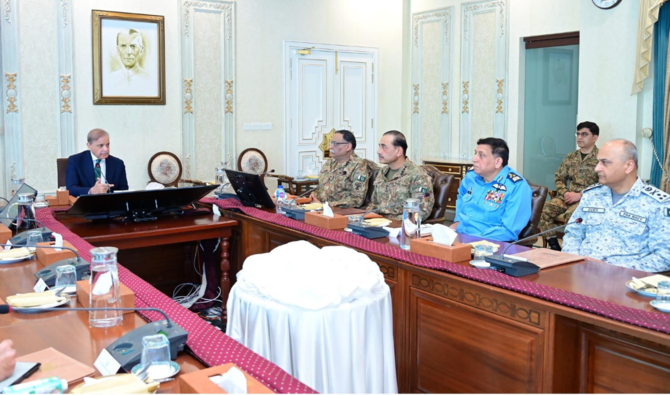
Prime Minister Shehbaz Sharif chairs a meeting of the National Security Committee in Islamabad, Pakistan on April 24, 2025. (PID)
“And I want to make it absolutely clear that we are fully prepared to counter this wave of terrorism.”
Asif and three other federal ministers were briefing the media on Pakistan’s retaliatory measures, including that Islamabad would exercise the right to hold all bilateral agreements with India, including but not limited to the 1972 Simla Agreement, in abeyance. In the absence of the Simla deal, India loses its rationale for wanting the Kashmir dispute to be treated as a bilateral dispute that must be settled only through bilateral negotiations. Under the treaty, New Delhi has consistently denied any third party intervention in the conflict, even from the United Nations.
Pakistan also closed the Attari-Wagah land border, the only operational land port between the two nations, with immediate effect and suspended all cross-border transit from India through this route “without exception.”
With no direct flights operating between the two countries, the move cuts all transport links between them.
Islamabad also suspended all visas under the SAARC Visa Exemption Scheme (SVES) issued to Indian nationals, deeming them canceled with immediate effect, with the exception of Sikh pilgrims who frequently travel to Pakistan to visit religious sites. Pakistan gave Indian nationals currently in Pakistan under SVES 48 hours to leave, and said Indian defense, naval and air advisers in Islamabad had been declared “persona non grata.”
“Our response will be tit-for-tat, four citizens are targeted, Indian citizens will also not remain safe in their cities,” the defense minister said.
Asif warned that even if a single Pakistani citizen was killed in an Indian-planned “terrorist” attack, Delhi would “pay for it.”
“This should be absolutely clear to them,” he said.
“BLAME GAME”
The Indus Waters Treaty, brokered by the World Bank in 1960, allocates the six Indus Basin rivers between India and Pakistan, with the Bank acting as its guarantor.
Pakistan has rights to the western rivers — Indus, Jhelum, and Chenab — for irrigation, drinking, and non-consumptive uses like hydropower. India controls the eastern rivers — Ravi, Beas, and Sutlej — for unrestricted use but must not significantly alter their flow.
Law Minister Azam Nazeer Tarar, who addressed the news conference alongside Asif, said the treaty was “sacred” for Pakistan and could not legally be “unilaterally” terminated.
“Pakistan has all the avenues and options available at the international level under the Indus Waters Treaty and the Vienna Convention and will exercise them if the treaty is unilaterally suspended,” he said.
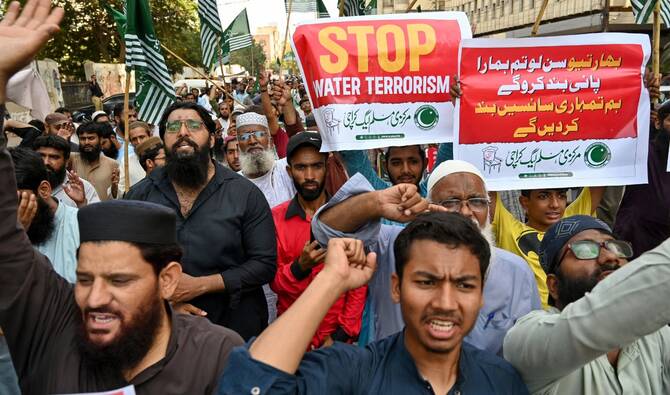
Activists of Pakistan Markazi Muslim League shout slogans during an anti-India protest in Karachi on April 24, 2025. (AFP)
Pakistan and India both claim Kashmir in full but rule it in part. India has long accused Pakistan of helping Islamist separatists who have battled security forces in its part of the territory, accusations Islamabad denies.
Indian officials have said Tuesday’s attack had “cross-border linkages” and Kashmiri police, in notices identifying three people “involved” in the violence, said two of them were Pakistani nationals. India has not elaborated on the links or shared proof.
Pakistan has said India’s accusations were made without any “credible investigation” or “verifiable evidence,” saying they are “frivolous” and “devoid of rationality.”
It has also called on India to refrain from a “reflexive blame game” and to take responsibility for its “failure to provide security” to people.


