

Pakistan says Azerbaijan’s SOCAR to finalize oil and gas investment next month

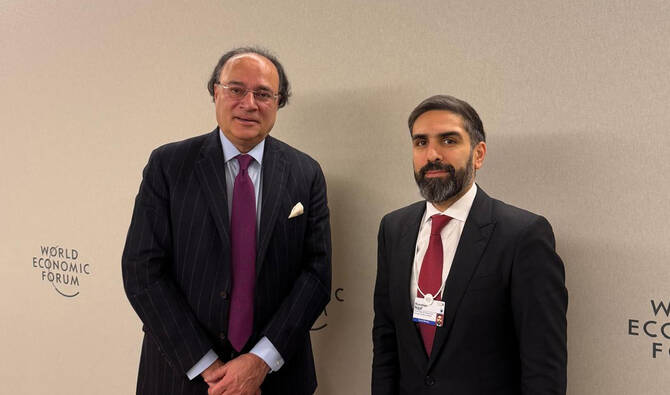
Pakistan’s Finance Minister, Muhammad Aurangzeb, meets the President of State Oil Company of the Republic of Azerbaijan (SOCAR), Rovshan Najaf (right), on the sidelines of the World Economic Forum Annual Meeting in Davos, Switzerland, on January 22, 2026. (Finance Ministry)
Short Url
Updated 22 January 2026
Follow

Pakistan says Azerbaijan’s SOCAR to finalize oil and gas investment next month

  • SOCAR signals February decision after Davos talks, citing Pakistan’s reform momentum
  • Existing LNG, fuel supply ties point to deeper Azerbaijan-Pakistan energy cooperation

ISLAMABAD: Pakistan’s finance ministry said on Thursday Azerbaijan’s state energy company SOCAR is set to finalize an investment in Pakistan’s oil and gas sector next month, following high-level engagements on the sidelines of the World Economic Forum in Davos.

The announcement came after a business roundtable chaired by Finance Minister Muhammad Aurangzeb, where SOCAR President Rovshan Najaf told Pakistani officials the company viewed Pakistan as a long-term energy partner, according to a statement from the finance ministry.

Pakistan has been seeking fresh foreign investment into its energy sector as part of broader economic reforms aimed at stabilizing supply, reducing costs and improving contractual transparency. The oil and gas sector, alongside mining and minerals, has been identified by Islamabad as central to energy security and industrial growth.

SOCAR already has a commercial footprint in Pakistan through SOCAR Trading, which supplies liquefied natural gas under a government-to-government framework with Pakistan LNG Limited. Under the arrangement, SOCAR can supply up to one LNG cargo per month without take-or-pay obligations, giving Pakistan greater flexibility in managing demand and pricing. The agreement has been extended into 2025, reflecting continued cooperation.

“SOCAR views Pakistan as a natural long-term energy partner,” Najaf said, according to the finance ministry statement, citing Pakistan’s “market depth, growing energy demand, and ongoing reform momentum in the oil and gas sector.”

He also highlighted SOCAR’s engagement with Pakistan State Oil on petroleum product supply and expressed interest in expanding cooperation across the broader oil and gas value chain as reforms advance.

Welcoming the planned investment, Aurangzeb reiterated the government’s commitment to attracting “strategic and commercially viable investment” in energy, saying reforms were focused on improving pricing transparency, contractual clarity and risk-sharing mechanisms, according to the statement.

SOCAR is a major state-owned energy company operating in more than 20 countries, with a workforce exceeding 66,000 employees and reported revenues of about $50.6 billion in 2024, the ministry said.

Pakistan and Azerbaijan have been deepening economic ties in recent years, with energy cooperation emerging as a key pillar alongside trade and investment discussions. Officials say the expected SOCAR investment would mark a significant step in strengthening bilateral energy links.

Pakistan’s president defends ongoing strikes in Afghanistan, urges Kabul to dismantle militants

Updated 02 March 2026
Follow

Pakistan’s president defends ongoing strikes in Afghanistan, urges Kabul to dismantle militants

  • Afghanistan on Thursday launched attacks in retaliation for Pakistani airstrikes the previous Sunday
  • Pakistan’s military says it is only targeting Afghan military installations to avoid civilian casualties

ISLAMABAD: Pakistan’s president on Monday defended his country’s ongoing military strikes in neighboring Afghanistan, saying Islamabad tried all forms of diplomacy before targeting militants operating from Afghan territory, and called on the Taliban government in Kabul to disarm groups responsible for attacks in Pakistan.

Pakistan earlier said it is in “open war” with Afghanistan, alarming the international community. The border area remains a stronghold for militant organizations including Al-Qaeda and the Daesh (Islamic State) group.

“(The Afghan Taliban) must choose to dismantle the terror groups that survive on conflict and its war economy,” Asif Ali Zardari said during a speech to lawmakers, adding that “no state accepts serial attacks on its soil.”

Afghanistan on Thursday launched attacks in retaliation for Pakistani airstrikes the previous Sunday. Since then, Pakistan has carried out operations along the border, with Information Minister Attaullah Tarar claiming the killing of 435 Afghan forces and the capture of 31 Afghan positions.

Kabul has denied such claims.

In Afghanistan, the deputy government spokesman Hamdullah Fitrat said Pakistan’s military fired mortar shells at a refugee camp in eastern Kunar province, killing three children and injuring three others.

Afghanistan’s defense ministry said Afghan forces carried out strikes targeting a Pakistani military facility near Paktia province, causing “substantial losses and heavy casualties.”

Pakistan’s military did not respond to questions. It has said Pakistan is only targeting Afghan military installations to avoid civilian casualties.

Pakistan has witnessed a surge of violence in recent months and blames it on the outlawed Pakistani Taliban, known as Tehreek-e-Taliban Pakistan or TTP. It operates both inside Pakistan and from Afghan territory.
Islamabad accuses Afghanistan’s Taliban government of providing safe havens for the TTP, which Kabul denies.

The latest cross-border fighting ended a ceasefire brokered by Qatar and Turkiye in October. The two sides failed to reach a permanent agreement during talks in Istanbul.

Zardari reiterated Pakistan’s call for talks, saying, “We have never walked away from dialogue.”

The Pakistani leader again accused Afghanistan of acting as a proxy for India by sheltering militant groups.

“Stop being used by another country as a battlefield for their ambitions,” he said.

Zardari cited a recent report from the United Nations Security Council’s monitoring team that described the presence of militant groups in Afghanistan as an extra-regional threat.