
ISLAMABAD: Pakistan said on Thursday any attempts by India to stop or divert its waters under the Indus Waters Treaty would be seen as an “act of war” that the country would respond to with “full force across the complete spectrum of national power.”
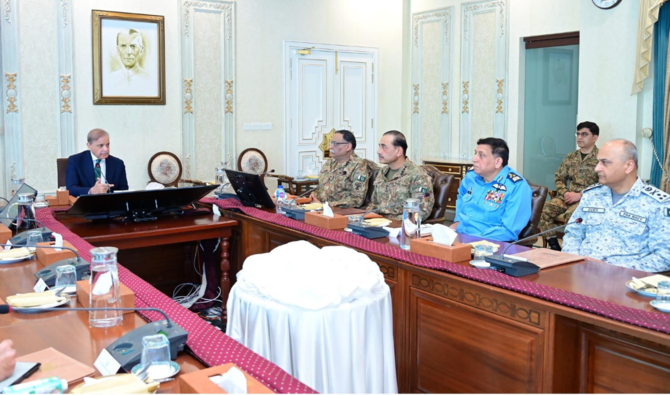
The announcement came as part of a raft of measures taken by Islamabad after Prime Minister Shehbaz Sharif chaired a meeting of the National Security Committee (NSC) to discuss Pakistan’s response to escalatory actions announced by India on Wednesday following a deadly militant attack in Indian-administered Kashmir in which 26 tourists were killed and that New Delhi says Islamabad is behind. Pakistan has denied involvement.
Kashmir has been disputed between India and Pakistan since 1947. Both control separate parts of the Himalayan region but claim it in full.
Indian Foreign Secretary Vikram Misri said on Wednesday a cabinet committee on security was briefed on the cross-border linkages of the latest attack, but did not offer any proof of the linkages or provide any more details. In response to the attack, he said India was spending the Indus Waters Treaty with immediate effect, closing the only open land border crossing point at Attari-Wagah, disallowing Pakistani nationals from traveling to India under special South Asian visas, and declaring all defense advisers in the Pakistani mission in New Delhi persona non grata, with a week to leave. India would also pull out its own defense advisers in Pakistan and reduce the staff size at its mission in Islamabad to 30 from 55, Misri said.
“The Committee reviewed the Indian measures announced on 23 April 2025 and termed them unilateral, unjust, politically motivated, extremely irresponsible and devoid of legal merit,” said a statement from three Pakistani PM’s office after the NSC meeting.
Islamabad said it rejected the Indian announcement to hold the Indus Waters Treaty in abeyance, as it was a binding international agreement brokered by the World Bank and contained no provision for unilateral suspension.
“Water is a vital national interest of Pakistan, a lifeline for its 240 million people and its availability will be safeguarded at all costs,” the statement said.
“Any attempt to stop or divert the flow of water belonging to Pakistan as per the Indus Waters Treaty, and the usurpation of the rights of lower riparian will be considered as an Act of War and responded with full force across the complete spectrum of National Power.”
The treaty, mediated by the World Bank in 1960, split the Indus River and its tributaries between the neighbors and regulated the sharing of water. The treaty remains one of the world’s most resilient water-sharing agreements, withstanding even wars and decades of strain between the neighbors.
Pakistan is heavily dependent on water flowing downstream from this river system from Indian Kashmir for its hydropower and irrigation needs. Suspending the treaty would allow India to deny Pakistan its share of the waters.
“COMMITTED TO PEACE”
Diplomatic relations between neighboring Pakistan and India were weak even before the latest measures were announced as Pakistan had expelled India’s envoy and not posted its own ambassador in New Delhi after India revoked the semi-autonomous status of Kashmir in 2019.
India has long accused Pakistan of involvement in an insurgency in Kashmir, but Islamabad says it only offers diplomatic and moral support to Kashmiris in their struggle for self-determination.
Tens of thousands of people have been killed in Kashmir since the uprising began in 1989, but it has tapered off in recent years and tourism has surged in the scenic region.
Among other retaliatory measures announced on Thursday, Pakistan said it would exercise the right to hold all bilateral agreements with India, including but not limited to the 1972 Simla Agreement, in abeyance.
The Simla Agreement says both countries will “settle their differences by peaceful means through bilateral negotiations.” India has consistently maintained that the Kashmir dispute is a bilateral issue and must be settled through bilateral negotiations as per the Simla Agreement, 1972 and under the treaty has denied any third party intervention even from the United Nations.
Pakistan also said it would close the Wagah land border with immediate effect and suspend all cross-border transit from India through this route “without exception.” With no direct flights operating between the two countries, the move cuts all transport links between them.
Islamabad said those who had crossed with valid visas through Wagah could return through that route by April 30.
Islamabad also suspended all visas under the SAARC Visa Exemption Scheme (SVES) issued to Indian nationals and deemed them canceled with immediate effect, with the exception of Sikh pilgrims who frequently travel to Pakistan to visit religious sites. Pakistan gave Indian nationals currently in Pakistan under SVES 48 hours to leave.
“Pakistan declares the Indian Defense, Naval and Air Advisers in Islamabad persona non grata,” the statement added.
“They are directed to leave Pakistan immediately but not later than 30 April 2025. These posts in the Indian High Commission are deemed annulled. Support staff of these Advisers are also directed to return to India.”
Islamabad will also reduce the strength of the Indian High Commission in the capital to 30 diplomats and staff members from April 30 and Pakistan’s airspace would be closed with immediate effect for all Indian owned or Indian operated airlines. All trade with India, including to and from any third country, has also been suspended.
“The Pakistani nation remains committed to peace, but will never allow anyone to transgress its sovereignty, security, dignity and their inalienable rights,” the statement concluded.
India has not yet responded to Pakistan’s measures but police in India’s Kashmir published notices on Thursday naming three suspected militants “involved in” Tuesday’s attack and announced rewards for information leading to their arrest.
Two of the three suspected militants are Pakistani nationals, the notices said.
Indian Prime Minister Narendra Modi, in his first speech since the attack in the Himalayan region, vowed on Thursday to punish all those responsible.
“I say to the whole world: India will identify, track and punish every terrorist and their backer,” the Indian prime minister said. “We will pursue them to the ends of the Earth.”
With inputs from Reuters