

Syrian president hails Pope Francis for solidarity in ‘darkest moments’

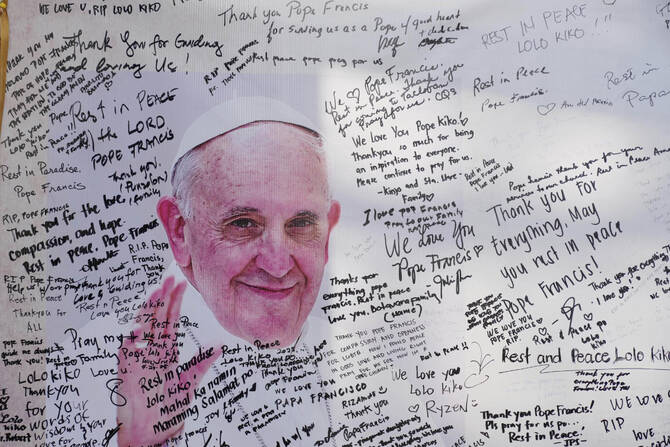
A message board for the late Pope Francis is covered with writings from Catholic devotees outside St. Peter Parish in Quezon city, Philippines, Thursday, April 24, 2025. (AP)
Short Url
Updated 24 April 2025
Follow

Syrian president hails Pope Francis for solidarity in ‘darkest moments’

  • Sharaa said of Francis: “His calls transcended political boundaries, and his legacy of moral courage and solidarity will remain alive in the hearts of many people”

DAMASCUS: Syria’s interim President Ahmed Al-Sharaa paid tribute to Pope Francis, saying he had supported the Syrian people in “their darkest moments.”


The Argentine pontiff, who died on Monday aged 88, “supported the Syrian people in their darkest moments, constantly raising his voice against the violence and injustice they faced,” Sharaa said in a statement on Wednesday.


Syria’s civil war began in 2011 with a crackdown by president Bashar Assad on a pro-democracy movement.


By the time Assad was ousted in an offensive led by Sharaa on December 8, more than 500,000 people had been killed and more than half the population displaced.


Syria is home to a majority Sunni Muslim population, but also a sizeable Christian minority from several denominations, as well as other religious minorities.


Extending condolences to Catholics, Sharaa said of Francis: “His calls transcended political boundaries, and his legacy of moral courage and solidarity will remain alive in the hearts of many people in our country.”


Syria’s Christian community has shrunk from around one million before the war to under 300,000 due to waves of displacement and emigration.


The capital Damascus is home to one of the oldest Christian communities in the world but its Christian population dwindled to only about two percent, the Vatican said last year.


While the war began as a crackdown on peaceful protests, religion and ethnicity swiftly came into focus as groups battling each other became increasingly radicalized.


Syria’s Christian community generally either supported the government or sought to be neutral in the war, with Assad, himself from the minority Alawite sect, portraying himself as a protector of minorities.


Critics of Assad, however, accused him of using minority communities to prop himself up, and of meting out especially brutal punishment for any detained members of minority communities who dared to voice dissent.


Sharaa and the new government are under pressure from Western countries to ensure they are inclusive in their exercise of power.


Sharaa, now the president of Syria, was the former head of the country’s Al-Qaeda offshoot, a radical Sunni Muslim group widely proscribed as a terrorist organization.


Since Assad’s ouster, the most serious violence to hit Syria was a massacre on the Mediterranean coast in March, which according to a war monitor saw more than 1,700 people killed.


The victims were mostly members of the Alawite minority of ousted president Assad.


Syria nears anniversary of Assad’s fall amid renewed ‘deeply troubling’ abuses, UN warns

Updated 05 December 2025
Follow

Syria nears anniversary of Assad’s fall amid renewed ‘deeply troubling’ abuses, UN warns

  • Early steps by interim leadership ‘encouraging but only the beginning’ of long process of accountability, human rights chief says
  • Concern that rising hate speech, both online and on the streets, has intensified violence against Alawite, Druze, Christian, Bedouin communities 

NEW YORK: Syria is days away from marking the first anniversary of the fall of President Bashar Assad’s regime, but the country’s interim authorities face mounting criticism over continuing abuses and a fragile security environment, the UN human rights chief said. 

In a statement on Friday, UN High Commissioner for Human Rights Volker Turk said early steps by the interim leadership, including the creation of national commissions for transitional justice and missing persons, and investigative bodies examining violence in coastal areas and in Suweida, were “encouraging but only the beginning” of a long process of accountability. 

Trials for suspects linked to last year’s coastal violence have begun, and a draft law on transitional justice has been announced. But Turk said the human rights situation remains deeply troubling. 

According to the UN, hundreds of people have been killed over the past year in summary executions, arbitrary killings, and abductions. Victims include members of minority communities and individuals accused of ties to the former government. Deaths were attributed to gunfire, stabbings, blunt-force attacks, shelling, hand grenades and explosive remnants of war. 

The UN said perpetrators include security forces under the interim authorities, armed groups aligned with them, remnants of the former government’s forces, local militias, and unidentified armed actors. 

Investigators also documented reports of sexual violence, arbitrary detention, looting, destruction of homes, forced evictions, and property confiscations, along with restrictions on free expression and peaceful assembly. 

Turk warned that rising hate speech, both online and on the streets, had intensified violence against Alawite, Druze, Christian, and Bedouin communities. 

The past year has also seen repeated Israeli military operations inside Syrian territory, including incursions and the occupation of additional areas. The UN said it had received reports of civilian casualties in a recent Israeli strike near Damascus, along with arrests and home searches carried out during military actions. 

Turk expressed concern that former armed groups have been integrated into new security forces without adequate human rights checks, raising the risk of repeat violations. 

“Proper vetting and comprehensive security sector reform are essential to prevent individuals responsible for serious abuses from entering the security forces,” he said. 

He urged Syria’s interim authorities to ensure independent and transparent investigations into all violations, past and present, and to hold those responsible to account. 

“Accountability, justice, peace, and the security of all Syrians are absolute prerequisites for a successful transition,” Turk said, adding that victims must have access to remedies and reparation. 

The UN Human Rights Office said its Damascus program is supporting efforts to advance inclusive transitional justice and strengthen the rule of law as Syria navigates a post-Assad transition.