

Bangladesh observes three days of mourning for Pope Francis

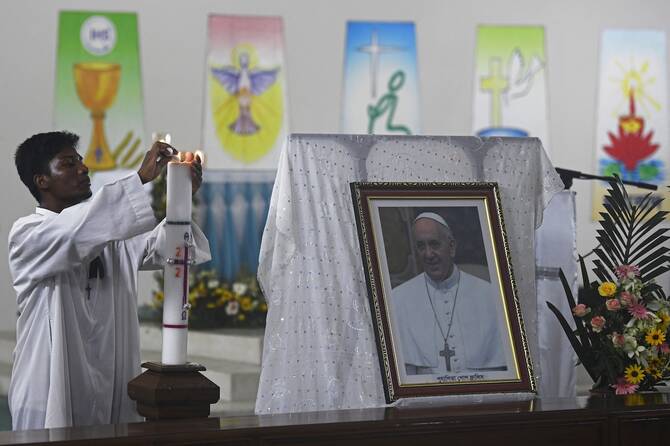
A church attendant lights a candle beside a portrait of late Pope Francis before the start of a special service at St. Mary’s Cathedral in Dhaka on April 22, 2025. (AFP)
Short Url
Updated 24 April 2025
Follow

Bangladesh observes three days of mourning for Pope Francis

  • The pontiff visited Bangladesh in 2017, at the beginning of the Rohingya refugee crisis
  • Bangladesh’s chief adviser, Muhammad Yunus, worked with Francis on poverty alleviation

DHAKA: National flags flew at half-mast in Bangladesh on Thursday as the Muslim-majority nation began three days of state mourning for Pope Francis.

The Argentine pontiff, leader of the Catholic Church since March 2013, died at his residence, Casa Santa Marta, in the Vatican on Monday. He was 88 years old.

Bangladesh’s interim administration issued a notification on Wednesday night, announcing that the government had decided to hold special prayers in memory of the pope and lower national flags to half-staff on buildings across the country, as well as at its missions abroad.

Bangladesh’s Christians account for less than 0.5 percent of its population. Most of them, about 400,000, are Catholic.

It is the first time Bangladesh is observing three days of remembrance for a Catholic leader.

“This is a great honor given to him,” Cardinal Patrick D’Rozario, former archbishop of Dhaka, told Arab News.

“Our country, Bangladesh, has decided well to mourn for three days. This is not because of the church, but because his messages were always universal, moral, and social.”


It was in the very first days of Francis’ papal service that the Rana Plaza building collapsed in Dhaka due to a structural failure, killing over 1,100 people, mostly garment factory workers.

In the aftermath of the tragedy, the pope called for prayers for the victims and their families, and urged a renewed commitment to fighting for the rights and dignity of workers, reflecting his long-standing advocacy for social justice.

He visited Dhaka in 2017, at the invitation of its government and the Catholic Church, at the beginning of the Rohingya crisis, when hundreds of thousands of members of the predominantly Muslim ethnic group were forced to flee Myanmar.

The majority of them have been sheltered by neighboring Bangladesh. Francis met with the refugees during his visit.

“He had a (heavy) heart because of the suffering of the people, and he also tried publicly to see the miseries of these people. He was deeply touched by Bangladesh’s gesture,” D’Rozario said.

Revered by millions of Catholics around the world, the pope’s message resonated in Bangladesh too.

In his final address from the balcony of St. Peter’s Basilica in the Vatican, Francis called for a ceasefire in Gaza and condemned the “deplorable humanitarian situation” caused by Israel’s ongoing deadly onslaught on the territory.

“He has been talking about the people’s suffering in Gaza ... On Easter Sunday, he spoke about four or five minutes about the Palestinians. So, there is that unity (in) support, also in Bangladesh,” D’Rozario said.

“Coming from Latin America, with a lot of suffering over there, a lot of poor people, he had a social message, a message on politics — good politics — a message on economics, message on trade and commerce, message on the international peace.”

The pope’s funeral mass will take place in St. Peter’s Square on Saturday.

Bangladesh’s chief adviser, Prof. Muhammad Yunus, who heads its interim government, is going to attend the service.

Yunus, an economist and Nobel Peace Prize laureate, worked with Francis on poverty alleviation.

“Pope Francis was a towering figure of moral clarity, humility, and compassion in our time. His lifelong dedication to justice, peace, and the dignity of every human being resonated far beyond the Catholic world,” he said in a statement on the pope’s passing.

“His leadership, rooted in the values of fraternity and service, inspired global efforts to uplift the poor, protect the vulnerable, and build a more humane and peaceful world.”


Report highlights role of British Muslim charitable giving in supporting UK public services

Updated 7 sec ago
Follow

Report highlights role of British Muslim charitable giving in supporting UK public services

  • The study, “Building Britain: British Muslims Giving Back,” finds that donations from British Muslims are helping to bolster overstretched service

LONDON: British Muslim charitable giving is playing an increasingly significant role in supporting frontline public services across the UK, according to a new report by policy and research organization Equi.

The study, “Building Britain: British Muslims Giving Back,” finds that donations from British Muslims are helping to bolster overstretched services, including local councils, the NHS and welfare systems, at a time of growing financial pressure.

The report estimates that Muslim donors contribute around £2.2 billion ($2.9 billion) annually, making them the UK’s most generous community.

This figure is around four times the national giving average and rises to almost 10 times the average among higher earners.

According to the findings, Muslim-led charities are providing a wide range of support, including housing assistance, emergency cash grants, food provision and mental health services, easing demand on statutory services.

Equi points to evidence from 2023 showing that housing support delivered by the National Zakat Foundation helped prevent evictions that would have cost councils an estimated £28.8 million, with every £1 of charitable spending generating £73 in public sector savings.

The report also highlights a generational shift, with younger British Muslims increasingly directing their donations toward domestic causes such as homelessness, child poverty and mental health challenges.

Despite their growing impact, Muslim charities face a number of barriers, including de-banking, restrictive funding rules, securitization measures and what the report describes as limited recognition from government. Equi argues that these challenges are constraining the sector’s ability to maximize its contribution.

“British Muslim giving is not just generosity but a lifeline for public services that needs recognizing,” said Equi Managing Director Prof. Javed Khan.

“From preventing evictions to supporting mental health, these donations are saving millions for the taxpayer and strengthening communities across Britain. The evidence is clear that Muslim-led action is delivering frontline support where the state is struggling,” he added.

Equi is calling on policymakers to engage more closely with Muslim-led charities and to move beyond what it describes as symbolic recognition.

The report recommends measures such as UK-based match-funding schemes and greater faith literacy within policymaking, which it says could unlock billions of pounds in additional domestic spending while maintaining the UK’s global humanitarian commitments.

The study concluded that with greater collaboration between government and Muslim charities, charitable giving could play an even more transformative role in strengthening public services and social cohesion across the country.