



MUSCAT: Desalination is fast becoming a cornerstone of global water resilience — and at the heart of this transformation is Veolia, a global leader in water technologies. With operations spanning continents, the company is placing the Gulf region at the center of its innovation strategy.
“Gulf countries, and particularly Oman, are now our global centre for desalination innovation,” said Estelle Brachlianoff, CEO of Veolia. “What we’re building here represents global excellence, underpinned by continuous technological evolution,” she told *Arab News en français.
Scaling solutions
Veolia currently operates more than 2,300 desalination facilities across 108 countries, representing 18 percent of the world’s installed capacity. As global demand soars, the company plans to double its output — from 1.4 to 2.8 billion cubic meters per year by 2030 — in a market expected to exceed 40 billion liters per day by decade’s end.
Recent projects, including Hassyan and Mirfa 2 in the UAE, underscore this momentum. A major facility is also in development in Rabat, Morocco. Meanwhile in Saudi Arabia, where daily desalination needs often top 600 million liters, Veolia is enabling a shift toward membrane-based systems tailored for scale, efficiency, and sustainability.
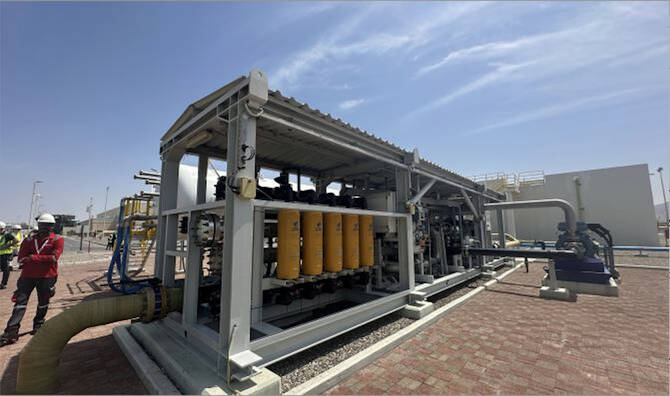
From solar-powered plants to AI-optimized membrane systems, Veolia continues to pioneer technologies like its patented Barrel™ modular system — highlighting the company's commitment to high-performance innovation.
FASTFACTS
Veolia leads globally in desalination, operating over 2,300 sites in 108 countries and aiming to double output by 2030.
Energy efficiency in desalination has improved dramatically, with power use down 85 percent since the early 2000s and water costs dropping from $5 to under $0.50 per cubic meter.
Veolia’s future-focused approach blends innovation, affordability, and environmental stewardship, reinforcing its global leadership in water technologies.
Breaking the myths
A key part of Veolia’s success has been challenging outdated perceptions around desalination. "We’ve broken all the old myths about desalination, one by one,” said Brachlianoff.
Energy consumption, once a major drawback, has dropped by over 85 percent since the early 2000s due to next-generation membranes and energy recovery technologies. Production costs have fallen from $5 to less than $0.50 per cubic meter, making desalinated water a viable option for municipalities and mid-sized industries alike.
Veolia’s new solutions are now also being deployed in sectors such as mining, refining, and even data centers. Projects in Sur, Oman, feature solar integration, while others introduce advanced brine discharge control systems, raising environmental standards across the board.
Gulf countries as living laboratories
Veolia’s work in Oman supports the country’s Vision 2040, particularly its renewable energy goals.
“We’re directly contributing to the goal of achieving 30% renewable energy in the national mix,” said Erwan Rouxel, CEO of Veolia Oman.
A solar plant already provides over a third of the Sur facility’s power needs. The company is also investing in landfill gas-to-energy projects. Crucially, Oman also serves as a hub for workforce development, with 75 percent of Veolia Oman’s staff being local nationals.
“Our Omanization efforts are crucial, not only for business continuity but also for creating shared value with the communities we serve,” Rouxel added.
In Saudi Arabia, Veolia is helping the country transition from thermal desalination to more efficient membrane-based processes.
“The country is shifting from thermal desalination to membrane-based desalination, particularly reverse osmosis,” said Adrien de Saint Germain, CEO of Veolia’s Water Technologies division. “And these aren’t small projects — some exceed 500 to 600 million liters per day. What matters now is how we optimize the entire environment around the membranes.”
He emphasized that Veolia’s approach involves more than technology — it is also about building long-term partnerships through cost-effective design and strategic delivery.
“What makes Saudi projects unique is their multi-year horizon and scale. We can plan strategically and deliver consistently,” he said.
Moroccan innovation in the Atlantic
While the Gulf drives growth in volume, Morocco is offering innovation on a different front — the Atlantic.
“In Morocco, we’re working with Atlantic seawater, which involves very different parameters: lower temperatures, different algae risks,” explained Anne Le Guennec, Senior EVP of Water Technologies. “But it’s the same scale: 800,000 cubic meters per day, just like Hassyan in Dubai.”
Regional expertise plays a critical role in success, she noted.
“From red algae to changing water quality, we know this region. And we work with strong local partners who can respond quickly and deploy workforce on a large scale,” she added.
Toward atomic-level filtration
Looking ahead, Veolia is pushing the boundaries of water purification for specialized industries.
“We’re currently developing solutions using ion-exchange resins,” Le Guennec revealed. “We’re talking atomic-level filtration, separating specific ions. This is where we’ll meet the ultrapure water needs for industries like pharmaceuticals and semiconductor manufacturing.”
This next-generation technology is also feeding into global projects, including the “water of the future” initiative in Paris, where Middle Eastern expertise will help deliver water free of micropollutants by 2027.
Long-term vision and global impact
For CEO Estelle Brachlianoff, Veolia’s strategy is defined by continuous innovation, cost-effectiveness, and environmental responsibility.
“Our ambition is clear: to maintain our global leadership in desalination by continuing to evolve, innovate, and provide the most cost-effective and energy-efficient solutions on the market,” she said.
As water scarcity intensifies worldwide, Veolia is not merely adapting — it is setting the standard.


