

Starmer and Xi call for deeper UK-China ties as Trump shakes up global relations

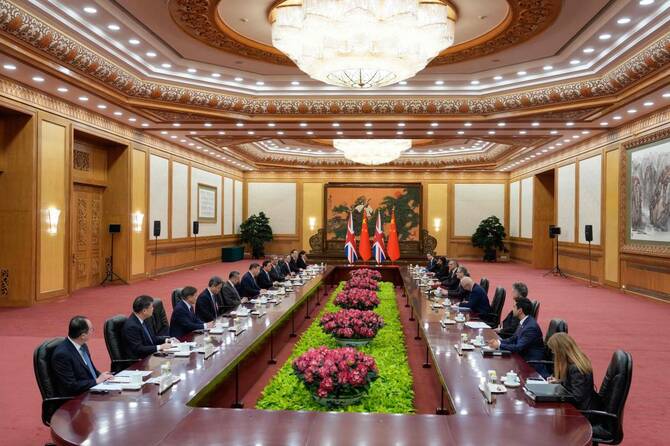
Britain’s Prime Minister Keir Starmer, fifth right, and China’s President Xi Jinping, sixth left, hold a meeting at the Great Hall of the People in Beijing on Jan. 29, 2026. (AFP)
Short Url
Updated 29 January 2026
Follow

Starmer and Xi call for deeper UK-China ties as Trump shakes up global relations

  • Neither Prime Minister Keir Starmer nor President Xi Jinping publicly mentioned Donald Trump
  • But the US president’s challenge to the post-Cold War order was clearly on their minds

BEIJING: The leaders of Britain and China called Thursday for a “strategic partnership” to deepen ties between their nations at a time of growing global turbulence as they sought to thaw relations after years of chill.

Neither Prime Minister Keir Starmer nor President Xi Jinping publicly mentioned Donald Trump, but the US president’s challenge to the post-Cold War order was clearly on their minds.

“I think that working together on issues like climate change, global stability during challenging times for the world is precisely what we should be doing as we build this relationship in the way that I’ve described,” Starmer told Xi at the start of their meeting in Beijing.

The two met for 80 minutes — double the scheduled time — in the Great Hall of the People as their nations try to improve relations after several years of acrimony. Relations have deteriorated over allegations of Chinese spying in Britain, China’s support for Russia in the Ukraine war and the crackdown on freedoms in Hong Kong, the former British colony that was returned to China in 1997. Starmer is the first British prime minister to visit in eight years.

Xi said that “China-UK relations experienced twists and turns in previous years, which was not in the interests of either country.”

“In the current turbulent and ever-changing international situation ... China and the UK need to strengthen dialogue and cooperation to maintain world peace and stability,” he said.

Chinese state broadcaster CCTV said Xi had stressed, without mentioning the US directly, that “major powers” must adhere to international law or the world would regress into a “jungle.”

Relationship is in ‘a good place’

Starmer’s Downing Street office said Britain wanted “a consistent, long-term, and strategic partnership that will benefit both countries.”

After the meeting, Starmer said the leaders had made “really good progress” on issues including slashing Chinese tariffs on Scotch whisky and introducing visa-free travel for British visitors.

“The relationship is in a good place, a strong place,” the British leader said.

Xi appeared to acknowledge the criticism that Starmer has faced for reaching out to China despite national security and human rights concerns. The UK recently approved controversial plans for a huge Chinese Embassy in London, removing a sticking point in relations but also overriding fears that the “mega-embassy” would make it easier for China to conduct espionage and intimidate dissidents.

“Good things often come with difficulties,” Xi said. “As long as it is the right thing to do in accordance with the fundamental interests of the country and its people, leaders will not shy away from difficulties and will forge ahead bravely.”

Starmer’s visit comes less than two months after a Hong Kong court convicted Jimmy Lai, a former newspaper publisher and British citizen, under a national security law that Beijing imposed on the territory after massive pro-democracy protests in 2019.

Starmer said he raised human rights issues with Xi and the two men had a “respectful discussion.”

Starmer, who was elected in July 2024, has said he will protect national security while keeping up diplomatic dialogue and economic cooperation with China. He told Xi that it has “been far too long” since a UK prime minister visited.

“I made a promise 18 months ago when we were elected into government, that I would make Britain face outward again,” the leader of the center-left Labour Party said. “Because as we all know, events abroad affect everything that happens back in our home countries, from prices on the supermarket shelves to how secure we feel.”

Starmer’s government has struggled to deliver the economic growth it promised and ease a cost-of-living crisis for millions of households and he sees China as a potential source of growth.

More than 50 UK business executives have joined him on the trip, along with the leaders of major cultural organizations, as he seeks to expand opportunities for British companies in China and secure Chinese investment in the UK

Trump tariffs spur new trade talks

The disruption to global trade under Trump has made expanding trade and investment more imperative for many governments. Vietnam and the European Union upgraded ties to a comprehensive strategic partnership Thursday, two days after the EU and India announced a free trade accord.

“At a moment when the international rules-based order is under threat from multiple sides, we need to stand side by side as reliable and predictable partners,” European Council President Antonio Costa said in Hanoi, Vietnam.

Starmer is the fourth leader of a US ally to visit Beijing this month, following those of South Korea, Canada and Finland. The German chancellor is expected to visit next month.

The UK leader also met Thursday with Zhao Leji, the chairman of China’s legislature, the National People’s Congress, and Premier Li Qiang, who told Starmer his efforts to improve relations had been “widely welcomed” in both countries.

The two countries were expected to sign a number of agreements. One will try to disrupt the trade in Chinese boat engines used by smugglers to bring people across the English Channel to Britain. More than half the engines come from China, the British government said. Under the agreement, U.K law enforcement agencies will work with Chinese authorities and manufacturers to prevent engines from ending up in the hands of criminal gangs.


Judge bars federal prosecutors from seeking the death penalty against Luigi Mangione

Updated 02 February 2026
Follow

Judge bars federal prosecutors from seeking the death penalty against Luigi Mangione

  • Judge Margaret Garnett’s Friday ruling foiled the Trump administration’s bid to see Mangione executed
  • Garnett dismissed a federal murder charge against Mangione, finding it technically flawed. She left in place stalking charges that could carry a life sentence

NEW YORK: Federal prosecutors can’t seek the death penalty against Luigi Mangione in the killing of UnitedHealthcare CEO Brian Thompson, a federal judge ruled Friday, foiling the Trump administration’s bid to see him executed for what it called a “premeditated, cold-blooded assassination that shocked America.”
Judge Margaret Garnett dismissed a federal murder charge that had enabled prosecutors to seek capital punishment, finding it technically flawed. She wrote that she did so to “foreclose the death penalty as an available punishment to be considered by the jury” as it weighs whether to convict Mangione.
Garnett also dismissed a gun charge but left in place stalking charges that carry a maximum punishment of life in prison. To seek the death penalty, prosecutors needed to show that Mangione killed Thompson while committing another “crime of violence.” Stalking doesn’t fit that definition, Garnett wrote in her opinion, citing case law and legal precedents.
In a win for prosecutors, Garnett ruled they can use evidence collected from his backpack during his arrest, including a 9mm handgun and a notebook in which authorities say Mangione described his intent to “wack” an insurance executive. Mangione’s lawyers had sought to exclude those items, arguing the search was illegal because police hadn’t yet obtained a warrant.
During a hearing Friday, Garnett gave prosecutors 30 days to update her on whether they’ll appeal her death penalty decision. A spokesperson for the US attorney’s office in Manhattan, which is prosecuting the federal case, declined to comment.
Garnett acknowledged that the decision “may strike the average person — and indeed many lawyers and judges — as tortured and strange, and the result may seem contrary to our intuitions about the criminal law.” But, she said, it reflected her “committed effort to faithfully apply the dictates of the Supreme Court to the charges in this case. The law must be the Court’s only concern.”
Mangione, 27, appeared relaxed as he sat with his lawyers during the scheduled hearing, which took place about an hour after Garnett issued her written ruling. Prosecutors retained their right to appeal but said they were ready to proceed to trial.
Outside court afterward, Mangione attorney Karen Friedman Agnifilo said her client and his defense team were relieved by the “incredible decision.”
Jury selection in the federal case is set for Sept. 8, followed by opening statements and testimony on Oct. 13. The state trial’s date hasn’t been set. On Wednesday, the Manhattan district attorney’s office urged the judge in that case to schedule a July 1 trial date.
“That case is none of my concern,” Garnett said, adding that she would proceed as if the federal case is the only case unless she hears formally from parties involved in the state case. She also said the federal case will be paused if the government appeals her death penalty ruling.
Thompson, 50, was killed on Dec. 4, 2024, as he walked to a midtown Manhattan hotel for UnitedHealth Group’s annual investor conference. Surveillance video showed a masked gunman shooting him from behind. Police say “delay,” “deny” and “depose” were written on the ammunition, mimicking a phrase used by critics to describe how insurers avoid paying claims.
Mangione, an Ivy League graduate from a wealthy Maryland family, was arrested five days later at a McDonald’s in Altoona, Pennsylvania, about 230 miles (about 370 kilometers) west of Manhattan.
Following through on Trump’s campaign promise to vigorously pursue capital punishment, Attorney General Pam Bondi ordered Manhattan federal prosecutors last April to seek the death penalty against Mangione.
It was the first time the Justice Department sought the death penalty in President Donald Trump’s second term. He returned to office a year ago with a vow to resume federal executions after they were halted under his predecessor, President Joe Biden.
Garnett, a Biden appointee and former Manhattan federal prosecutor, ruled after hearing oral arguments earlier this month.
Besides seeking to have the death penalty rejected on the grounds Garnett cited, Mangione’s lawyers argued that Bondi’s announcement flouted long-established Justice Department protocols and was “based on politics, not merit.”
They said her remarks, followed by posts to her Instagram account and a TV appearance, “indelibly prejudiced” the grand jury process resulting in his indictment weeks later.
Prosecutors urged Garnett to keep the death penalty on the table, arguing that the charges were legally sound and Bondi’s remarks weren’t prejudicial, as “pretrial publicity, even when intense, is not itself a constitutional defect.”
Prosecutors argued that careful questioning of prospective jurors would alleviate the defense’s concerns about their knowledge of the case and ensure Mangione’s rights are respected at trial.
“What the defendant recasts as a constitutional crisis is merely a repackaging of arguments” rejected in previous cases, prosecutors said. “None warrants dismissal of the indictment or categorical preclusion of a congressionally authorized punishment.”