

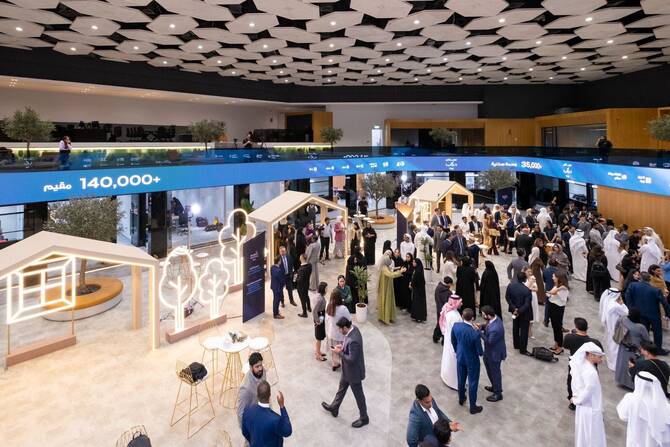
Dubai Financial Market profit surges 298% in H1 on strong investor inflows

he gains came alongside a sharp 298 percent increase in net profit before tax, which reached 777.1 million dirhams. Supplied
Short Url
Updated 03 August 2025
Follow

Dubai Financial Market profit surges 298% in H1 on strong investor inflows

  • Consolidated revenue jumped 191% to 888.9 million dirhams
  • DFM’s average daily traded value rose 75% year-on-year to 692 million dirhams

RIYADH: Dubai Financial Market’s capitalization rose 9.7 percent year on year to 995 billion dirhams ($270.90 billion) in the first half of 2025, supported by strong investor inflows and rising trade volumes. 

The gains came alongside a sharp 298 percent increase in net profit before tax, which reached 777.1 million dirhams, the exchange said in its financial statement published via state news agency WAM.  

Consolidated revenue jumped 191 percent to 888.9 million dirhams, while expenses excluding tax held steady at 111.8 million dirhams compared to 110.3 million dirhams a year earlier. 

The strong performance reflects broader momentum across Gulf Cooperation Council capital markets, with combined capitalization surpassing $4.2 trillion by the end of 2024. The Saudi Exchange alone reached SR9.13 trillion ($2.43 trillion) in equity market capitalization in the first half of 2025. 

“DFM delivered a positive performance in the first half of 2025, underpinned by growing market depth and investor engagement,” said Helal Saeed Al-Marri, chairman of DFM.  

The DFM General Index also advanced 10.6 percent, reflecting local market resilience and a broader global shift toward growth-oriented economies. 

“The rise in the DFM General Index, alongside sustained participation from institutional and foreign investors, is set against the backdrop of a dynamic Dubai economy, where record real estate activity, growing hedge fund presence, and increased capital flows have reinforced the emirate’s status as a global financial hub,” added Al-Marri.  

DFM’s average daily traded value rose 75 percent year-on-year to 692 million dirhams, with total traded value climbing 77 percent to 85 billion dirhams. The average number of daily trades increased 37 percent to around 13,900, according to WAM. 

DFM also onboarded 53,655 new investors, 84 percent of whom were foreign, bringing the total investor base to over 1.2 million. 

Institutional activity accounted for 71 percent of total trading, with foreign investors contributing 53 percent of volume and holding 20 percent of market capitalization. 

“DFM’s performance in the first half of 2025 reflects a market evolving with purpose, demonstrating steady progress in executing our strategic initiatives and maintaining investor confidence,” said Hamed Ali, CEO of DFM and Nasdaq Dubai.  

“As we expand access to new products and deepen market infrastructure, DFM remains a magnet for capital and a launchpad for the region’s most ambitious issuers,” he added.


Education spending surges 251% as students return from autumn break: SAMA

Updated 12 December 2025
Follow

Education spending surges 251% as students return from autumn break: SAMA

RIYADH: Education spending in Saudi Arabia surged 251.3 percent in the week ending Dec. 6, reflecting the sharp uptick in purchases as students returned from the autumn break.

According to the latest data from the Saudi Central Bank, expenditure in the sector reached SR218.73 million ($58.2 million), with the number of transactions increasing by 61 percent to 233,000.

Despite this surge, overall point-of-sale spending fell 4.3 percent to SR14.45 billion, while the number of transactions dipped 1.7 percent to 236.18 million week on week.

The week saw mixed changes between the sectors. Spending on freight transport, postal and courier services saw the second-biggest uptick at 33.3 percent to SR60.93 million, followed by medical services, which saw an 8.1 percent increase to SR505.35 million.

Expenditure on apparel and clothing saw a decrease of 16.3 percent, followed by a 2 percent reduction in spending on telecommunication.

Jewelry outlays witnessed an 8.1 percent decline to reach SR325.90 million. Data revealed decreases across many other sectors, led by hotels, which saw the largest dip at 24.5 percent to reach SR335.98 million. 

Spending on car rentals in the Kingdom fell by 12.6 percent, while airlines saw a 3.7 percent increase to SR46.28 million.

Expenditure on food and beverages saw a 1.7 percent increase to SR2.35 billion, claiming the largest share of the POS. Restaurants and cafes retained the second position despite a 12.6 percent dip to SR1.66 billion.

Saudi Arabia’s key urban centers mirrored the national decline. Riyadh, which accounted for the largest share of total POS spending, saw a 3.9 percent dip to SR4.89 billion, down from SR5.08 billion the previous week.

The number of transactions in the capital settled at 74.16 million, down 1.4 percent week on week.

In Jeddah, transaction values decreased by 5.9 percent to SR1.91 billion, while Dammam reported a 0.8 percent surge to SR713.71 million.

POS data, tracked weekly by SAMA, provides an indicator of consumer spending trends and the ongoing growth of digital payments in Saudi Arabia. 

The data also highlights the expanding reach of POS infrastructure, extending beyond major retail hubs to smaller cities and service sectors, supporting broader digital inclusion initiatives. 

The growth of digital payment technologies aligns with the Kingdom’s Vision 2030 objectives, promoting electronic transactions and contributing to the nation’s broader digital economy.