

IMF must be more active on debt restructurings, Georgieva says

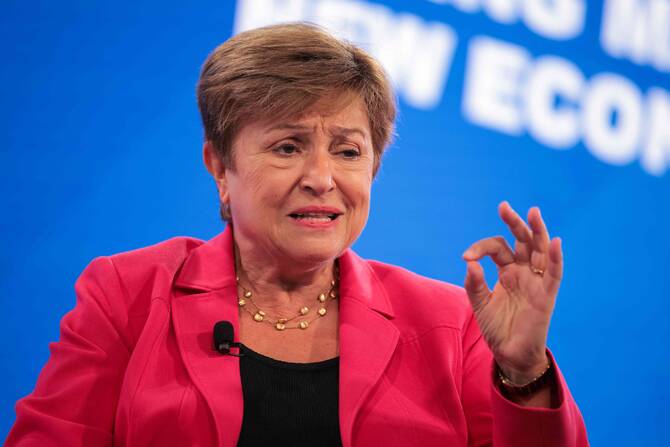
IMF managing director Kristalina Georgieva. Getty
Short Url
Updated 23 April 2025
Follow

IMF must be more active on debt restructurings, Georgieva says

  • African countries want IMF to provide technical assistance
  • Debt roundtable to release new playbook for debt restructurings
  • African leaders, IMF met

WASHINGTON: The International Monetary Fund must be more active in debt restructuring processes, the global lender’s managing director, Kristalina Georgieva, said on Tuesday, noting the growing challenges facing vulnerable low- and middle-income countries.

Georgieva told an event hosted by the Bretton Woods Committee booster group that African countries and others, in a 1-1/2-hour meeting, said they wanted the IMF to provide more technical assistance to countries grappling with high debt levels.

She said the Global Sovereign Debt Roundtable, which includes creditor and borrowing countries as well as the IMF and the World Bank, had separately approved a new playbook to help countries navigate the complex process of restructuring heavy debt burdens.

The roundtable will release the document after a closed-door meeting in Washington on Wednesday during the spring meetings of the IMF and the World Bank.

A joint statement released by Georgieva and Hervé Ndoba, chair of the African Caucus and Central African Republic’s minister of finance and budget, said Africa faces the risk of further shocks that could undo strong policy actions taken to bring down inflation, stabilize public debt and reduce external imbalances.

“While growth in Africa is showing some resilience in the face of multiple shocks, the sudden shift in the global outlook has interrupted the growth momentum,” the two leaders said, noting that growth on the African continent had been revised down by 0.3 percentage point to 3.9 percent for 2025.

African leaders and the IMF agreed on the need to ensure macroeconomic and financial stability while working to meet the continent’s economic development goals. They said domestic reform efforts should promote fiscal sustainability by boosting revenue and improving spending efficiency.

“Now, more than ever, the Fund is committed to working with its member countries to help navigate the complex global economic environment,” the joint statement said, noting that addition of a 25th chair on the Executive Board for sub-Saharan Africa strengthened the region’s voice in the fund.

The statement also pledged that the IMF would “remain agile” in responding to emerging challenges, and providing support to initiatives like the G20 Common Framework and the Global Sovereign Debt Roundtable.

It welcomed IMF steps to review both its debt sustainability framework for low-income countries and the design and conditionality of lending programs with an eye to addressing macroeconomic imbalances and promoting growth.

The African Consultative Group includes governors from 12 African countries belonging to the African Caucus and IMF management.


First EU–Saudi roundtable on critical raw materials reflects shared policy commitment

Updated 16 January 2026
Follow

First EU–Saudi roundtable on critical raw materials reflects shared policy commitment

RIYADH: The EU–Saudi Arabia Business and Investment Dialogue on Advancing Critical Raw Materials Value Chains, held in Riyadh as part of the Future Minerals Forum, brought together senior policymakers, industry leaders, and investors to advance strategic cooperation across critical raw materials value chains.

Organized under a Team Europe approach by the EU–GCC Cooperation on Green Transition Project, in coordination with the EU Delegation to Saudi Arabia, the European Chamber of Commerce in the Kingdom and in close cooperation with FMF, the dialogue provided a high-level platform to explore European actions under the EU Critical Raw Materials Act and ResourceEU alongside the Kingdom’s aspirations for minerals, industrial, and investment priorities.

This is in line with Saudi Vision 2030 and broader regional ambitions across the GCC, MENA, and Africa.

ResourceEU is the EU’s new strategic action plan, launched in late 2025, to secure a reliable supply of critical raw materials like lithium, rare earths, and cobalt, reducing dependency on single suppliers, such as China, by boosting domestic extraction, processing, recycling, stockpiling, and strategic partnerships with resource-rich nations.

The first ever EU–Saudi roundtable on critical raw materials was opened by the bloc’s Ambassador to the Kingdom, Christophe Farnaud, together with Saudi Deputy Minister for Mining Development Turki Al-Babtain, turning policy alignment into concrete cooperation.

Farnaud underlined the central role of international cooperation in the implementation of the EU’s critical raw materials policy framework.

“As the European Union advances the implementation of its Critical Raw Materials policy, international cooperation is indispensable to building secure, diversified, and sustainable value chains. Saudi Arabia is a key partner in this effort. This dialogue reflects our shared commitment to translate policy alignment into concrete business and investment cooperation that supports the green and digital transitions,” said the ambassador.

Discussions focused on strengthening resilient, diversified, and responsible CRM supply chains that are essential to the green and digital transitions.

Participants explored concrete opportunities for EU–Saudi cooperation across the full value chain, including exploration, mining, and processing and refining, as well as recycling, downstream manufacturing, and the mobilization of private investment and sustainable finance, underpinned by high environmental, social, and governance standards.

From the Saudi side, the dialogue was framed as a key contribution to the Kingdom’s industrial transformation and long-term economic diversification agenda under Vision 2030, with a strong focus on responsible resource development and global market integration.

“Developing globally competitive mineral hubs and sustainable value chains is a central pillar of Saudi Vision 2030 and the Kingdom’s industrial transformation. Our engagement with the European Union through this dialogue to strengthen upstream and downstream integration, attract high-quality investment, and advance responsible mining and processing. Enhanced cooperation with the EU, capitalizing on the demand dynamics of the EU Critical Raw Materials Act, will be key to delivering long-term value for both sides,” said Al-Babtain.

Valere Moutarlier, deputy director-general for European industry decarbonization, and directorate-general for the internal market, industry, entrepreneurship and SMEs at European Commission, said the EU Critical Raw Materials Act and ResourceEU provided a clear framework to strengthen Europe’s resilience while deepening its cooperation with international partners.

“Cooperation with Saudi Arabia is essential to advancing secure, sustainable, and diversified critical raw materials value chains. Dialogues such as this play a key role in translating policy ambitions into concrete industrial and investment cooperation,” she added.