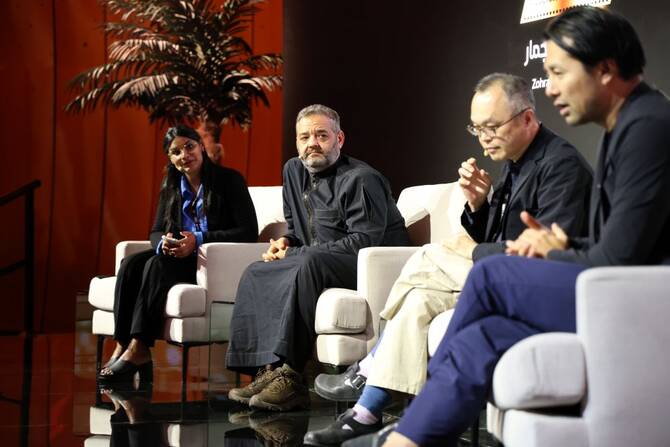


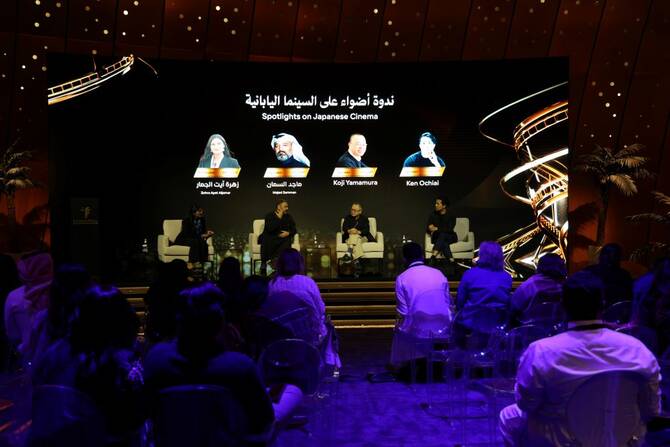

DHAHRAN: From Tokyo to Dhahran, audience members at the 11th Saudi Film Festival were treated to a rich cross-cultural exchange during a panel this week that explored the cinematic parallels and connections between Japan and Saudi Arabia.
Moderated by Zohra Ait El-Jamar, head of Hayy Jameel Cinema, the panel featured US-based Japanese director and photographer Ken Ochiai, Oscar-nominated Japanese animator Koji Yamamura, and Ithra’s Japanese-fluent Saudi film expert Majed Z. Samman.
Yamamura, who has had a career spanning 45 years and teaches at Tokyo University of the Arts, said: “What I make is more artistic films, not commercial ones.”
The globally acclaimed animator offered a masterclass earlier in the festival.
Ochiai, who viewed the Saudi film “Hobal” at the festival, noted striking similarities between Japanese and Saudi cultural expressions in cinema.
He praised “Hobal,” pointing to the strong emphasis on cinematography, concise dialogue, and captivating narrative.
“Less is good, if you can convey feelings through facial expressions,” he said.
The panel encouraged the audience to watch more foreign films “to broaden your perspective.”
Samman said that Saudi audiences have favored three main film categories for decades: “Hollywood, Bollywood, and anime.”
He said that his love of cinema began while studying in Tokyo.
“Saudis grew up on anime that was mostly dubbed into Arabic,” he said, adding that many popular films, such as “Inception,” were based on Japanese originals.
Japanese films often require a bit of homework beforehand, Samman said.
“If you’re not into it (Japanese storytelling style), or if you’re not going to research it, you might think it’s stupid or cheesy — or, what’s happening here? I think we need to bridge that gap between the culture and the visual language,” he said.
Ochiai explained the differing approaches to film editing, saying that in Hollywood, several takes are shot, and editing happens later. In contrast, Japanese filmmakers often prefer to edit in real time, based on a meticulously planned storyboard, in order to minimize extra work.
While Japanese films can sometimes feel lacking in context, every country has its own visual language, he said.
Japanese cinema’s minimalist sensibility resonates deeply within Japan, though it can sometimes feel mysterious or confusing to outside audiences. This is because Japan’s film industry has traditionally prioritized domestic viewers, without filling in background details that international audiences might need.
Ochiai said that audiences today who focus on trending aesthetics, especially on TikTok, may be looking in the wrong direction.
“What we really need to focus on is the message of the film. How you learn is not on YouTube, but how you learn is from the past, like the movies from the past, because everything is coming from the top.
“Art is a copy of something. So, if you copy the copy of the copy of the copy, it just gets watered down — the quality — so you should learn the history of the cinema so that you can also bring something new to the table,” he said.