

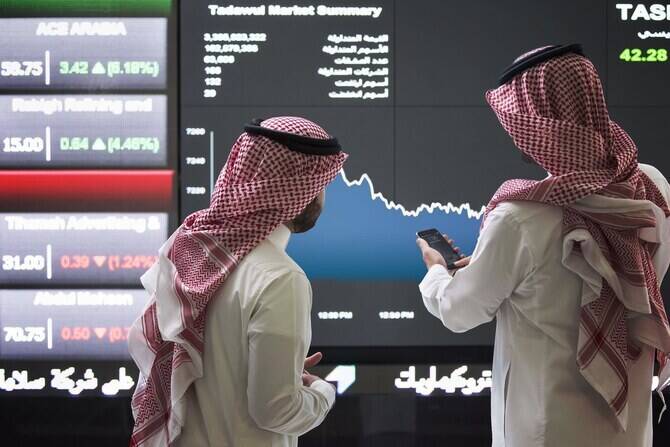
Closing Bell: Saudi indices end day in the red

Total trading turnover stood at SR3.5 billion ($953.3 million), as 45 stocks advanced while 195 declined.
Short Url
Updated 21 April 2025
Follow

Closing Bell: Saudi indices end day in the red

RIYADH: Saudi Arabia’s stock market closed lower on Monday, with the Tadawul All Share Index falling 77.94 points, or 0.67 percent, to end the session at 11,548.66.

Total trading turnover stood at SR3.5 billion ($953.3 million), as 45 stocks advanced while 195 declined.

The Kingdom’s parallel market, Nomu, also closed in the red, shedding 340.41 points, or 1.17 percent, to finish at 28,637.78.

Of the listed stocks, 29 rose while 44 declined. The MSCI Tadawul Index dipped by 8.02 points, or 0.54 percent, closing at 1,466.51.

Alistithmar Capital REIT was the session’s top performer on the main index, jumping 9.92 percent to close at SR7.98.

Saudi Printing and Packaging Co. followed closely, gaining 9.86 percent to reach SR12.70. Nice One Beauty Digital Marketing Co. also saw notable gains, rising 4.78 percent to SR38.35, while Zamil Industrial Investment Co. climbed 3.92 percent to SR38.40.

On the other end of the spectrum, Dar Alarkan Real Estate Development Co. posted the steepest decline, falling 5.51 percent to SR22.30. Eastern Province Cement Co. dropped 4.48 percent to SR34.10, and Riyadh Cables Group Co. slid 4.26 percent to SR126.

National Gypsum Co. announced a 22.03 percent year-on-year increase in revenue for the fiscal year ending December 31, 2024, reporting SR63.32 million compared to SR51.89 million the previous year. Despite the rise in sales, the company posted a net loss of SR14.72 million, reversing a profit of SR5.13 million a year earlier.

The loss was attributed to higher sales costs and a decline in other income, including a SR10.7 million fine paid to the General Authority for Competition and the absence of land compensation income that had been recorded the prior year. Shares of National Gypsum Co. dropped 1.59 percent to settle at SR19.80.

Banque Saudi Fransi reported a 16.38 percent increase in net profit for the first quarter ending March 31, 2025, reaching SR1.34 billion compared to SR1.15 billion in the same quarter of the previous year.

The bank’s total operating income rose 13.17 percent year on year to SR2.64 billion, driven by increases in special commission income and trading income.

Net income growth was supported by an 8.1 percent rise in net special commission income, while operating expenses grew by 12.16 percent. Total comprehensive income more than doubled to SR1.92 billion, up 120.85 percent from the same period last year. The bank’s share price rose 0.92 percent to SR17.50.

Riyad Bank posted a 19.39 percent year-on-year increase in net profit for the first quarter of 2025, reaching SR2.49 billion compared to SR2.07 billion in the same period last year.

Total operating income grew 10.18 percent year on year to SR4.5 billion, while total comprehensive income increased by 23.62 percent to SR2.68 billion.

The bank attributed the rise in profitability to growth in net special commission income, trading income, exchange income, and net fee and commission income.

Operating expenses fell due to lower impairment charges for credit losses and other financial assets, though this was partially offset by higher employee and premises-related costs. Despite the strong earnings, Riyad Bank’s share price slipped 0.82 percent to SR30.15.


Middle East war economic impact to depend on duration, damage, energy costs, IMF official says

Updated 05 March 2026
Follow

Middle East war economic impact to depend on duration, damage, energy costs, IMF official says

  • Katz: Prolonged increase in energy prices could unanchor inflation expectations
  • IMF: 2026 global GDP outlook was solid, too early to judge war’s impact on growth

WASHINGTON: The Middle East war’s impact on the global economy will depend on its duration and damage to infrastructure and industries in the region, particularly whether energy price increases are short-lived or persistent, the International Monetary Fund’s number two official said on Tuesday.

IMF First Deputy Managing Director Dan Katz told the Milken Institute Future of Finance conference in Washington that if there is prolonged uncertainty from the conflict and a prolonged impact on energy prices, “I would expect central banks to be cautious and ‌respond to the ‌situation as it materializes.”
He said the conflict could ​be “very ‌impactful ⁠on ​the global economy ⁠across a range of across a range of metrics, whether it’s inflation, growth and so on” but it was still early to have a firm conviction.
Prior to the US and Israeli air strikes on Iran and counterattacks across the region, the IMF had forecast solid global GDP growth of 3.3 percent in 2026, powering through tariff disruptions due in part to the continued AI investment boom and expectations of productivity gains.
Katz said ⁠that the economic impact from the Middle East conflict would ‌be influenced by its duration and further geopolitical ‌developments.
Earlier, the IMF said it was monitoring the ​conflict’s disruptions to trade and economic activity, ‌surging energy prices and increased financial market volatility.
“The situation remains highly fluid and ‌adds to an already uncertain global economic environment,” the Fund said in a statement issued from Washington. Katz said the IMF will look at the conflict’s direct impacts on the region, including damage to infrastructure, and disruptions to key sectors.
“Tourism is an important one. Air travel. Is ‌there physical damage to infrastructure, production facilities, and the big industry in particular that everyone will be focused on is, ⁠of course, the energy ⁠industry,” he said.
Oil rose further on Tuesday as Iran vowed to attack ships passing through the Strait of Hormuz. Brent crude oil , the global benchmark, surged to $83 per barrel, up 15 percent from its level on Friday.
Katz said he expected central banks to “look through” a temporary rise in energy prices, given their focus on core inflation. But central banks could respond if a more persistent energy shock results in “a destabilizing of inflation expectations.”
He said the post-COVID inflation spike of 2022 was influenced by energy impacts from Russia’s invasion of Ukraine, with more pass-through from headline inflation to core inflation.
“And so I’m sure central banks, as they are thinking about how the ​geopolitical situation is translating into ​energy markets, will be looking at the lessons of the pandemic and seeing if they can apply any of those lessons in setting monetary policy,” Katz said.