


LONDON: Saudi Arabia may be thousands of miles from British shores, but the depth of its relationship with the UK is perhaps best illustrated by a little-known defense arrangement: The Kingdom is the only country outside British soil to host an air defense system otherwise deployed exclusively on UK territory.
It is a striking symbol of trust — and one that Arab News Editor in Chief Faisal J. Abbas was keen to highlight at a high-level event in London this week, pushing back against the perception that London has been absent from the current crisis.
“There’s a lot that happens behind closed doors,” Abbas told the audience, acknowledging that domestic pressures have caused “big distractions” for the UK government while insisting that London’s behind-the-scenes engagement with Gulf partners remains significant.
As evidence, he pointed to the largely unheralded role British intelligence played in helping stabilize Syria following the fall of the Assad regime — a contribution, he said, that took many by surprise but proved decisive in shaping the country’s fragile transition after five decades of brutal dictatorship.

Emergency personnel work to extinguish a fire in a building after an Iranian strike in the capital Manama on February 28, 2026. (AFP)
For Abbas, it was a reminder that British influence in the region often operates below the radar and is all the more effective for it.
That quiet but substantive commitment, he argued, was further underscored by Prince William’s visit to Saudi Arabia in February this year — his first official visit to the Kingdom and one that Abbas described as being “very successful.”
The trip, organized under the current Labour government, carried its own diplomatic message.
“The current government would not have requested the heir to the throne to come to our state visit to Saudi Arabia if they didn’t see the value of this relationship,” Abbas said. “That just shows you the level of commitment that the UK has.”

International nation flags fluter outside the damaged Crown Plaza hotel, following an Iranian military strike, in Manama on March 1, 2026. (AFP)
Turning to intra-Gulf dynamics, Abbas painted a picture of a bloc that has, at least in the crucible of conflict, rediscovered its unity.
The war has reinforced just how deeply the region’s fortunes are intertwined, and past tensions, he argued, were never about fundamental disagreements but rather “tactical differences” that tend to resolve themselves.
Pointing to the Saudi-Qatari reconciliation as the clearest proof of that pattern, he said that the disagreements with the UAE reached their “boiling point” in Yemen, but that competition between the two countries “makes everybody perform at their best.”
That same measured pragmatism extended to Abu Dhabi’s widely discussed departure from OPEC. Abbas declined to pass judgment, comparing it to Brexit — a sovereign decision that will attract strong opinions on both sides, with history the only reliable verdict.

People carry the coffin of a person killed during a drone attack on a high-rise apartment building in Bahrain's capital Manama to its grave during the burial on March 10, 2026. (AFP)
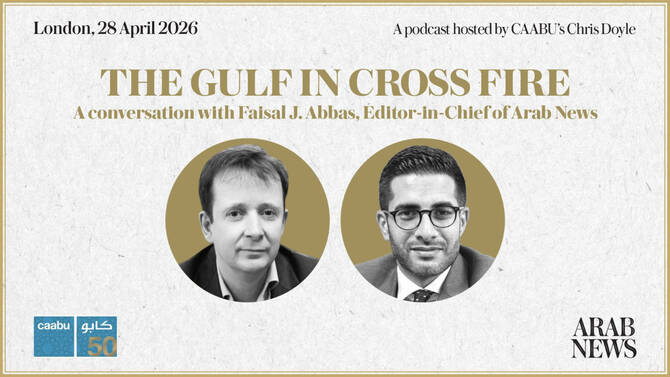
Policymakers, diplomats and Gulf royals gathered at the talk in London for a high-level discussion hosted by the Council for Arab-British Understanding, or CAABU, examining the shifting political and human landscape of the Gulf amid escalating regional tensions.
The event, titled “The Gulf in Cross Fire: A Conversation with Faisal J. Abbas,” featured a wide-ranging dialogue between CAABU Director Chris Doyle and the Arab News editor, drawing an audience that included members of the UK Parliament, senior diplomats and influential figures from across the Gulf.
Held behind closed doors, the discussion sought to provide a “pulse check” on sentiment within Saudi Arabia and the wider Gulf region following the profound geopolitical and humanitarian repercussions of the recent U.S.-Israel war against Iran.
Doyle opened the conversation by framing the Gulf as being at a critical inflection point, navigating both unprecedented economic transformation and acute regional instability. Abbas, drawing on his extensive regional insight, offered a nuanced assessment of how governments and societies in the Gulf are responding to the crisis.

A plume of smoke rises after a reported Iranian strike on fuel tanks in Muharraq on March 12, 2026. (AFP)
“Gulf countries have shown a tremendous amount of courage, a tremendous amount of wisdom and a tremendous amount of resilience and self-restraint,” the Arab News editor said.
“It (the situation) is bad, but it could have been far worse if we were adrenaline- or testosterone-driven and allowed this to drag. We certainly do not want this to be an Arab-Persian war. We do not want this to be a Sunni-Shia war.”
The conversation also explored the importance of a united diplomatic strategy at a time of conflict and warned about the dangers of having a fragmented Iran as a neighbor across the Gulf.
“We will inflict serious damage on Iran, given the firepower that exists in Saudi Arabia and collectively in the GCC. But what do we do then? Not in the day after, but the day after the day after. Because the day after is people celebrating either winning the war or losing the war, etc. But what do you do with a fragmented Iran? With a destroyed Iran? Who’s going to pick up the pieces?”

The Dubai skyline with the landmark Burj Khalifa skyscraper (R) is pictured as a smoke plume rises from an ongoing fire near Dubai International Airport on March 16, 2026. (AFP)
Attendees described the discussion as both candid and sobering, with particular emphasis placed on the tension between resilience and vulnerability in Gulf states at a time of heightened uncertainty.
Pakistan’s role as a trusted mediator was welcomed by most sides, as Prime Minister Shehbaz Sharif and Chief of Army Staff Gen. Asim Munir led negotiations.
“People say, but it wasn’t successful. I just go to George Mitchell about it, seeing 700 days of failure and one day of success,” Abbas said.
“We've only had 20, 21 hours of negotiations. And, you know, if people were expecting a miracle, even miracles don't happen that quickly. But we remain optimistic. I think all sides involved are interested in finding a solution.”

The Dubai skyline with the landmark Burj Khalifa skyscraper (R) is pictured as a smoke plume rises from an ongoing fire near Dubai International Airport on March 16, 2026. (AFP)
The event underscored CAABU’s role in fostering informed dialogue between the UK and the Arab world, particularly at a moment when the Gulf’s strategic importance is once again in sharp global focus.
As the evening concluded, participants were left with a clearer understanding that the region’s economic momentum and stability are tied to the crosscurrents of war and diplomacy.
“As we’ve seen, and we wish other people in the world might have known this very basic piece of wisdom, which is: Starting a war is very easy — ending it is difficult,” Abbas said.




