DR Congo ex-rebel leader Lumbala’s war crimes trial opens in France

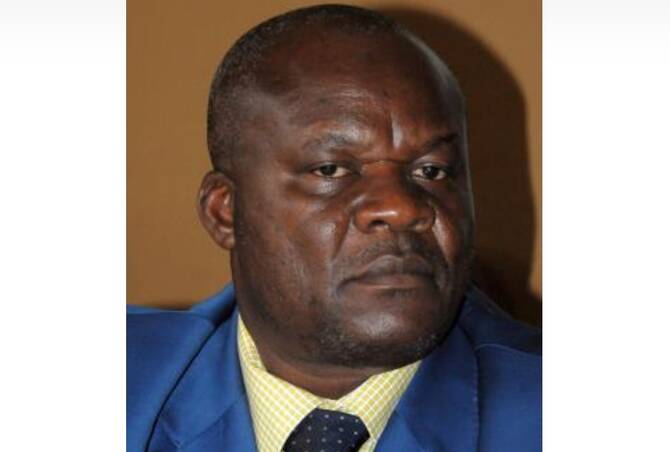
Former Congolese rebel leader Roger Lumbala went on trial in France Wednesday over atrocities committed in the Democratic Republic of Congo’s bloody eastern conflict more than two decades ago. (AFP/File)
Short Url
Updated 12 November 2025
Follow

DR Congo ex-rebel leader Lumbala’s war crimes trial opens in France

  • Lumbala, 67, is accused of complicity in crimes against humanity for his role during the 1998-2003 Second Congo War
  • Human rights groups have hailed his trial as an opportunity to deter further abuses in the eastern DRC

PARIS: Former Congolese rebel leader Roger Lumbala went on trial in France Wednesday over atrocities committed in the Democratic Republic of Congo’s bloody eastern conflict more than two decades ago.
Lumbala, 67, is accused of complicity in crimes against humanity for his role during the 1998-2003 Second Congo War, during which more than a half-dozen African nations were drawn into the globe’s deadliest conflict since World War II.
As the trial started in Paris, Lumbala presented himself as a former trade minister and former lawmaker, as well as the “promoter of two television channels” in DRC.
He was arrested in France, where he owned a flat, under the principle of universal jurisdiction in December 2020 and has been held in a Paris prison since.
If convicted, he faces a maximum sentence of life imprisonment.
Human rights groups have hailed his trial as an opportunity to deter further abuses in the eastern DRC, where a Rwanda-backed militia’s 2025 advance has fanned the flames of the fighting plaguing the mineral-rich region for more than three decades.
Investigating magistrates describe Lumbala as a warlord who let fighters from his Uganda-backed rebel movement, the Rally of Congolese Democrats and Nationalists (RCD-N), pillage, execute, rape and mutilate with impunity.
UN investigators also accuse his paramilitaries of targeting ethnic pygmies.
Lumbala, who briefly served as trade minister then ran for president in 2006, insists he was merely a politician with no soldiers or volunteers under his control.
He is almost certain to contest the competence of the French justice system to try him.
Dozens of victims are expected to testify in the more than a month’s worth of hearings before the judge is set to hand down their verdict on December 19.
But there are doubts over whether all will be able to make the trip to the French capital.
The NGOs TRIAL International, the Clooney Foundation for Justice, the Minority Rights Group, Justice Plus and PAP-RDC, which supports pygmy peoples, have hailed the proceedings as “a crucial opportunity to deliver justice for survivors.”

- Rape as ‘weapon’ -

The charges center on the actions of Lumbala’s RCD-N in 2002 and 2003 in the northeastern Ituri and Haut-Uele provinces bordering Uganda and modern-day South Sudan, primarily against the Nande and Bambuti pygmy ethnic groups.
French authorities believe RCD-N fighters used rape as a “weapon of war,” especially toward women from the Nande and Bambuti communities, which the militia suspected of pro-government sympathies.
United Nations investigators believe the RCD-N’s offensive was designed to secure access to the region’s resources, which include gold, diamonds and the coltan crucial to the making of mobile phones.
The Congolese east’s rich mineral veins have been at the center of much of the fighting to bedevil the region in the past three decades. The dozens of armed groups fighting there have at times been joined by foreign powers vying for control of mines.
The DRC has also previously accused Lumbala of high treason and complicity with the M23 armed group during its first mutiny in the eastern DRC, which ended with its 2013 defeat.
Since taking up arms again the M23 has seized swathes of the eastern North and South Kivu provinces with Rwanda’s support in recent years.
The United Nations likewise believes the militia and its Rwandan allies have committed human rights abuses in the east, though Rwanda denies involvement.
“Holding Lumbala accountable for his actions sends a strong signal in today’s ongoing violent conflict in DRC that abuses will be investigated and justice sought,” said Samuel Ade Ndasi, a litigation officer with the Minority Rights Group NGO.
“We believe that this will act as a deterrent to those perpetrating such abuses now.”


What to know about the search for the Brown University shooting suspect

Updated 17 December 2025
Follow

What to know about the search for the Brown University shooting suspect

  • The video from more than hour before the attack shows the suspect running at times in quiet residential streets near campus

PROVIDENCE, R.I.: With the Brown University shooter still on the loose Tuesday, authorities released new video of a suspect and police fanned out to Providence schools to reassure parents, kids and teachers as investigators pushed for new evidence that might help them crack the case.
Here’s a look at what to know about the attack and the search:
Search on after new video and description of suspect
Authorities released a video timeline and a slightly clearer image of the man suspected in Saturday’s attack in an engineering building classroom, where two students were killed and nine were wounded. The video from more than hour before the attack shows the suspect running at times in quiet residential streets near campus.
In videos previously made public, the suspect’s face was masked or turned away and authorities were only able to give a vague description of him as having a stocky build and about 5 feet, 8 inches (173 centimeters) tall.
The gunman fired more than 40 rounds from a 9 mm handgun, a law enforcement official told The Associated Press on the condition of anonymity because they weren’t authorized to discuss the investigation publicly.
Police have asked the public for tips, and said they had received about 200 by Tuesday. Col. Oscar Perez, the Providence police chief, asked the public Tuesday to look at their camera systems in the area where the person was walking to review any footage that goes back a week.
Authorities on Sunday released a different person of interest after determining he wasn’t behind the attack, which happened in a first-floor classroom where students were cramming for an exam. Providence police spokeswoman Kristy dosReis said the man’s detention didn’t affect the ongoing investigation.
Police fan out to local schools
Tensions remain high in Providence. Ten state troopers were assigned to support the local police sent to beef up security at schools, district Superintendent Javier Montañez said. The district said it canceled after-school activities, sporting events and field trips this week “out of an abundance of caution.”
The attack and the shooter’s escape also have raised questions about campus security, including a lack of security cameras, and led to calls for better locks on campus doors. But some said what they called the real issue needs to be addressed.
“The issue isn’t the doors, it’s the guns,” said Zoe Kass, a senior who fled the engineering building Saturday.
Authorities have said that one reason they lacked video of the shooter was because Brown’s older engineering building doesn’t have many cameras.
University defends response
Brown President Christina Paxson defended the university’s response, saying it was deeply committed to the safety, security and well-being of its students. She also said the campus is equipped with 1,200 cameras.
“I have been deeply saddened by people questioning that,” she said Tuesday. “As time goes on, there is a natural instinct to assign responsibility for tragic events like this. Anxiety here is very natural, but the shooter is responsible.”
Paxson said the university has two security systems. One system is activated at a time of emergency and sent out text messages, phone calls and emails that, in this shooting, reached 20,000 individuals. The other system features three sirens across campus, but Paxson said that would not be activated in an active shooter situation.
“Those get activated when there is a broad scale emergency, and we want people to rush into buildings,” she said. “In the case of an active shooter, activating that system could have caused people to rush into Barus and Holley.”
When pressed by a reporter who noted the university website says the sirens can be used when there is an active shooter, Paxson reaffirmed she didn’t think it would be used in that situation.
“It depends on the circumstances and where the active shooter would be but you don’t want to ever get people rushing into buildings that might be the site of an active shooter,” she said.
Details about the victims emerge
Two of the wounded students had been released from the hospital as of Tuesday, Brown spokeswoman Amanda McGregor said. Of the seven others, one remained in critical condition, five were in critical but stable condition and one was in stable condition, Providence Mayor Brett Smiley said.
One of the wounded, 18-year-old freshman Spencer Yang of New York City, told the New York Times and the Brown Daily Herald there was a scramble after the gunman entered the room. Yang said he wound up on the ground and was shot in the leg.
The students who died were MukhammadAziz Umurzokov, an 18-year-old freshman from Brandermill, Virginia, and Ella Cook, a 19-year-old sophomore from a suburb of Birmingham, Alabama.
Jacob Spears, 18, a freshman from Evans, Georgia, was shot in the stomach, “but through sheer adrenaline and courage, he managed to run outside, where he was aided by others,” according to a GoFundMe site organized for him.
Durham Academy, a private K-12 school in Durham, North Carolina, confirmed that a recent graduate, Kendall Turner, was wounded.