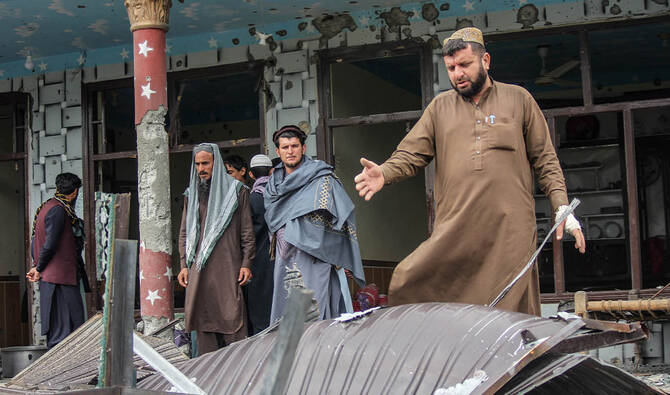

ISLAMABAD: The Pakistani military on Tuesday dismissed Afghanistan’s claims of targeting civilian areas in its ongoing strikes against suspected militant bases in the neighboring country, describing them as a “coordinated disinformation strategy.”
Pakistan and Afghanistan have been locked in a conflict since Feb. over a surge in attacks in Pakistan’s western regions bordering Afghanistan, which Islamabad blames on Afghanistan-based militant groups. Kabul denies the allegation.
Both sides have repeatedly conducted artillery, air and drone strikes against the other during the fighting, their worst in decades, with Kabul often accusing Islamabad of targeting civilian areas. Pakistan says its strikes have only targeted militants.
Pakistan’s Chief of Defense Forces (CDF) Field Marshal Asim Munir on Tuesday presided over a meeting of the top army commanders to review the prevailing security environment and the ongoing operation Ghazab-lil-Haq against Afghanistan-based militant groups.
“It noted recent pattern of ongoing propaganda campaign by Taliban regime to falsely portray Pakistan as targeting civilians inside Afghanistan, terming such misleading narratives as part of a coordinated disinformation strategy by the regime to distract attention from their internal failures and play victim card,” said the Inter-Services Public Relations (ISPR), the Pakistani military’s media wing.
“The Forum categorically rejected these frivolous allegations and reaffirmed that Pakistan’s defensive actions remain focused, precise, and directed solely against infiltrators, terrorist hideouts and support infrastructures.”
The Afghan side did not immediately respond to the statement.
Islamabad accuses Afghanistan of providing safe havens to militants who carry out attacks inside Pakistan, especially the Pakistani Taliban. The group is separate but closely allied with the Afghan Taliban. Kabul denies this.
The fighting in February began when Afghanistan launched cross-border artillery strikes into Pakistan, saying it was in retaliation for earlier Pakistani airstrikes on Afghan border areas.
The latest round of fighting upended a Qatari-mediated ceasefire in October that halted earlier clashes between the two sides, which had killed dozens of civilians, security forces and militants. The two sides differ widely on the casualty figures.
China, which shares its western border with both nations, Saudi Arabia, Qatar and Turkiye have tried to mediate the conflict between the neighbors.
In early April, Afghan and Pakistani officials met for Chinese-mediated peace talks in Urumqi in western China, with Beijing saying the two sides had agreed not to escalate their conflict and “explore a comprehensive solution,” but cross-border clashes have continued, although at a lower intensity than before the talks.
The ISPR said the Pakistani army commanders acknowledged continued degradation of militants and their “support infrastructure” in operation Ghazab-lil-Haq.
“It noted that the irrational and perverted policy of Afghan Taliban regime to provide safe havens to Khawarij (Pakistani Taliban) and other terrorist organizations, with total disregard to interests of Afghan people, is increasingly backfiring and stands fully exposed,” the ISPR said.
The army brass also undertook a comprehensive review of the internal security situation.
“The Forum resolved to maintain current operational tempo to decisively dismantle terrorist networks, disrupt their support infrastructure, and deny them any operational space within Pakistan,” the ISPR added.