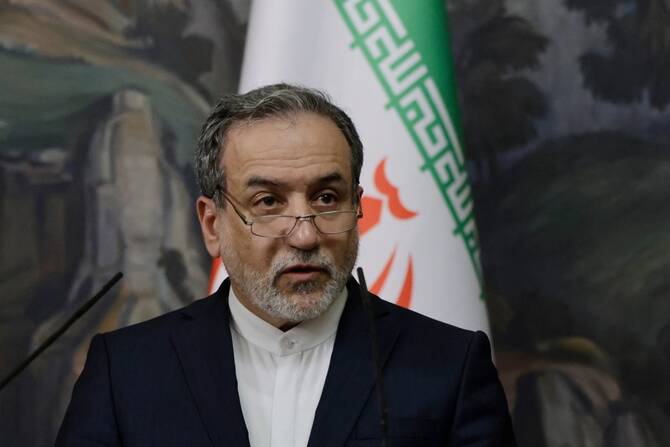
ROME: Iran and the United States will begin having experts meet to discuss details of a possible deal over Tehran’s rapidly advancing nuclear program, the top Iranian diplomat said Saturday after a second round of negotiations in Rome.
The comments by Iranian Foreign Minister Abbas Araghchi, who met with US Mideast envoy Steve Witkoff for several hours, suggest movement in the talks. The experts will meet in Oman before Araghchi and Witkoff meet again in Oman on April 26, Araghchi said.
There was no immediate readout from the US side after the meeting at the Omani Embassy in Rome’s Camilluccia neighborhood. However, President Donald Trump has been pushing for a rapid deal with Iran while threatening military action against it.
“The talks were held in a constructive environment and I can say that is moving forward,” Araghchi told Iranian state television. “I hope that we will be in a better position after the technical talks.”
He added: “This time, we succeeded to reach a better understanding about a sort of principles and aims.”
Iranian officials described the talks as indirect, like those last weekend in Muscat, Oman, with Omani Foreign Minister Badr Al-Busaidi shuttling between them in different rooms.
That talks are even happening represents a historic moment, given the decades of enmity between the two countries since the 1979 Islamic Revolution and the US Embassy hostage crisis. Trump, in his first term, unilaterally withdrew from Iran’s nuclear deal with world powers in 2018, setting off years of attacks and negotiations that failed to restore the accord that drastically limited Tehran’s enrichment of uranium in exchange for the lifting of economic sanctions.
Talks come as tensions rise in the Mideast
At risk is a possible American or Israeli military strike on Iran’s nuclear sites, or the Iranians following through on their threats to pursue an atomic weapon. Meanwhile, tensions in the Middle East have spiked over the Israel-Hamas war in the Gaza Strip and after US airstrikes targeting Yemen’s Iranian-backed Houthi rebels killed more than 70 people and wounded dozens more.
“I’m for stopping Iran, very simply, from having a nuclear weapon,” Trump said Friday. “I want Iran to be great and prosperous and terrific.”
Araghchi met Saturday morning with Italian Foreign Minister Antonio Tajani ahead of the talks with Witkoff.
Rafael Mariano Grossi, the head of the International Atomic Energy Agency, the United Nations’ nuclear watchdog, also met Tajani on Saturday. Grossi’s agency would likely be key in verifying compliance by Iran should a deal be reached, as it did with the 2015 accord Iran reached with world powers.
Tajani said Italy was ready “to facilitate the continuation of the talks even for sessions at the technical level.”
A diplomat deal “is built patiently, day after day, with dialogue and mutual respect,” he said in a statement.
Araghchi, Witkoff both traveled ahead of talks
Both men have been traveling in recent days. Witkoff had been in Paris for talks about Ukraine as Russia’s full-scale war there grinds on. Araghchi paid a visit to Moscow, where he met with officials, including Russian President Vladimir Putin.
Russia, one of the world powers involved in Tehran’s 2015 nuclear deal, could be a key participant in any future deal reached between Tehran and Washington. Analysts suggest Moscow could potentially take custody of Iran’s uranium enriched to 60 percent purity — a short, technical step away from weapons-grade levels of 90 percent.
Oman’s capital, Muscat, hosted the first round of negotiations between Araghchi and Witkoff last weekend, which saw the two men meet face to face after indirect talks. Oman, a sultanate on the eastern edge of the Arabian Peninsula, has long served as an interlocutor between Iran and the West.
Ahead of the talks, however, Iran seized on comments by Witkoff first suggesting Iran could enrich uranium at 3.67 percent, then later saying that all enrichment must stop. Ali Shamkhani, an adviser to Supreme Leader Ayatollah Ali Khamenei, wrote on X before the talks that Iran would not accept giving up its enrichment program like Libya, or agreeing to using uranium enriched abroad for its nuclear program.
“Iran has come for a balanced agreement, not a surrender,” he wrote.
Iran seeks a deal to steady a troubled economy
Iran’s internal politics are still inflamed over the mandatory hijab, or headscarf, with women still ignoring the law on the streets of Tehran. Rumors also persist over the government potentially increasing the cost of subsidized gasoline in the country, which has sparked nationwide protests in the past
Iran’s rial currency plunged to over 1 million to a US dollar earlier this month. The currency has improved with the talks, however, something Tehran hopes will continue.
Meanwhile, two used Airbus A330-200 long sought by Iran’s flag carrier, Iran Air, arrived at Tehran’s Mehrabad International Airport on Thursday, flight-tracking data analyzed by The Associated Press showed. The planes, formerly of China’s Hainan Airlines, had been in Muscat and re-registered to Iran.
The aircraft have Rolls-Royce engines, which include significant American parts and servicing. Such a transaction would need approval from the US Treasury given sanctions on Iran. The State Department and Treasury did not respond to requests for comment.
Under the 2015 deal, Iran could purchase new aircraft and had lined up tens of billions of dollars in deals with Airbus and Boeing Co. However, the manufacturers backed away from the deals over Trump’s threats to the nuclear accord.


![]()


Iran and US conclude second round of negotiations over Tehran’s nuclear program in Rome
Short Url
https://arab.news/c6s7p
Iran and US conclude second round of negotiations over Tehran’s nuclear program in Rome
- Iranian Foreign Minister Abbas Araghchi arrived in Rome
- Tehran and Washington have had no diplomatic relations since shortly after Iran’s 1979 Islamic revolution

Ukrainians defy cold, Russian strikes at sub-zero street party
KYIV: Music blasts from speakers and lights strobe in the dark as revellers, clad in puffer jackets and bobble hats, brave Kyiv’s freezing cold at an outdoor party despite blackouts triggered by Russian strikes.
Moscow has been pummelling Ukraine’s power grid with drones and missiles, plunging millions into darkness and cold as temperatures dip as low as -20C.
“People are tired of sitting without power, feeling sad... It’s a psychological burden on everyone’s mental health,” Olena Shvydka, who threw the street party with the support of her neighbors, told AFP.
“Now we’re letting off some steam, so to speak.”
Across the country, around 58,000 workers were racing to restore power, with additional crews deployed to the capital where, according to Ukrainian President Volodymyr Zelensky, the situation was “extremely tough.”
A massive Russian strike on Kyiv cut off heating to half the city’s apartment buildings earlier this month.
The ongoing hours-long power outages are the worst yet of the war, which will hit the four-year mark next month.
In Shvydka’s building, equipped with a generator, heating is “almost always” there but the blackouts have been dragging on for hours.
“We didn’t have electricity for 18 hours two days ago, then for 17 hours three days ago,” she said. This was when the idea for the street party was born.
- ‘Civilized resistance’ -
“In our community chat, we decided to do something to support the general spirit of our residential complex,” Yevgeniy, Shvydka’s neighbor, told AFP.
“Despite the very difficult situation, people want to hold on and celebrate. And they are waiting for victory no matter what,” said Yevgeniy, a retired military officer who did not give his full name.
When neighbors started setting up generators, mixers and lights, “the temperature was about -10C. Now it’s probably -15C or more,” Shvydka said.
Clutching hot drinks in paper cups, warming around braziers or bopping to the thudding music, the crowd was undeterred, refusing to cave in despite the ongoing Russian invasion.
“What the Russians are trying to do to us is instil fear, anxiety, and hatred,” Olga Pankratova, a mother of three and a former army officer, told AFP.
“These kinds of gatherings provide some kind of civilized resistance to the force that is being directed at us — rockets, explosions, flashes. It unites us,” Pankratova said.
The loudspeakers started blasting Bon Jovi’s “It’s My Life.”
Hands in the air, the revellers belted out the rock anthem’s lyrics.
“It is impossible to defeat these people,” Yevgeniy said, looking around the party.
“The situation is very difficult — but the people are invincible.”
Moscow has been pummelling Ukraine’s power grid with drones and missiles, plunging millions into darkness and cold as temperatures dip as low as -20C.
“People are tired of sitting without power, feeling sad... It’s a psychological burden on everyone’s mental health,” Olena Shvydka, who threw the street party with the support of her neighbors, told AFP.
“Now we’re letting off some steam, so to speak.”
Across the country, around 58,000 workers were racing to restore power, with additional crews deployed to the capital where, according to Ukrainian President Volodymyr Zelensky, the situation was “extremely tough.”
A massive Russian strike on Kyiv cut off heating to half the city’s apartment buildings earlier this month.
The ongoing hours-long power outages are the worst yet of the war, which will hit the four-year mark next month.
In Shvydka’s building, equipped with a generator, heating is “almost always” there but the blackouts have been dragging on for hours.
“We didn’t have electricity for 18 hours two days ago, then for 17 hours three days ago,” she said. This was when the idea for the street party was born.
- ‘Civilized resistance’ -
“In our community chat, we decided to do something to support the general spirit of our residential complex,” Yevgeniy, Shvydka’s neighbor, told AFP.
“Despite the very difficult situation, people want to hold on and celebrate. And they are waiting for victory no matter what,” said Yevgeniy, a retired military officer who did not give his full name.
When neighbors started setting up generators, mixers and lights, “the temperature was about -10C. Now it’s probably -15C or more,” Shvydka said.
Clutching hot drinks in paper cups, warming around braziers or bopping to the thudding music, the crowd was undeterred, refusing to cave in despite the ongoing Russian invasion.
“What the Russians are trying to do to us is instil fear, anxiety, and hatred,” Olga Pankratova, a mother of three and a former army officer, told AFP.
“These kinds of gatherings provide some kind of civilized resistance to the force that is being directed at us — rockets, explosions, flashes. It unites us,” Pankratova said.
The loudspeakers started blasting Bon Jovi’s “It’s My Life.”
Hands in the air, the revellers belted out the rock anthem’s lyrics.
“It is impossible to defeat these people,” Yevgeniy said, looking around the party.
“The situation is very difficult — but the people are invincible.”
Latest updates


© 2026 SAUDI RESEARCH & PUBLISHING COMPANY, All Rights Reserved And subject to Terms of Use Agreement.