Ukrainians defy cold, Russian strikes at sub-zero street party

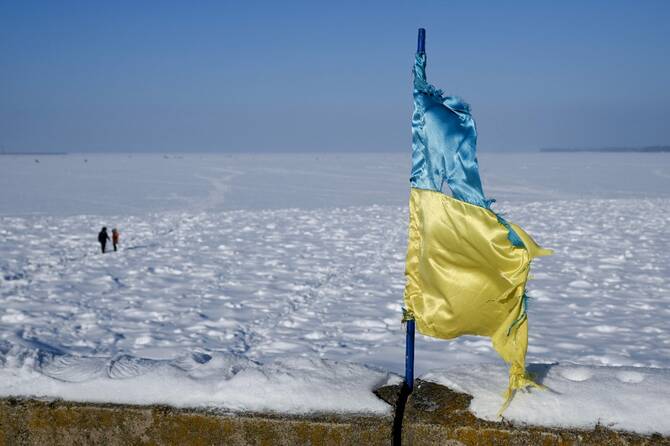
A damaged Ukrainian flag flutters on the embankment as people walk across the frozen Kyiv Reservoir located on the Dnieper north of Kyiv, Ukraine. (AFP)
Short Url
Updated 19 January 2026
Follow

Ukrainians defy cold, Russian strikes at sub-zero street party

  • Moscow has been pummelling Ukraine’s power grid with drones and missiles, plunging millions into darkness and cold as temperatures dip as low as -20C

KYIV: Music blasts from speakers and lights strobe in the dark as revellers, clad in puffer jackets and bobble hats, brave Kyiv’s freezing cold at an outdoor party despite blackouts triggered by Russian strikes.
Moscow has been pummelling Ukraine’s power grid with drones and missiles, plunging millions into darkness and cold as temperatures dip as low as -20C.
“People are tired of sitting without power, feeling sad... It’s a psychological burden on everyone’s mental health,” Olena Shvydka, who threw the street party with the support of her neighbors, told AFP.
“Now we’re letting off some steam, so to speak.”
Across the country, around 58,000 workers were racing to restore power, with additional crews deployed to the capital where, according to Ukrainian President Volodymyr Zelensky, the situation was “extremely tough.”
A massive Russian strike on Kyiv cut off heating to half the city’s apartment buildings earlier this month.
The ongoing hours-long power outages are the worst yet of the war, which will hit the four-year mark next month.
In Shvydka’s building, equipped with a generator, heating is “almost always” there but the blackouts have been dragging on for hours.
“We didn’t have electricity for 18 hours two days ago, then for 17 hours three days ago,” she said. This was when the idea for the street party was born.

- ‘Civilized resistance’ -

“In our community chat, we decided to do something to support the general spirit of our residential complex,” Yevgeniy, Shvydka’s neighbor, told AFP.
“Despite the very difficult situation, people want to hold on and celebrate. And they are waiting for victory no matter what,” said Yevgeniy, a retired military officer who did not give his full name.
When neighbors started setting up generators, mixers and lights, “the temperature was about -10C. Now it’s probably -15C or more,” Shvydka said.
Clutching hot drinks in paper cups, warming around braziers or bopping to the thudding music, the crowd was undeterred, refusing to cave in despite the ongoing Russian invasion.
“What the Russians are trying to do to us is instil fear, anxiety, and hatred,” Olga Pankratova, a mother of three and a former army officer, told AFP.
“These kinds of gatherings provide some kind of civilized resistance to the force that is being directed at us — rockets, explosions, flashes. It unites us,” Pankratova said.
The loudspeakers started blasting Bon Jovi’s “It’s My Life.”
Hands in the air, the revellers belted out the rock anthem’s lyrics.
“It is impossible to defeat these people,” Yevgeniy said, looking around the party.
“The situation is very difficult — but the people are invincible.”



Bangladesh readies for polls, worry among Hasina supporters

Updated 6 sec ago
Follow

Bangladesh readies for polls, worry among Hasina supporters

  • The Muslim-majority nation of 170 million people will hold elections on February 12, its first since the uprising
  • Hasina was sentenced to death for crimes against humanity in Nov. and her former ruling party has been outlawed

Gopalganj: Bangladesh is preparing for the first election since the overthrow of Sheikh Hasina, but supporters of her banned Awami League (AL) are struggling to decide whether to shift their allegiance.

In Gopalganj, south of the capital Dhaka and a strong bastion of Hasina’s iron-grip rule, residents are grappling with an election without the party that shaped their political lives for decades.

“Sheikh Hasina may have done wrong — she and her friends and allies — but what did the millions of Awami League supporters do?” said tricycle delivery driver Mohammad Shahjahan Fakir, 68, adding that he would not vote.

“Why won’t the ‘boat’ symbol be there on the ballot paper?” he said, referring to AL’s former election icon.

The Muslim-majority nation of 170 million people will hold elections on February 12, its first since the uprising.

Hasina, who crushed opposition parties during her rule, won landslide victories in Gopalganj in every election since 1991.

After a failed attempt to cling to power and a brutal crackdown on protesters, she was ousted as prime minister in August 2024 and fled to India.

She was sentenced to death in absentia for crimes against humanity by a court in Dhaka in November, and her former ruling party, once the country’s most popular, has been outlawed.

Human Rights Watch has condemned the AL ban as “draconian.”

“There’s so much confusion right now,” said Mohammad Shafayet Biswas, 46, a banana and betel leaf seller in Gopalganj.

“A couple of candidates are running from this constituency — I don’t even know who they are.”

As a crowd gathered in the district, one man shouted: “Who is going to the polling centers? We don’t even have our candidates this time.”

‘DEHUMANISE’

Hasina’s father, Sheikh Mujibur Rahman, the founding president of Bangladesh, hailed from Gopalganj and is buried in the town.

Statues of Rahman have been torn down nationwide, but in Gopalganj, murals and statues are well-maintained.

Since Hasina’s downfall, clashes have broken out during campaigning by other parties, including one between police and AL supporters in July 2025, after which authorities filed more than 8,000 cases against residents.

Sazzad Siddiqui, a professor at Dhaka University, believes voter turnout in Gopalganj could be the lowest in the country.

“Many people here are still in denial that Sheikh Hasina did something very wrong,” said Siddiqui, who sat on a government commission formed after the 2025 unrest.

“At the same time, the government has constantly tried to dehumanize them.”

This time, frontrunners include candidates from the Bangladesh Nationalist Party (BNP) and Jamaat-e-Islami, the country’s largest religious party.

Both are from Hasina’s arch-rivals, now eyeing power.

“I am going door to door,” BNP candidate S.M Zilany, 57, told AFP, saying many would-be voters had never had a candidate canvass for their backing.

“I promise them I will stand by them.”

Zilany said he had run twice against Hasina — and was struck down by 34 legal cases he claimed had been politically motivated.

This time, he said that there was “a campaign to discourage voters from turning up.”

Jamaat candidate M.M Rezaul Karim, 53, said that under Hasina, the party had been driven underground.

“People want a change in leadership,” Karim told AFP, saying he was open to all voters, whatever their previous loyalties.

“We believe in coexistence; those involved in crimes should be punished; others must be spared,” Karim said.

Those once loyal to Hasina appear disillusioned. Some say they had abandoned the AL, but remain unsure whom to support.

“I am not going to vote,” said one woman, who asked not to be named.

“Who should I vote for except Hasina? She is like a sister.”