

Transavia France will launch flights to Madinah

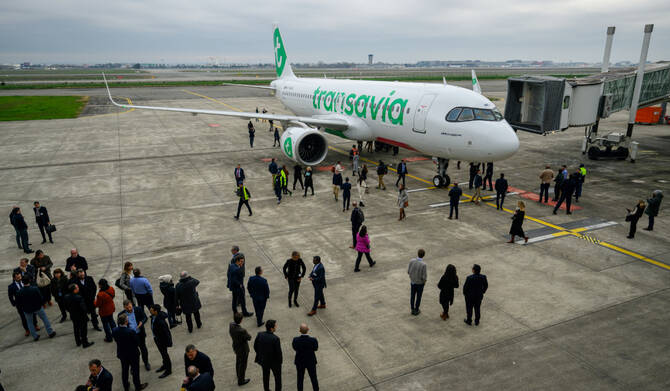
Staff and attendees walk around an Airbus A230neo aircraft during a delivery event to low-cost carrier Transavia, in Toulouse, southwestern France, on January 10, 2024. (AFP)
Short Url
Updated 18 April 2025
Follow

Transavia France will launch flights to Madinah

  • CEO of the Air Connectivity Program Majid Khan described the development of air connectivity between France and Saudi Arabia as a fundamental pillar of the National Tourism Strategy

RIYADH: The Air Connectivity Program, in partnership with the Al Madinah Region Development Authority, has announced the expansion of Transavia France’s travel services to Saudi Arabia.

Beginning in October, new routes will be launched from Paris-Orly, Lyon, Marseille, and Toulouse to Madinah.

This expansion complements the successful launch last year of routes connecting Paris-Orly and Lyon with Jeddah, enhancing air connectivity and reflecting the growth in travel demand between the two countries.

It also underscores the Kingdom’s position as a major destination and supports the tourism goals of Saudi Vision 2030 by increasing the number of tourists to the Kingdom.

CEO of the Air Connectivity Program Majid Khan described the development of air connectivity between France and Saudi Arabia as a fundamental pillar of the National Tourism Strategy.

He highlighted that this expansion will help capitalize on the significant opportunities in France’s Umrah market, while supporting the Kingdom’s tourism objectives.

CEO of Tibah Airports Operation Co. Sofiene Abdessalem stated that the selection of Madinah among Transavia France’s new destinations confirms the city’s religious and cultural status, while underlining the efforts made to enhance its presence on the international air connectivity map.

Chief Commercial Officer of Transavia France Nicolas Henin said the airline is excited to start flights to Madinah and strengthen its ongoing partnership with Saudi airports.


Saudi kitchen to provide 24,000 daily meals to Palestinians in Gaza

Updated 27 February 2026
Follow

Saudi kitchen to provide 24,000 daily meals to Palestinians in Gaza

  • The kitchen plans to produce 3,600,000 meals to Palestinians in central Gaza and to enable the employment of 40 local workers
  • Dr. Abdullah Al-Rabeeah, the general supervisor of KSrelief, said that 90 percent of Gaza’s population is below the poverty line, lacking access to food, water, and medicine

RIYADH: King Salman Humanitarian Aid and Relief Center, also known as KSrelief, established a central kitchen in the Gaza Strip to support the Palestinian people as part of Saudi Arabia’s humanitarian efforts.

The Saudi kitchen has begun providing 24,000 daily hot meals since the start of Ramadan last week for Palestinians in the central Gaza towns of Deir Al-Balah and Al-Qarara.

The initiative is part of the Saudi Popular Campaign for the Relief of the Palestinian People in the Gaza Strip, in cooperation with the Saudi Center for Culture and Heritage.

At the end of the initiative period, the kitchen will have produced and distributed 3,600,000 meals to Palestinians in central Gaza and enabled the employment of 40 local workers, according to the Saudi Press Agency.

Dr. Abdullah Al-Rabeeah, the general supervisor of KSrelief, told SPA that the humanitarian crisis in the Gaza Strip is “one of the largest crises in the history of humanity.”

He highlighted that Palestinians are facing displacement and urgent humanitarian needs, with 90 percent of Gaza’s population below the poverty line, lacking access to food, water, medicine, and necessities for children and infants.

Saudi Arabia was one of the first countries to launch an air bridge, as well as sea and land convoys, sending aid to Gaza via over 80 planes and dozens of vessels, through the Jordanian and Egyptian crossings.

Dr. Al-Rabeeah noted that KSrelief used airdrops to deliver aid to Gaza after October 2023, when other means were not possible, the SPA added.

He said the Saudi kitchen will serve over 36,000 families and described it as “the largest central kitchen available for a group of displaced people.”