Nine Nigerian troops killed, several missing in jihadist ambush

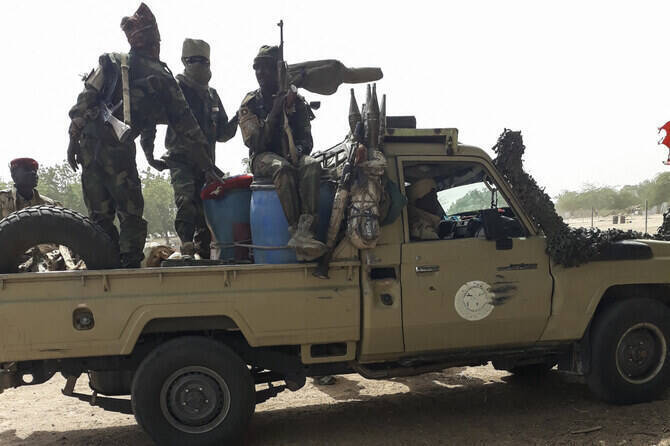
At least nine Nigerian soldiers were killed and over a dozen are missing after Daesh-aligned militants ambushed a military patrol in northeast Borno state, military and militia sources told AFP Tuesday. (AFP/File)
Short Url
Updated 28 January 2026
Follow

Nine Nigerian troops killed, several missing in jihadist ambush

  • “We lost nine soldiers in an ambush by Daesh-WAP terrorists and many others are still missing,” a military officer said
  • The soldiers dispersed in all directions following sustained gunfire from the militants

KANO, Nigeria: At least nine Nigerian soldiers were killed and over a dozen are missing after Daesh-aligned militants ambushed a military patrol in northeast Borno state, military and militia sources told AFP Tuesday.
Fighters from Daesh West Africa Province (Daesh-WAP) on Friday used explosives and guns to attack a column of more than 30 troops on foot patrol outside the town of Damask near the border with Niger, the sources said.
“We lost nine soldiers in an ambush by Daesh-WAP terrorists and many others are still missing,” a military officer said.
The soldiers, who were 25 kilometers (15 miles) from their base, dispersed in all directions following sustained gunfire from the militants, said the officer who asked not to be identified.
“The terrorists detonated an explosive device they had planted on the road in advance, increasing the casualties and confusion among the soldiers,” he said.
Eight soldiers managed to return to base while the rest remain missing, including their commander with the rank of a major, the officer said.
“A man who identified himself as an Daesh-WAP terrorist keeps answering the call to the commander’s mobile phone, suggesting he is in the hands of the terrorists,” he added.
Ya-Mulam Kadai, a spokesman for government-funded anti-militant militia assisting the military in Damask, gave the same casualty toll.
The nine bodies of the slain soldiers were recovered by a military search team deployed at the scene of the attack, he said.
The military did not respond to AFP’s request for comment.
The Nigerian military has in recent weeks intensified ground operations against Daesh-WAP, particularly in its Sambisa forest stronghold, with the military making regular claims of killing huge numbers of militant fighters.
Daesh-WAP and rival Boko Haram factions have been attacking military targets, raiding bases, laying ambush and planting explosives against patrols on highways.
Nigeria’s insurgency has killed more than 40,000 people and displaced around two million in the northeast since it erupted in 2009, according to the United Nations.
The conflict has spilled into neighboring Niger, Cameroon and Chad, leading the region to launch a military coalition to fight the militant groups.


Greenland villagers focus on ‘normal life’ amid stress of US threat

Updated 4 sec ago
Follow

Greenland villagers focus on ‘normal life’ amid stress of US threat

  • Proudly showing off photographs on her tablet of her grandson’s first hunt, Dorthe Olsen refuses to let the turmoil sparked by US president Donald Trump take over her life
SARFANNGUIT: Proudly showing off photographs on her tablet of her grandson’s first hunt, Dorthe Olsen refuses to let the turmoil sparked by US president Donald Trump take over her life in a small hamlet nestled deep in a Greenland fjord.
Sarfannguit, founded in 1843, is located 36 kilometers (22 miles) east of El-Sisimiut, Greenland’s second-biggest town, and is accessible by boat in summer and snowmobile or dogsled in winter if the ice freezes.
The settlement has just under 100 residents, most of whom live off from hunting and fishing.
On this February day, only the wind broke the deafening silence, whipping across the scattering of small colorful houses.
Most of them looked empty. At the end of a gravel road, a few children played outdoors, rosy-cheeked in the bitter cold, one wearing a Spiderman woolly hat.
“Everything is very calm here in Sarfannguit,” said Olsen, a 49-year-old teacher, welcoming AFP into her home for coffee and traditional homemade pastries and cakes.
In the background, a giant flat screen showed a football match from England’s Premier League.
Olsen told AFP of the tears of pride she shed when her grandson killed his first caribou at age 11, preferring to talk about her family than about Trump.
The US president has repeatedly threatened to seize the mineral-rich island, an autonomous territory of Denmark, alleging that Copenhagen is not doing enough to protect it from Russia and China.
He nevertheless climbed down last month and agreed to negotiations.
Greenland’s health and disability minister, Anna Wangenheim, recently advised Greenlanders to spend time with their families and focus on their traditions, as a means of coping with the psychological stress caused by Trump’s persistent threats.
The US leader’s rhetoric “has impacted a lot of people’s emotions during many weeks,” Wangenheim told AFP in Nuuk.
’Powerless’
Olsen insisted that the geopolitical crisis — pitting NATO allies against each other in what is the military alliance’s deepest crisis in years — “doesn’t really matter.”
“I know that Greenlanders can survive this,” she said.
Is she not worried about what would happen to her and her neighbors if the worst were to happen — a US invasion — especially given her settlement’s remote location?
“Of course I worry about those who live in the settlements,” she said.
“If there’s going to be a war and you are on a settlement, of course you feel powerless about that.”
The only thing to do is go on living as normally as possible, she said, displaying Greenland’s spirit of resilience.
That’s the message she tries to give her students, who get most of their news from TikTok.
“We tell them to just live the normal life that we live in the settlement and tell them it’s important to do that.”
The door opened. It was her husband returning from the day’s hunt, a large plastic bag in hand containing a skinned seal.
Olsen cut the liver into small pieces, offering it with bloodstained fingers to friends and family gathered around the table.
“It’s my granddaughter’s favorite part,” she explained.
Fishing and hunting account for more than 90 percent of Greenland’s exports.
No private property
Back in El-Sisimiut after a day out seal hunting on his boat, accompanied by AFP, Karl-Jorgen Enoksen stressed the importance of nature and his profession in Greenland.
He still can’t get over the fact that an ally like the United States could become so hostile toward his country.
“It’s worrying and I can’t believe it’s happening. We’re just trying to live the way we always have,” the 47-year-old said.
The notion of private property is alien to Inuit culture, characterised by communal sharing and a deep connection to the land.
“In Greenlandic tradition, our hunting places aren’t owned. And when there are other hunters on the land we are hunting on, they can just join the hunt,” he explained.
“If the US ever bought us, I can for example imagine that our hunting places would be bought.”
“I simply just can’t imagine that,” he said, recalling that his livelihood is already threatened by climate change.
He doesn’t want to see his children “inherit a bad nature — nature that we have loved being in — if they are going to buy us.”
“That’s why it is we who are supposed to take care of OUR land.”