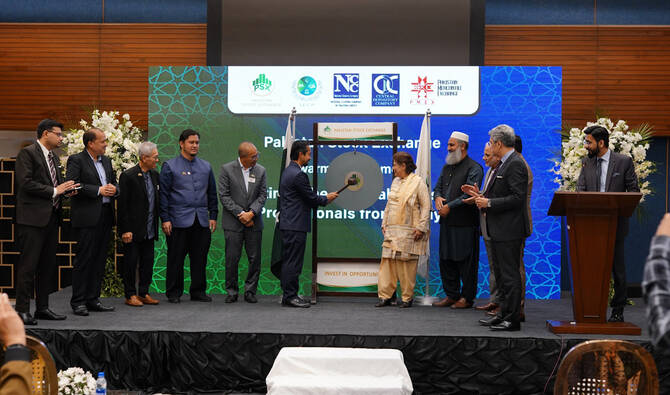
KARACHI: The Pakistan Stock Exchange (PSX) on Thursday welcomed a delegation of Malaysian Shariah scholars and professionals as the country seeks to advance its Islamic finance sector and foster cross-border collaboration between Shariah-compliant capital markets.
PSX and the Securities and Exchange Commission of Pakistan (SECP) have been striving in recent years to promote an Islamic capital market and create the enabling environment for the growth of Shariah-compliant investment.
Shariah lays down certain principles with regard to financial contracts and the conduct of business and trading in general. In particular, Shariah prohibits any transaction that involves an element of interest (riba). In order to ensure Shariah compliance of a product or service, it must be free from such prohibited elements and conform to other requirements of Shariah. Various stock exchanges, including PSX, have designed and launched products and services that cater to the specific requirements of Shariah.
PSX lists Shariah-compliant shares, sukuk (Islamic bonds), Islamic Exchange Traded Funds (Islamic ETFs), and Islamic Real Estate Investment Trusts (Islamic REITs). It is also deemed permissible as per Shariah for investors to subscribe to the Initial Public Offerings (IPOs) of Shariah-compliant securities. In addition, PSX offers Shariah-compliant indices comprised of shares of listed companies that meet certain predefined Shariah and technical screening criteria. A Shariah compliant facility to finance the purchase of shares is also available, through the National Clearing Company of Pakistan Limited (NCCPL), called Murabahah Share Finance.
Welcoming the visiting delegation from Malaysia, PSX Chairperson Dr. Shamshad Akhtar expressed hope for greater collaboration between the Islamic finance sectors of the two countries.
“Pakistan is also witnessing a growing demand for Shariah-compliant investment avenues,” PSX quoted Akhtar as telling the delegation. “With over 50% of listed companies on the exchange being Shariah-compliant, PSX offers a compelling platform for faith-based investments, including equities, sukuk, Islamic mutual funds, and ETFs.”
Since launching its first Ijarah-based Sukuk in 2008, Pakistan has issued Ijarah sukuk worth over Rs6.5 trillion as of August 2024.%
“The continued expansion of Islamic finance institutions, diversified asset classes, and investor-friendly regulatory frameworks are contributing to the sector’s momentum,” the PSX statement added.
Tariq Naseem, Head of Islamic Finance at SECP, provided an in-depth briefing to the visiting dignitaries regarding the progress and advancements in Islamic finance within Pakistan’s capital markets and non-banking financial sectors, particularly regulatory reforms and developments in the Islamic financial services industry undertaken to cater to both local and international market needs. The discussion also addressed the potential for enhanced collaboration between Malaysia and Pakistan in promoting Islamic finance on a global platform.
Farrukh H. Sabzwari, Managing Director and CEO of the Pakistan Stock Exchange, expressed his aspiration to benefit from Malaysia’s expertise in Islamic finance for the advancement of Pakistan’s capital market.
Sabzwari said only 0.14% of Pakistan’s population constituted the investor base, compared to 1% in Bangladesh, underscoring the significant potential for growth. He said approximately 80% of daily transactions at PSX were Sharia-compliant.
“Concluding the event, PSX management reaffirmed the Exchange’s dedication to building a robust Shariah-compliant capital market while highlighting the efforts of the PSX Shariah Focus Group — a multi-stakeholder platform comprising industry leaders, Shariah scholars, and financial experts — working collectively to foster an inclusive, faith-based financial system,” the PSX statement added.
Pakistan’s government has failed to achieve a target set by the central bank to increase the share of Islamic banking deposits in the country by 50% by January this year, according to official documents seen by Arab News this week, as Islamabad attempts to rid the country’s banking system of interest.
Pakistan’s Federal Shariat Court (FSC) directed the government in April 2022 to eliminate interest by 2027. Following the order, the government and the State Bank of Pakistan have taken several measures ranging from changing laws in October 2024 to issuing sukuk bonds to replace interest-based treasury bills and investment bonds.
According to a presentation shared by the SBP with bankers in August 2024, a copy of which Arab News has seen, the central bank set an “indicative target” for the government to increase the share of Islamic banking deposits to 50% by January 2025, 65% by January 2026, 80% by January 2027 and 100% by December 2027.
Pakistan, however, missed this target and was able to increase the market share of its Shariah-compliant banking deposits to only 24.9% by December 2024, the document stated.


![]()

Pakistan Stock Exchange seeks Islamic finance expertise from Malaysia
Short Url
https://arab.news/r43qz
Pakistan Stock Exchange seeks Islamic finance expertise from Malaysia
- PSX welcomes delegation of Malaysian scholars to foster collaboration between Shariah-compliant capital markets
- Since launching first Ijarah-based sukuk in 2008, Pakistan has issued Ijarah sukuk worth over Rs6.5 trillion as of August 2024
Latest updates


© 2026 SAUDI RESEARCH & PUBLISHING COMPANY, All Rights Reserved And subject to Terms of Use Agreement.