

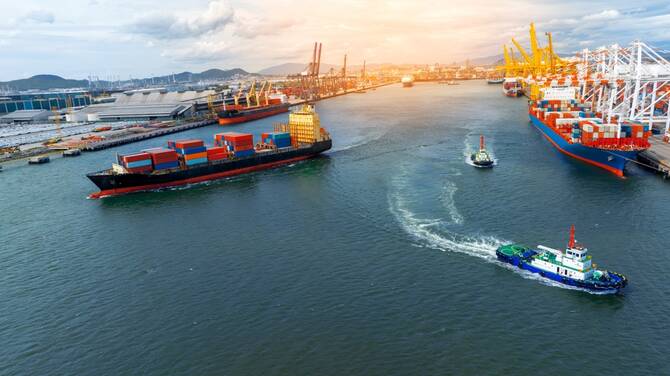
Saudi Mawani achieves a 10.58% YoY increase in container handling during 2025

Transshipment containers achieved an 11.78 percent rise, to reach 1.9 million standard containers, compared to 1.7 million standard containers in the same period last year. Shutterstock.
Short Url
Updated 13 January 2026
Follow

Saudi Mawani achieves a 10.58% YoY increase in container handling during 2025

RIYADH: Saudi ports supervised by the Saudi Ports Authority, or Mawani, have recorded a 10.58 percent year-on-year increase in the number of containers handled during 2025 by 10.58 percent to reach 8.3 million standard containers, compared to 7.5 million standard containers last year.

Transshipment containers achieved an 11.78 percent rise, to reach 1.9 million standard containers, compared to 1.7 million standard containers in the same period last year.

The total number of outgoing containers rose by 11.72 percent to reach 3.1 million twenty-foot equivalent units, compared to 2.8 million TEUs, while the total number of incoming containers increased by 8.82 percent to reach 3.2 million TEUs, compared to 2.9 million TEUs last year.

The total tonnage handled, general cargo, solid bulk cargo, and liquid bulk cargo, recorded an increase of 1.06 percent, reaching 242 million tonnes compared to 239 million tonnes in 2024. The total general cargo amounted to 12 million tonnes, liquid bulk cargo to 176 million tonnes, and solid bulk cargo to 53 million tonnes.

Passenger numbers increased by 47.07 percent to reach 1.8 million passengers, compared to 736,177 passengers last year.

Shipping traffic decreased by 17.98 percent to reach 9,508 ships, compared to 11,592 during the same period last year.

The number of vehicles decreased by 4.92 percent to reach 1.03 million, compared to 1.08 million last year.

Ports received 8.9 million head of cattle, a decrease of 7.55 percent compared to 9.7 million during the same period last year.

The increase in the number of containers handled contributes to several economic benefits, including boosting trade and stimulating industries and sectors related to maritime transport.

It also contributes to fostering growth in tourism, maritime activity, and associated services, supporting supply chains, as well as the Kingdom’s food security, in line with the objectives of the National Transport and Logistics Strategy to solidify Saudi Arabia’s position as a global logistics hub.

It is worth noting that the ports overseen by Mawani achieved a 12.5 percent increase in the number of containers handled during December, reaching 800,089 TEUs, compared to 711,170 TEUs in 2024.

Transshipment containers also saw a 19.25 percent increase, reaching 188,995 TEUs, compared to 158,491 TEUs during the same period last year.


Inaugural EU–Saudi roundtable on critical raw materials reflects shared policy commitment

Updated 4 sec ago
Follow

Inaugural EU–Saudi roundtable on critical raw materials reflects shared policy commitment

RIYADH: The EU–Saudi Arabia Business and Investment Dialogue on Advancing Critical Raw Materials Value Chains, held in Riyadh as part of the Future Minerals Forum, brought together senior policymakers, industry leaders, and investors to advance strategic cooperation across critical raw materials value chains.

Organized under a Team Europe approach by the EU–GCC Cooperation on Green Transition Project, in coordination with the EU Delegation to Saudi Arabia, the European Chamber of Commerce in the Kingdom and in close cooperation with FMF, the dialogue provided a high-level platform to explore European actions under the EU Critical Raw Materials Act and ResourceEU alongside the Kingdom’s aspirations for minerals, industrial, and investment priorities.

This is in line with Saudi Vision 2030 and broader regional ambitions across the GCC, MENA, and Africa.

ResourceEU is the EU’s new strategic action plan, launched in late 2025, to secure a reliable supply of critical raw materials like lithium, rare earths, and cobalt, reducing dependency on single suppliers, such as China, by boosting domestic extraction, processing, recycling, stockpiling, and strategic partnerships with resource-rich nations.

The first ever EU–Saudi roundtable on critical raw materials was opened by the bloc’s Ambassador to the Kingdom, Christophe Farnaud, together with Saudi Deputy Minister for Mining Development Turki Al-Babtain, turning policy alignment into concrete cooperation.

Farnaud underlined the central role of international cooperation in the implementation of the EU’s critical raw materials policy framework.

“As the European Union advances the implementation of its Critical Raw Materials policy, international cooperation is indispensable to building secure, diversified, and sustainable value chains. Saudi Arabia is a key partner in this effort. This dialogue reflects our shared commitment to translate policy alignment into concrete business and investment cooperation that supports the green and digital transitions,” said the ambassador.

Discussions focused on strengthening resilient, diversified, and responsible CRM supply chains that are essential to the green and digital transitions.

Participants explored concrete opportunities for EU–Saudi cooperation across the full value chain, including exploration, mining, and processing and refining, as well as recycling, downstream manufacturing, and the mobilization of private investment and sustainable finance, underpinned by high environmental, social, and governance standards.

From the Saudi side, the dialogue was framed as a key contribution to the Kingdom’s industrial transformation and long-term economic diversification agenda under Vision 2030, with a strong focus on responsible resource development and global market integration.

“Developing globally competitive mineral hubs and sustainable value chains is a central pillar of Saudi Vision 2030 and the Kingdom’s industrial transformation. Our engagement with the European Union through this dialogue to strengthen upstream and downstream integration, attract high-quality investment, and advance responsible mining and processing. Enhanced cooperation with the EU, capitalizing on the demand dynamics of the EU Critical Raw Materials Act, will be key to delivering long-term value for both sides,” said Al-Babtain.

Valere Moutarlier, deputy director-general for European industry decarbonization, and directorate-general for the internal market, industry, entrepreneurship and SMEs at European Commission, said the EU Critical Raw Materials Act and ResourceEU provided a clear framework to strengthen Europe’s resilience while deepening its cooperation with international partners.

“Cooperation with Saudi Arabia is essential to advancing secure, sustainable, and diversified critical raw materials value chains. Dialogues such as this play a key role in translating policy ambitions into concrete industrial and investment cooperation,” she added.