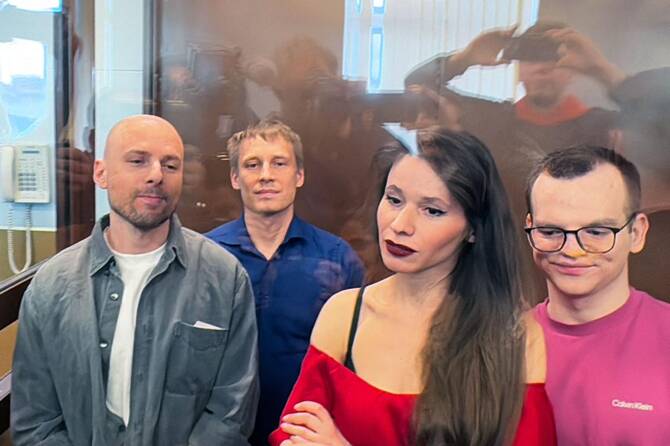
MOSCOW: A Russian court on Tuesday convicted four journalists of extremism for working for an anti-corruption group founded by the late opposition leader Alexei Navalny and sentenced them to 5 1/2 years in prison each.
Antonina Favorskaya, Kostantin Gabov, Sergey Karelin and Artyom Kriger were found guilty of involvement with a group that had been labeled as extremist. All four had maintained their innocence, arguing they were being prosecuted for doing their jobs as journalists.
The closed-door trial was part of an unrelenting crackdown on dissent that has reached an unprecedented scale after Moscow sent troops into Ukraine in February 2022.
The authorities have targeted opposition figures, independent journalists, rights activists and ordinary Russians critical of the Kremlin with prosecution, jailing hundreds and prompting thousands to flee the country.
Favorskaya and Kriger worked with SotaVision, an independent Russian news outlet that covers protests and political trials. Gabov is a freelance producer who has worked for multiple organizations, including Reuters. Karelin, a freelance video journalist, has done work for Western media outlets, including The Associated Press.
The four journalists were accused of working with Navalny’s Foundation for Fighting Corruption, which was designated as extremist and outlawed in 2021 in a move widely seen as politically motivated.
Navalny was President Vladimir Putin’s fiercest and most prominent foe and relentlessly campaigned against official corruption in Russia. Navalny died in February 2024 in an Arctic penal colony while serving a 19-year sentence on a number of charges, including running an extremist group, which he had rejected as politically driven.
Favorskaya said at an earlier court appearance open to the public that she was being prosecuted for a story she did on abuse Navalny faced behind bars. Speaking to reporters from the defendants’ cage before the verdict, she also said she was punished for helping organize Navalny’s funeral.
Gabov, in a closing statement prepared for court that was published by the independent Novaya Gazeta newspaper, said the accusations against him were groundless and the prosecution failed to prove them.
“I understand perfectly well ... what kind of country I live in. Throughout history, Russia has never been different, there is nothing new in the current situation,” Gabov said in the statement. “Independent journalism is equated to extremism.”
In a statement Karelin prepared for his closing arguments that also was published by Novaya Gazeta, he said he had agreed to do street interviews for Popular Politics, a YouTube channel founded by Navalny’s associates, while trying to provide for his wife and a young child. He stressed that the channel wasn’t outlawed as extremist and had done nothing illegal.
“Remorse is considered to be a mitigating circumstance. It’s the criminals who need to have remorse for what they did. But I am in prison for my work, for the honest and impartial attitude to journalism, FOR THE LOVE for my family and country,” he wrote in a separate speech for court that also was published by the outlet, in which he emphasized his feelings in capital letters.
Kriger, in a closing statement published by SotaVision, said he was imprisoned and added to the Russian financial intelligence’s registry of extremists and terrorists “only because I have conscientiously carried out my professional duties as an honest, incorruptible and independent journalist for 4 1/2 years.”
“Don’t despair guys, sooner or later it will end and those who delivered the sentence will go behind bars,” Kriger said after the verdict.
Supporters who gathered in the court building chanted and applauded as the four journalists were led out of the courtroom after the verdict.
The Russian human rights group Memorial designated all four as political prisoners, among more than 900 others held in the country. That number includes Mikhail Kriger, Artyom Kriger’s uncle, a Moscow-based activist who was arrested in 2022 and is serving a seven-year prison sentence.
Mikhail Kriger was convicted of justifying terrorism and inciting hatred over Facebook comments in which he expressed a desire “to hang” Putin.


![]()

Four journalists who were accused of working for Kremlin foe Navalny are convicted of extremism
Short Url
https://arab.news/mn4c5
Four journalists who were accused of working for Kremlin foe Navalny are convicted of extremism
- All four maintained their innocence, arguing they were being prosecuted for doing their job as journalists
- The closed-door trial was part of an unrelenting crackdown on dissent that has reached an unprecedented scale after Moscow sent troops into Ukraine in February 2022


Latest updates


Recommended


© 2026 SAUDI RESEARCH & PUBLISHING COMPANY, All Rights Reserved And subject to Terms of Use Agreement.