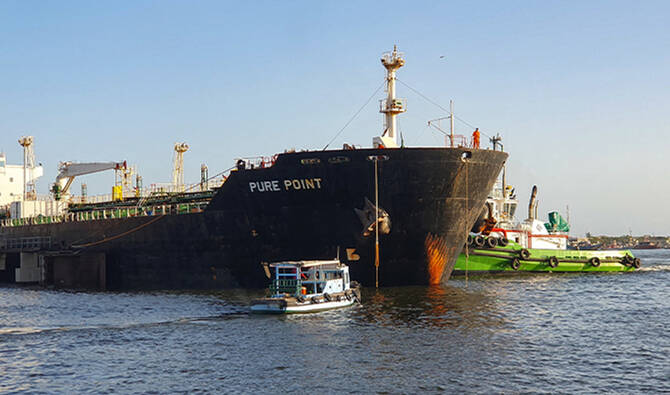
KARACHI: Pakistan is considering importing crude oil from the United States for the first time to offset a trade imbalance that triggered higher US tariffs, according to a government source directly involved with the proposal and a refinery executive.
Countries are scrambling to find ways to lower their US tariff burdens, including buying more US oil and gas, as President Donald Trump’s sweeping import duties rattle economies and markets.
“It is one of the products being reviewed ahead of a delegation leaving for the US to talk about tariffs,” said a government source directly involved with the proposal to the prime minister to buy more US crude.
“It is under active consideration. We are exploring opportunities and the structure to do it, but the PM has to approve it,” he said.
Trump has imposed a 10 percent baseline tariff on all imports to the US and higher duties on dozens of other countries. Pakistan faces a 29 percent tariff due to a trade surplus with the US of about $3 billion, although that is subject to the 90-day pause Trump announced last week.
The refinery executive told Reuters that the idea is to buy US crude equivalent to Pakistan’s current imports of oil and refined products, or about $1 billion of oil.
The sources declined to be named as the proposal is in its preliminary stage.
Pakistan’s petroleum ministry did not immediately respond to a request for comment.
Pakistan imported 137,000 barrels per day of crude in 2024, mostly light grades from the Middle East, with Saudi Arabia and the United Arab Emirates among its top suppliers, data from analytics firm Kpler showed. Oil imports amounted to $5.1 billion in 2024, data from Pakistan’s central bank showed.
In February, Saudi Arabia, through the Saudi Fund for Development (SFD), extended a $1.2 billion financing facility to Pakistan for the import of oil products for a year. The SFD has provided approximately $6.7 billion to Islamabad for oil products since 2019.
Before Trump’s partial tariff pause last week, Pakistan said that it would send a delegation to the US in the coming weeks to negotiate new tariffs.
Several big energy importers are looking to buy more from the US to ease trade surpluses.
Last Friday, Indian state gas firm GAIL India Ltd. issued a tender to buy a 26 percent stake in a US liquefied natural gas (LNG) project and import LNG, while Japan, South Korea and Taiwan have discussed participating in an LNG project in the US state of Alaska.

Pakistan mulls US oil imports to ease trade imbalance
https://arab.news/9cuf8
Pakistan mulls US oil imports to ease trade imbalance
- Pakistan said that it would send a delegation to the US in the coming weeks to negotiate new tariffs
- Countries are scrambling to find ways to lower their US tariff burdens, including buying more US oil and gas
Pakistan says military operation concluded in Balochistan, 216 militants killed
- Separatist BLA militant group claimed responsibility for coordinated attacks across Balochistan last week
- Military says 36 civilians, 22 law enforcement and security forces personnel have been killed in attacks
PESHAWAR: Pakistani forces have concluded a security operation in the southwestern Balochistan province and killed 216 militants after a series of coordinated attacks by separatist militants last week, the military’s media wing said on Thursday.
Separatist militant group Baloch Liberation Army (BLA) claimed responsibility for a series of attacks in Balochistan last Friday and Saturday in multiple districts across the province, one of the deadliest flare-ups in the area in recent years.
Pakistan military’s media wing, the Inter-Services Public Relations (ISPR), said security forces launched operations in Panjgur and Harnai district’s outskirts on Jan. 29 based on intelligence confirming the presence of “terrorist elements,” killing 41 militants.
It said the military launched a broader series of intelligence-based operations in multiple areas of the province after that to dismantle “terrorist sleeper cells,” referring to it as “Operation Radd-ul-Fitna-1.”
“As a result of these well-coordinated engagements and subsequent clearance operations, 216 terrorists have been sent to hell, significantly degrading the leadership, command-and-control structures and operational capabilities of terrorist networks,” the ISPR said in a statement.
The military said 36 civilians, including women and children, were killed by militants while 22 security forces and law enforcement personnel also lost their lives.
The ISPR said a substantial cache of foreign-origin weapons, ammunition, explosives and equipment were also recovered during the counteroffensive operations.
“Preliminary analysis indicates systematic external facilitation and logistical support to these extremist proxies,” the statement said.
The military said Pakistan’s armed forces remain steadfast in their resolve to combat “terrorism,” vowing that counterterror operations will continue until militants are completely eliminated.
“Operation Radd-ul-Fitna-1 stands as a testament to Pakistan’s and particularly Balochistan’s proud peoples’ unwavering commitment to always prefer peace over violence, unity over division and development over violence,” the ISPR said.
Pakistan’s government has accused India of being behind the militant attacks in Balochistan, charges that New Delhi has rejected as “baseless.”
Balochistan, Pakistan’s largest province by land area, has long faced a separatist insurgency that has intensified in recent years. Militants frequently target security forces, government officials, infrastructure projects, foreigners and non-local workers.
The province holds vast reserves of minerals and hydrocarbons and is central to the multibillion-dollar China-Pakistan Economic Corridor (CPEC), a flagship component of China’s Belt and Road Initiative.
Separatist groups such as the BLA accuse Islamabad of exploiting Balochistan’s natural resources while denying locals a fair share. Pakistan’s civilian and military leadership reject the claim and say they are investing in the province’s development.