

No intention of responding to tariffs imposed by Trump administration — Pakistan finance minister

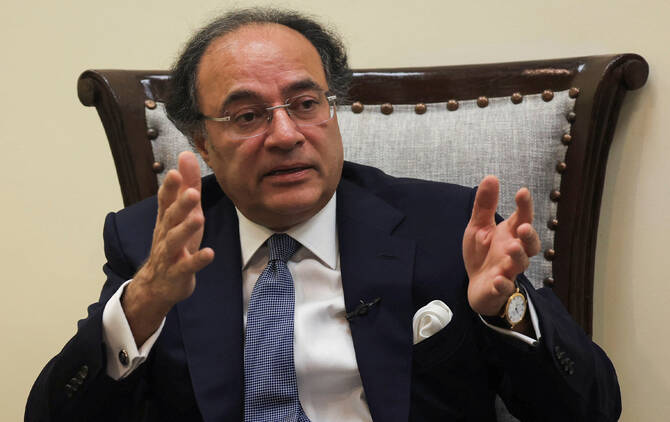
Pakistan’s Finance Minister Muhammad Aurangzeb speaks during an interview at his office in Islamabad, Pakistan on July 19, 2024. (Reuters/File)
Short Url
Updated 14 April 2025
Follow

No intention of responding to tariffs imposed by Trump administration — Pakistan finance minister

  • Islamabad was slapped with 29% tariff rate before Trump’s 90-day temporary pause 
  • 10% blanket duty on almost all US imports will remain in effect, the White House has said

ISLAMABAD: Pakistani Finance Minister Muhammad Aurangzeb has said Islamabad was concerned about new tariffs imposed by the US administration of President Donald Trump but had no intentions of imposing reciprocal taxes, BBC reported on Sunday.

Islamabad would have been slapped with a 29% tariff rate before Trump’s temporary suspension announcement on Wednesday. A 10% blanket duty on almost all US imports will remain in effect, the White House has said.

“There is a minimum tariff of 10% and then there is an additional tariff, I think we need to talk about this issue,” Aurangzeb said in an interview to the BBC. 

In response to a question about reciprocal tariffs, he said: “If your question is whether we are going to give any response [to the US] in return, the answer is no.”

“There is a situation of uncertainty, and we all have to think about how to move forward with this new world order,” the finance minister added. 

When asked if he felt Pakistan was losing out in the tug-of-war between the US and China, he said Washington had been a “strategic partner” of Pakistan for a long time, not just in trade but also in other sectors, while relations with China were important in their own right. 

A study by the Pakistan Institute of Development Economics (PIDE) entitled ‘Impact of Unilateral Tariff Increase by United States on Pakistani Exports’ said this month when added to the existing 8.6% Most Favored Nation (MFN) tariff, the total duty after the imposition of the 29% tariff could reach 37.6%. This would likely result in a 20-25% decline in Pakistani exports to the US, translating into an annual loss of $1.1-1.4 billion, with the textile sector bearing the brunt of the blow.

The textile sector in Pakistan generates about $17 billion in exports and is the largest employer in the country, according to the Pakistan Textile Council. The industry is expected to face significant challenges from the tariffs, with potential losses of up to $2 billion in textile exports estimated by experts if the 29% tariff rate is reinstated after Trump’s 90-day pause ends.

Despite the risks, the PIDE reports also view the tariffs crisis as an “opportunity for strategic transformation.” 

In the short term, it recommended that Pakistan engage in high-level diplomatic efforts to highlight the mutual costs of the tariffs and preserve long-standing trade relations. In the long term, it called for the need to diversify both export products and markets, seeing destinations such as the European Union, China, Asean nations, Africa and the Middle East as offering growth potential in sectors like IT, halal food, processed foods and sports goods.


Oman to establish international financial center to drive economic vision

Updated 10 sec ago
Follow

Oman to establish international financial center to drive economic vision

RIYADH: Oman is set to establish an International Financial Center, in a move to diversify the national economy and position the nation as a leading global hub.

According to a press release, the new establishment aims to draw international investment, advance innovation across various services, and strengthen Oman’s standing in the global financial ecosystem. It will function with full administrative, regulatory, and legislative autonomy from its headquarters in Madinat Al Irfan.

With a legal decree now in place, the coming months will focus on finalizing the regulatory framework, engaging stakeholders, and establishing operational structures.

The aim is to launch the center’s activities and commence full operations before the end of the year, marking a significant milestone in realizing Oman Vision 2040.

Officials hailed the decree as a transformative step. The president of the Oman Investment Authority stated that the center reflects the Sultan’s vision to “create an attractive investment environment” and will provide a “secure and transparent” hub distinguished by stability and efficiency.

“The aspiration is that the center will become a strategic destination and a source of capital inflows,” Abdulsalam Mohammed Al-Murshidi added, linking it directly to Oman’s broader goals of economic diplomacy and diversification.

A key feature of IFC Oman is its legal foundation. It will develop a comprehensive regulatory and judicial framework aligned with international standards and based on English Common Law, a system trusted by global investors and institutions.

To ensure robust and transparent governance, the establishment will be overseen by an IFC Oman board appointed by Sultan Haitham bin Tariq.

Three independent entities will operate under the law: an authority for management, a regulator for oversight, and a dispute resolution authority to handle legal matters.

Aiming to be a magnet for investment, IFC Oman will offer a compelling package of incentives for qualifying firms, including tax exemptions for up to 50 years. The center plans to focus initially on financial activities and their supporting sectors.

Mahmood Abdullah Al-Aweini, chairman of the IFC Oman Executive Committee, positioned the move as a natural progression following Oman’s recent credit rating improvements. He emphasized that IFC Oman will offer competitive costs, regulatory agility, and reliable services to ease business establishment and global market access.

“Together with our strategic partners, we aim to work toward bringing this ambitious vision into reality,” Al-Aweini said, expressing confidence in the center’s future.
