


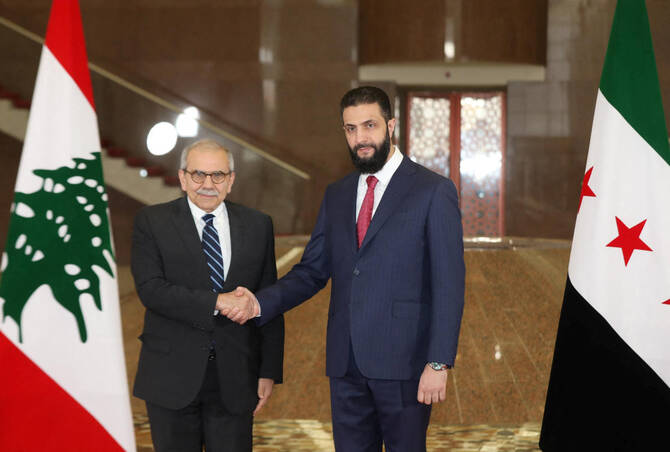


BEIRUT: Syrian President Ahmad Al-Sharaa held a meeting on Monday with Lebanese Prime Minister Nawaf Salam at the People’s Palace in Damascus.
It was Salam’s first official trip to Damascus, and the second visit by a Lebanese prime minister after Najib Mikati traveled in January, following the fall of Bashar Assad’s regime and the rise to power of Hayat Tahrir Al-Sham under the leadership of Al-Sharaa.
It comes ahead of Lebanese President Joseph Aoun’s official two-day visit to Doha on Tuesday, following a formal invitation from Qatar Emir Sheikh Tamim bin Hamad Al-Thani.
An official source told Arab News that Salam’s Syria visit aims “to explore a new path for correcting relations, based on mutual respect for each country’s sovereignty, and to establish and reinforce stability.”
The visit’s agenda includes unresolved issues between the two countries.
Salam was accompanied by Foreign Minister Youssef Rajji, Defense Minister Michel Menassa, and Interior Minister Ahmad Hajjar.
At the end of March, Saudi Arabia sponsored an agreement in Jeddah between Menassa and his Syrian counterpart Murhaf Abu Qasra.
The agreement addressed border issues following bloody clashes between smugglers, which escalated into confrontations between members of the new Syrian authority and armed Lebanese tribe members in overlapping villages in eastern Lebanon.
It prompted the Lebanese military to intervene, deploy reinforcements to stop the clashes, shut down illegal crossings, and later form a liaison committee to monitor the agreement’s implementation and prevent violations.
A joint operations room is planned to enhance security, reduce smuggling, and set up army monitoring points along the border to ensure stability in preparation for demarcation.
During the meeting between the Lebanese and Syrian defense ministers in Jeddah, also attended by Saudi Defense Minister Khalid bin Salman, it was decided that they would return to Riyadh soon to assess the situation.
The agreement signed by the two ministers emphasized “the strategic importance of demarcating the borders between Lebanon and Syria.”
It also called for the formation of legal and specialized committees in various fields, along with the activation of coordination mechanisms to tackle security and military challenges, especially regarding any developments along their shared border.
The border between Lebanon and Syria spans 375 km and features a geographical intertwining of mountains, slopes, and plains. Notably, there are no visible markers indicating where one country ends and the other begins.
Six official border crossings connect the two nations, while numerous unofficial crossings exist in the north and east.
Over the years, Hezbollah exploited these unofficial routes, transforming them into areas of influence for smuggling weapons, money, people, and drugs.
Before his departure to Damascus, Salam met in Beirut with Arab League Secretary-General Ahmed Aboul Gheit, who was in the Lebanese capital to participate in the opening of the Sustainable Development Forum, which was held in partnership with the UN Economic and Social Commission for Western Asia.
The Prime Minister’s media office reported that Aboul Gheit emphasized the depth of Lebanese-Arab relations, as the Arab world has consistently stood by Lebanon during times of crisis.
“We have highlighted the importance of Lebanon committing to its reform agenda. This includes providing necessary support to Arab countries to uphold Lebanon’s sovereignty, exerting pressure on Israeli forces to withdraw from southern Lebanon, and ensuring that the Lebanese state has full authority over its territory,” the office said.
The forum addressed developments in the Gaza Strip, calling for an immediate end to Israeli military operations.
It also tackled the ongoing Arab and international efforts to uphold the principles of the 2002 Arab League Summit in Beirut, which endorsed a two-state solution to the Israeli-Palestinian conflict.
Prime Minister Salam reviewed bilateral agreements during his discussions with Syrian leaders in Damascus.
Other issues include canceling the Lebanese-Syrian Higher Council, addressing the border issue in preparation for demarcation through a joint committee under Riyadh’s sponsorship, and the matter of Syrian refugee repatriation.
Deputy Prime Minister Tarek Mitri has developed a plan to expedite the return of 400,000 refugees if an agreement is reached with Damascus.
The discussion includes investment agreements in agriculture, transit, oil and gas, which aim to transform both countries into secure export platforms for Arab goods.
The case of the missing Lebanese persons in Syrian prisons is also on the agenda, as well as the situation of detained Syrians in Lebanese jails, who currently account for about 45 percent of the total prison population in Lebanon, contributing to overcrowding in the cells.


