

Thousands remain displaced in Jenin as Israeli military campaign continues for 84th day

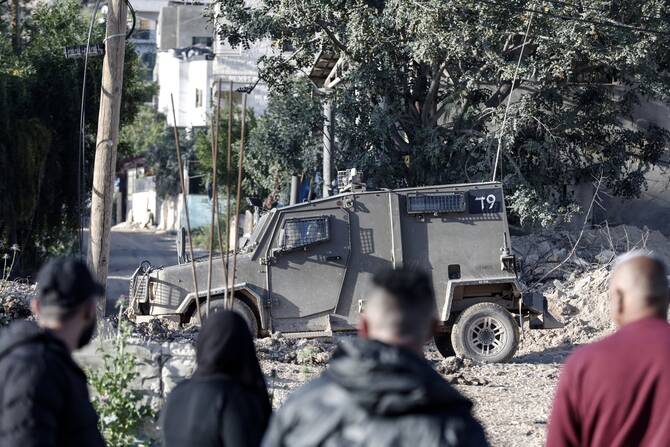
An Israeli military vehicle is parked outside the martyrs cemetery in Jenin refugee camp while Palestinians try to visit the tombs of relatives, Mar. 30, 2025.
Short Url
Updated 14 April 2025
Follow

Thousands remain displaced in Jenin as Israeli military campaign continues for 84th day

  • 6,000 people remain displaced within Jenin city, while 3,200 have sought refuge in the dormitories of the Arab American University
  • Discussions with the Palestinian Authority are ongoing to provide mobile homes for displaced residents

LONDON: Israeli forces have continued operations in Jenin and its refugee camp for the 84th day, with homes being bulldozed and burned while some have been converted into military positions.

On Monday morning, Israeli forces detained two Palestinians from the village of Yamoun, located west of Jenin, after storming the town and conducting raids on homes, WAFA news agency reported.

Israeli forces deployed infantry units around Al-Amal Hospital and Al-Rabi Building on Al-Mahta Street, near the Jenin refugee camp, conducting raids in the area, WAFA added.

Jenin Governor Kamal Abu Al-Rub said 21,000 people remain displaced as a result of the Israeli military campaign, with 6,000 residents sheltering within Jenin city. At the same time, 3,200 people sought refuge in the dormitories of the Arab American University, and 4,181 individuals found shelter in Burqin village. Abu Al-Rub said discussions with the Palestinian Authority are ongoing to provide mobile homes for the displaced residents in Jenin.

Over the weekend, Israeli forces sent reinforcements and armored vehicles into Jenin and its refugee camp, including D10 bulldozers and infantry. Israeli forces conduct military training near the Jalameh checkpoint, north of Jenin, and occasionally fire live ammunition toward the deserted Jenin camp, WAFA reported.


UN-sanctioned migrant smuggler killed in western Libya

Updated 58 min 5 sec ago
Follow

UN-sanctioned migrant smuggler killed in western Libya

  • Libyan authorities report that a notorious militia leader, Ahmed Oumar Al-Fitouri Al-Dabbashi, was killed in a raid by security forces on Friday
  • In 2018, the UN and US sanctioned him for controlling migrant departure areas and exposing migrants to fatal conditions

CAIRO: A notorious militia leader in Libya, sanctioned by the UN for migrant trafficking across the Mediterranean Sea, was killed on Friday in a raid by security forces in the west of the country, according to Libyan authorities.
Ahmed Oumar Al-Fitouri Al-Dabbashi, nicknamed Ammu, was killed in the western city of Sabratha when security forces raided his hideout. The raid came in response to an attack on a security outpost by Al-Dabbashi’s militia, which left six members of the security forces severely wounded, according to a statement issued by the Security Threat Enforcement Agency, a security entity affiliated with Libya’s western government.
Al-Dabbashi, who was also sanctioned by the US Treasury for trafficking, was the leader of a powerful militia, the “Brigade of the Martyr Anas Al-Dabbashi,” in Sabratha, the biggest launching point in Libya for Europe-bound African migrants.
Al-Dabbashi’s brother Saleh Al-Dabbashi, another alleged trafficker, was arrested in the same raid, added the statement.
In June 2018, the UN Security Council imposed sanctions on Al-Dabbashi, along with another five Libyan traffickers. At the time, the UN report said that there was enough evidence that Al-Dabbashi’s militia controlled departure areas for migrants, camps, safe houses and boats.
Al-Dabbashi himself exposed migrants, including children, to “fatal circumstances” on land and at sea, and of threatening peace and stability in Libya and neighboring countries, according to the same report.
Al-Dabbashi was also sanctioned by the US Treasury for the same reason.
Libya has been a main transit point for migrants fleeing war and poverty in Africa and the Middle East. The country was plunged into chaos following a NATO-backed uprising that toppled and killed longtime autocrat Muammar Qaddafi in 2011.
The country has been fragmented for years between rival administrations based in the east and the west of Libya, each backed by various armed militias and foreign governments.