

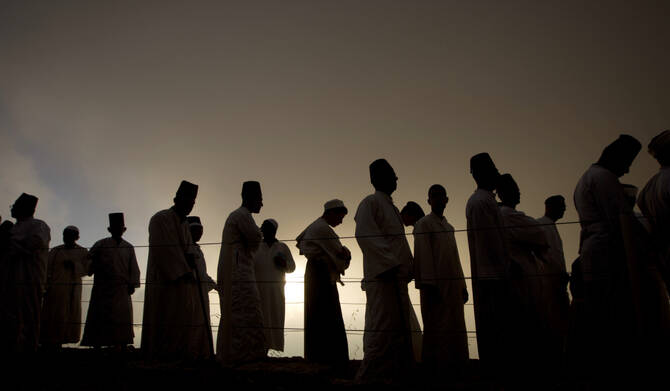

GERIZIM, Palestinian Territories: Wearing white overalls and red fez hats, dozens of Samaritan men slaughtered sheep for Passover Friday as prayers in ancient Hebrew echoed across Mount Gerizim in the Israeli-occupied West Bank.
A group of priests in colorful robes recited the sacred verses as younger men in white caps herded the sheep.
“What’s happening here is something that we’ve been doing for 3,600 years,” 30-year-old Abood Cohen told AFP.
Dressed in butcher’s whites, the young Samaritan wore a smudge of sheep’s blood on his forehead as he explained the traditions of his small religious community that developed alongside Judaism.
According to their tradition, Samaritans are descended from Israelites and view Jews as close, yet distinct, relatives.
Many Christians recognize the name through the parable of the Good Samaritan.
“Every family has to bring one sheep,” Cohen said. The animal is then slaughtered and cooked on Mount Gerizim near the West Bank city of Nablus.
“Why do we do it here in Gerizim? Because the holiest place on earth is Mount Gerizim for the Samaritans,” he said.
The community believes this is the place where Abraham almost sacrificed his son for God.
Like Jews, Samaritans celebrate the Israelites’ freedom from slavery in Egypt at Passover.
“The Samaritans’ Passover is the festival of freedom, the festival of independence, of the forgiveness of our Lord for the children of Israel,” Khader Adel Najer Cohen, a priest and director of the Samaritan Studies Center, told AFP.
But the ritual slaughter, as well as the fact that the community’s holiest site is Gerizim, not the Temple Mount in Jerusalem, are two elements that set Samaritans apart from Jews.
Passover is also the time for two Samaritan communities to come together, Abood Cohen said.
Out of 880 Samaritans, half live in Gerizim and speak mostly Arabic, while the other half have lived in the Tel Aviv suburb of Holon since the early 20th century, and speak mostly Hebrew.
“They get involved in the Israeli culture more, so they might speak Hebrew more than us,” said Abood Cohen, who works as a tour guide.
Yefet Tsedaka, a Samaritan priest from Holon and editor of a Samaritan community magazine, highlighted the communities’ shared heritage.
“We in Holon are just a branch of the Gerizim, because the high priest is here,” he said.
Sitting next to him, Hosni Wasef Cohen, priest and director of the Samaritan museum, concurred.
“As Samaritans, we all come together here to make the sacrifice. There is no difference between Samaritans here and in Holon.”
Gerizim’s Samaritans have historically strong ties with Palestinians, and some hold political office in nearby Nablus.
But since the war in Gaza and heightened tensions in the West Bank have led to movement restrictions for Palestinians, crowds were smaller this year.
“It’s very different (this year). If there were no war, there would be many guests coming from Nablus — our friends, and our friends from the government would come to Nablus and the Israelis too, and they would all gather here,” said Jameel Samri, a Samaritan priest.
“We hope there will be peace and that everyone can come and see” next year, he added.
Hod, a Holon Samaritan who did not wish to share his last name for privacy reasons, told AFP that “because of the situation we need to reduce the amount of the Arabs that come here.”
A worker in the high-tech sector, Hod added that “we want to be good with the Israel side, because we are Israelis.”
But priest Khader Cohen lamented the distance that the war and the movement restrictions had brought to the communities.
“We used to love that the Palestinians and Israelis would participate with us and celebrate together, because we are a bridge of love and peace between peoples,” he told AFP.


