

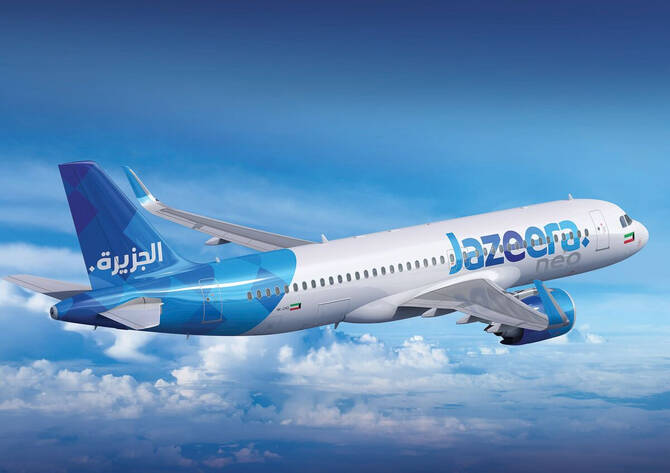
Kuwait’s Jazeera Airways introduces ‘fly now, pay later’ option

The launch highlights increasing collaboration between airlines and financial technology firms in the Gulf, as carriers introduce more flexible payment options within their booking platforms. File
Short Url
Updated 22 February 2026
Follow

Kuwait’s Jazeera Airways introduces ‘fly now, pay later’ option

RIYADH: Kuwaiti low-cost carrier Jazeera Airways has introduced a “fly now, pay later” payment option, partnering with local fintech firm deema to offer interest-free installment payments.

The airline said the new payment solution allows passengers to split flight costs into two to four installments through deema, Kuwait’s first licensed buy-now, pay-later platform, providing greater flexibility for travelers amid rising demand for digital payment options. 

The integration is embedded into Jazeera Airways’ booking platform, enabling instant eligibility checks at checkout and allowing customers to complete purchases without additional financing steps, according to a press release.

The launch highlights increasing collaboration between airlines and financial technology firms in the Gulf, as carriers introduce more flexible payment options within their booking platforms. 

Barathan Pasupathi, CEO of Jazeera Airways, said: “At Jazeera Airways, we are committed to lowering the barriers to travel through agile digital innovation. By achieving our fastest-ever payment integration with deema, we are not just adding a payment method; we are providing a seamless, Kuwaiti homegrown financial solution.”  

He added: “This partnership empowers our passengers to ‘fly now and pay later’ with absolute ease, reinforcing our mission to make travel accessible to everyone.” 

The system currently supports transactions in Kuwaiti dinars, with the airline receiving the full booking amount upfront while deema handles customer repayments. 

“We are very excited to partner with Jazeera Airways as the first airline in Kuwait to introduce the deema solution. This was one of the quickest integrations achieved - thanks to the fast moving and talented team at Jazeera Airways,” said Bader Al-Ghanim, head of innovation and partnerships at deema.  

He added: “This project truly demonstrates the airline’s ability to rapidly deploy customer-centric solutions to meet the evolving needs of its tech-savvy travelers.” 

Jazeera Airways said the partnership forms part of a wider effort to expand its digital ecosystem and support Kuwait’s growing fintech sector by working with local technology providers. 

The airline added that the “fly now, pay later” offering is among several planned digital initiatives aimed at improving customer experience across its expanding route network. 


European gas prices soar almost 50% as Iran conflict halts Qatar LNG output

Updated 02 March 2026
Follow

European gas prices soar almost 50% as Iran conflict halts Qatar LNG output

  • Analysts warn prolonged disruption could push prices higher
  • Some shipments of oil, LNG through Strait of Hormuz suspended
  • Benchmark Asian LNG price up almost 39 percent

LONDON: ​Benchmark Dutch and British wholesale gas prices soared by almost 50 percent on Monday, after major liquefied natural gas exporter Qatar Energy said it had halted production due to attacks in the Middle East.

Qatar, soon to cement its role as the world’s second largest LNG exporter after the US, plays a major role in balancing both Asian and European markets’ demand of LNG.

Most tanker owners, oil majors and ‌trading houses ‌have suspended crude oil, fuel and liquefied natural ​gas shipments ‌via ⁠the ​Strait of ⁠Hormuz, trade sources said, after Tehran warned ships against moving through the waterway.

Europe has increased imports of LNG over the past few years as it seeks to phase out Russian gas following Russia’s invasion of Ukraine.

Around 20 percent of the world’s LNG transits through the Strait of Hormuz and a prolonged suspension or full closure would increase global competition for other ⁠sources of the gas, driving up prices internationally.

“Disruptions to ‌LNG flows would reignite competition between ‌Asia and Europe for available cargoes,” said ​Massimo Di Odoardo, vice president, gas ‌and LNG research at Wood Mackenzie.

The Dutch front-month contract at the ‌TTF hub, seen as a benchmark price for Europe, was up €14.56 at €46.52 per megawatt hour, or around $15.92/mmBtu, by 12:55 p.m. GMT, ICE data showed.

Prices were already some 25 percent higher earlier in the day but extended gains ‌after QatarEnergy’s production halt.

Benchmark Asian LNG prices jumped almost 39 percent on Monday morning with the S&P Global ⁠Energy Japan-Korea-Marker, widely used ⁠as an Asian LNG benchmark, at $15.068 per million British thermal units, Platts data showed.

“If LNG/gas markets start to price in an extended period of losses to Qatari LNG supply, TTF could potentially spike to 80-100 euros/MWh ($28-35/mmBtu),” Warren Patterson, head of commodities strategy at ING, said. The British April contract was up 40.83 pence at 119.40 pence per therm, ICE data showed.

Europe is also relying on LNG imports to help fill its gas storage sites which have been depleted over the winter and are currently around 30 percent full, the latest data from Gas Infrastructure ​Europe showed. In the European carbon ​market, the benchmark contract was down €1.10 at €69.17 a tonne