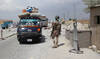
BIHSUD: Afghans gathered around a mass grave Sunday to bury villagers killed in overnight air strikes by Pakistan, which said its military targeted militants.
The overnight attacks killed at least 18 people and were the most extensive since border clashes in October, which left more than 70 dead on both sides and wounded hundreds.
“The house was completely destroyed. My children and family members were there. My father and my sons were there. All of them were killed,” said Nezakat, a 35-year-old farmer in Bihsud district, who only gave one name.
Islamabad said it hit seven sites along the border region targeting Afghanistan-based militant groups, in response to suicide bombings in Pakistan.
The military targeted the Pakistani Taliban and its associates, as well as an affiliate of the Daesh group, a statement by the Ministry of Information and Broadcasting said.
Afghan government spokesperson Zabihullah Mujahid said “people’s homes have been destroyed, they have targeted civilians, they have committed this criminal act” with the bombardment of Nangarhar and Paktika provinces.
Residents from around the remote Bihsud district in Nangarhar joined searchers to look for bodies under the rubble, an AFP journalist said, using shovels and a digger.
“People here are ordinary people. The residents of this village are our relatives. When the bombing happened, one person who survived was shouting for help,” said neighbor Amin Gul Amin, 37.
Nangarhar police told AFP the bombardment started at around midnight and hit three districts, with those killed all in a civilian’s house.
“Twenty-three members of his family were buried under the rubble, of whom 18 were killed and five wounded,” said police spokesperson Sayed Tayeeb Hammad.
Strikes elsewhere in Nangarhar wounded two others, while in Paktika an AFP journalist saw a destroyed guesthouse but there were no immediate reports of casualties.
- ‘Calculated response’ -
Afghanistan’s defense ministry said it will “deliver an appropriate and calculated response” to the Pakistani strikes.
The two countries have been locked in an increasingly bitter dispute since the Taliban authorities retook control of Afghanistan in 2021.
Pakistani military action killed 70 Afghan civilians between October and December, according to the UN mission in Afghanistan.
Several rounds of negotiations followed an initial ceasefire brokered by Qatar and Turkiye, but they have failed to produce a lasting agreement.
Saudi Arabia intervened this month, mediating the release of three Pakistani soldiers captured by Afghanistan in October.
The deteriorating relationship has hit people in both countries, with the land border largely shut for months.
Pakistan said Sunday that despite repeated urging by Islamabad, the Taliban authorities have failed to act against militant groups using Afghan territory to carry out attacks in Pakistan.
The Afghan government has denied harboring militants.
Islamabad launched the strikes after a suicide blast at a Shiite mosque in Islamabad two weeks ago and other such attacks more recently in northwestern Pakistan.
The Daesh group had claimed responsibility for the mosque bombing, which killed at least 40 people and wounded more than 160 in the deadliest attack in Islamabad since 2008.
The militant group’s regional chapter, Islamic State-Khorasan, also claimed a deadly suicide bombing at a Kabul restaurant last month.


Afghans mourn villagers killed in Pakistani strikes

https://arab.news/9c4rr
Afghans mourn villagers killed in Pakistani strikes

- Afghans gathered around a mass grave Sunday to bury villagers killed in overnight air strikes by Pakistan, which said its military targeted militants


Saudi ambassador becomes first foreign envoy to meet Bangladesh’s new PM
- Tarique Rahman took oath as PM last week after landslide election win
- Ambassador Abdullah bin Abiyah also meets Bangladesh’s new FM
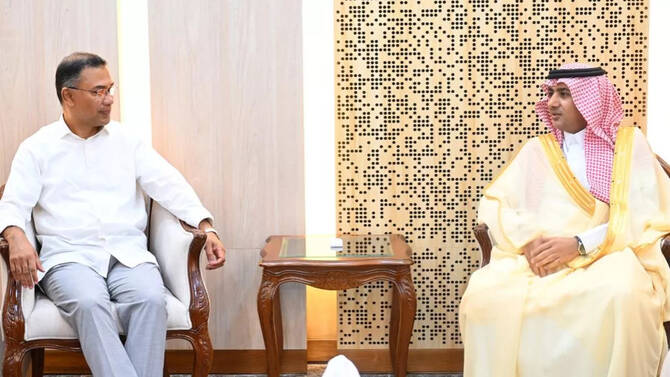
Dhaka: Saudi Arabia’s ambassador to Dhaka became on Sunday the first foreign envoy to meet Bangladesh’s new Prime Minister Tarique Rahman since he assumed the country’s top office.
Rahman’s Bangladesh Nationalist Party made a landslide win in the Feb. 12 election, securing an absolute majority with 209 seats in the 300-seat parliament.
The son of former Prime Minister Khaleda Zia and former President and BNP founder Ziaur Rahman, he was sworn in as the prime minister last week.
The Saudi government congratulated Rahman on the day he took the oath of office, and the Kingdom’s Ambassador Abdullah bin Abiyah was received by the premier in the Bangladesh Secretariat, where he also met Bangladesh’s new foreign minister.
“Among the ambassadors stationed in Dhaka, this is the first ambassadorial visit with Prime Minister Tarique Rahman since he assumed office,” Saleh Shibli, the prime minister’s press secretary, told Arab News.
“The ambassador conveyed greetings and best wishes to Bangladesh’s prime minister from the king and crown prince of Saudi Arabia … They discussed bilateral matters and ways to strengthen the ties among Muslim countries.”
Rahman’s administration succeeded an interim government that oversaw preparations for the next election following the 2024 student-led uprising, which toppled former leader Sheikh Hasina and ended her Awami League party’s 15-year rule.
New Cabinet members were sworn in during the same ceremony as the prime minister last week.
Foreign Minister Khalilur Rahman is a former UN official who served as Bangladesh’s national security adviser during the interim government’s term.
He received Saudi Arabia’s ambassador after the envoy’s meeting with the prime minister.
“The foreign minister expressed appreciation for the Saudi leadership’s role in promoting peace and stability in the Middle East and across the Muslim Ummah. He also conveyed gratitude for hosting a large number of Bangladeshi workers in the Kingdom and underscored the significant potential for expanding cooperation across trade, investment, energy, and other priority sectors, leveraging the geostrategic positions of both countries,” the ministry said in a statement.
“The Saudi ambassador expressed his support to the present government and his intention to work with the government to enhance the current bilateral relationship to a comprehensive relationship.”
Around 3.5 million Bangladeshis live and work in Saudi Arabia. They have been joining the Saudi labor market since 1976, when work migration to the Kingdom was established during the rule of the new prime minister’s father.
Bangladeshis are the largest expat group in the Kingdom and the largest Bangladeshi community outside Bangladesh and send home more than $5 billion in remittances every year.