

Pakistan to provide Hajj pilgrims high-speed train service in Kingdom this year

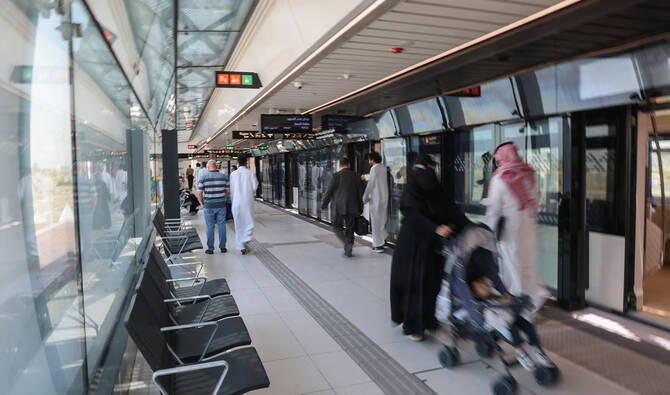
People exit a metro train at King Saud University station in Riyadh on April 27, 2025. (AFP/ file)
Short Url
Updated 22 February 2026
Follow

Pakistan to provide Hajj pilgrims high-speed train service in Kingdom this year

  • Several thousand Pakistani pilgrims will use Haramain High-Speed Railway which will reduce Makkah, Madinah travel times
  • Pakistan will send 179,210 pilgrims for Hajj 2026 as training, accommodation and logistical arrangements enter final phase

ISLAMABAD: Pakistan will provide Hajj pilgrims high-speed train service between the holy cities of Makkah and Madinah this year, the country’s religion ministry said on Sunday, as Islamabad’s preparations for Hajj 2026 enter their final phase.

The Haramain High-Speed Railway connects Makkah and Madinah via Jeddah and King Abdullah Economic City along a 453-kilometer railway line and operates some of the world’s fastest passenger trains, with speeds of up to 300 kilometers an hour.

This year 179,210 pilgrims from Pakistan will perform Hajj, according to the religious affairs ministry. Of these, 119,210 pilgrims will travel under the government scheme, while 60,000 will go through private tour operators, with applications processed on a first-come, first-served basis.

“This year the Haramain High-Speed Railway will be offered for the first time to several thousand Pakistani pilgrims on trial basis,” Muhammad Umar Butt, a Pakistani religious affairs ministry spokesman, told Arab News.

“The exact number will be released later.”

The pilot project will also include travel from hotel to train stations and luggage service, according to the official. Pakistani pilgrims are usually provided buses to commute between the two holy cities, which takes six to eight hours. The train service will reduce this duration to less than 2 and half hours.

Butt said Pakistan’s preparations for the annual pilgrimage were in final stages and the first Hajj flight will leave for the Kingdom in the mid of April.

He urged pilgrims to join the second phase of mandatory trainings which will begin after Eid Al-Fitr.

Pakistan sends one of the world’s largest Hajj contingents each year, requiring months of logistical coordination between Islamabad and Saudi authorities to manage housing in Makkah and Madinah, transport to holy sites and training in religious rites.

Authorities say these trainings are essential because many Pakistani pilgrims travel abroad for the first time and must learn both rituals and administrative procedures before departure.

“A total of 183 training workshops have been conducted [so far] in 107 cities to educate pilgrims about Hajj rituals and administrative matters,” Religious Affairs Secretary Dr. Sajid Mahmood Chauhan said last week, after a meeting to review accommodation, transport, vaccinations and travel documentation for Hajj pilgrims.

Officials said preparations for accommodation and transport in Mina and Arafat as well as food services had entered the final phase, while vaccination, air tickets and visa issuance for Hajj pilgrims would begin soon.

“Makkah and Madinah accommodation has been secured better than last year,” Hajj Director-General Abdul Wahab Soomro told the meeting.


Pakistan’s Senate passes bill to regulate virtual assets, protect investors

Updated 11 min 7 sec ago
Follow

Pakistan’s Senate passes bill to regulate virtual assets, protect investors

  • PVARA chairman terms the approval of bill a ‘defining moment’ for Pakistan’s digital economy
  • Senator says Pakistan will soon be trading major crypto coins such as Bitcoin, Ethereum, XRP

ISLAMABAD: The Senate, the upper house of Pakistan parliament, has passed the Virtual Assets Bill 2026 that paves the way for regulation and supervision of the digital assets sector to protect investors, the Pakistan Virtual Assets Regulatory Authority (PVARA) said on Friday. 

Pakistan has in recent months stepped up efforts to draft rules for regulating the fast-expanding market for digital coins and tokens, requiring virtual asset service providers to secure government approval. Islamabad’s move to embrace digital currency marks a significant policy shift as it had banned cryptocurrency in 2018, citing financial risks.

PVARA will oversee the registration and licensing of virtual asset exchanges, custodians and other service providers, according to the bill. It will set conduct of business requirements, enforce customer protection safeguards and implement measures to combat money-laundering and financial crime.

“The passage of this bill through the Senate represents a defining moment for Pakistan’s digital economy,” PVARA quoted its Chairman Bilal bin Saqib as saying. “We are transforming years of unregulated activity into a transparent, secure, and investor-friendly ecosystem that positions Pakistan as a credible jurisdiction for virtual assets.”

The legislation introduces regulatory provisions, including mandatory licensing for virtual asset service providers, market surveillance mechanisms, anti-money laundering and counter-terrorism financing compliance, and coordination with Pakistani financial regulators, including the State Bank of Pakistan and the Securities and Exchange Commission of Pakistan.

The bill establishes a formal legal framework empowering PVARA to oversee virtual asset service providers and seeks to enhance market transparency by aligning the country’s digital asset regime with international standards. It will now be sent to the National Assembly, lower house of parliament, for approval before being submitted to President Asif Ali Zardari for its enactment into law.

Pakistan ranks among the world’s largest cryptocurrency markets by adoption, with millions of citizens actively engaged in virtual assets. PVARA said the Virtual Assets Bill 2026 provides a legal foundation to channel this organic growth into a regulated framework.

On Wednesday, Dr. Afnanullah Khan, a Pakistani senator from the ruling party, said major crypto coins such as Bitcoin, Ethereum and XRP will soon be traded in Pakistan through crypto exchanges.

Last week, Pakistan launched a crypto testing framework called the “regulatory sandbox” to regulate digital assets, allowing firms to trial new products and services under official supervision. The initiative creates a controlled environment where companies can test crypto-related services under the oversight of PVARA before full-scale approval.

In January, Pakistan signed a memorandum of understanding with a company affiliated with World Liberty Financial, a crypto-based finance platform launched in September 2024 and linked to US President Donald Trump’s family, to explore the use of a dollar-linked Stablecoin for cross-border payments. Stablecoins are cryptocurrencies pegged to a fiat currency to maintain a stable value.