

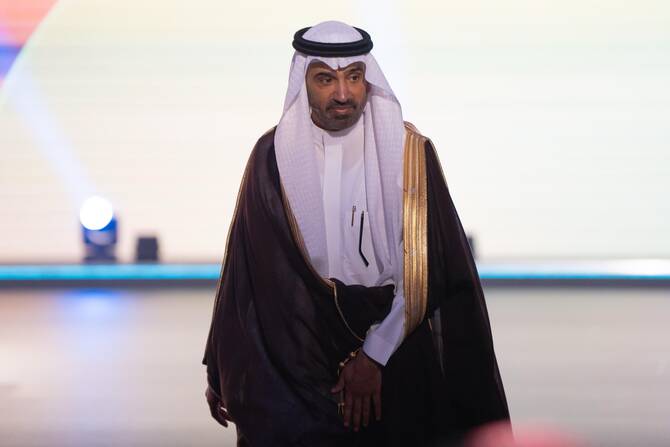

RIYADH: Saudi Arabia has launched a National Skills Platform to equip its workforce with future-ready capabilities and align national talent with global trends, according to a top official.
The Minister of Human Resources and Social Development Ahmed Al-Rajhi made the announcement during his keynote speech at the Human Capabilities Initiative, where he described human capital as “the defining variable of global prosperity.”
He highlighted the Kingdom’s commitment to using advanced technology, specifically artificial intelligence, to modernize and improve its training and workforce development systems.
“We are proud to take another step forward and announce a new initiative, the National Skills Platform, designed ... to empower our workforce and strengthen our national talent base with essential skills for the future,” Al-Rajhi said.
He added: “The platform represents a milestone in our journey that offers a unique and simple, agile journey, ensuring that every employee is equipped to meet the changing requirements of the labor market.”
By leveraging AI, the government aims to create smarter, more efficient training pathways tailored to individuals’ needs and aligned with the demands of local and global labor markets.
“This is part of our responsibility in providing accessible, high-quality training opportunities for all to drive personal growth and national development,” said Al-Rajhi.
The initiative is part of a broader strategy to address global labor shifts driven by AI and automation.
“By 2030, over 92 million jobs will become obsolete as automation and artificial intelligence change the way industries and people operate,” Al-Rajhi stated.
He added: “At the same time, entirely new industries and roles are emerging at an expected rate. The global skills gap is widening, with nearly 40 percent of skills expected to change and 63 percent of their employers already identifying their biggest challenge in finding qualified talent.”
He pointed to specific challenges in the technology sector, particularly in global cybersecurity, which alone faces a talent gap of 3.4 million workers. AI-related roles also remain largely unfilled, with a 50 percent hiring gap.
In response, the Kingdom has adopted a demand-driven workforce strategy.
“We have set up 13 sector skill councils consisting of over 240 million members from public and private sectors. These councils are responsible for identifying skills and job requirements and how to address them,” Al-Rajhi said.
In partnership with the Human Capability Development Program, Saudi Arabia launched the Skills Accelerator Initiative in March 2023 to train more than 300,000 individuals “with expertise in high-growth sectors such as energy, healthcare, finance, and retail.”
A parallel track aimed at women’s employment exceeded its initial target by 22 percent, with a reported 92 percent retention rate among trainees.
Reflecting on the initiative, Al-Rajhi said: “We do this by analyzing what the market needs in collaboration with businesses, educational institutions and experts, then we give access to this training to every individual possible, regardless of their location, by blending virtual learning with hands-on training.”
He continued: “Technical expertise alone is not enough. Leadership, strategic thinking, and adaptability are equally important, and skilling and reskilling for the workforce is a national priority that all stakeholders should engage in.”
The minister also highlighted the Waad National Training Campaign, describing it as an investment in “the promise of human potential.”
Launched in March 2023, Waad delivered over 1 million training opportunities in its first phase. A second phase was introduced in November, aiming to reach 3 million opportunities with support from 16 public and private sector partners.
The initiatives are supported by a growing network of more than 70 training institutions and over 45,000 businesses.
Expanding beyond national borders, Al-Rajhi announced the government has extended its Talent Enrichment Program globally through the Professional Accreditation Program that is enabling professionals in 160 countries to gain globally recognized credentials.
He added: “Our aim is to enhance global workforce mobility and competitiveness with over 1,300 accredited professionals. This initiative recognizes globalization, and it is a demand for global talent development and integration.”
In another announcement during the forum, Saudi Arabia revealed that the National Occupational Safety and Health Institute will be launched during the 7th International Conference on Occupational Safety and Health.
The institute, a partnership between the Technical and Vocational Training Corp. and the National Council for Occupational Safety and Health, aims to train over 35,000 individuals in occupational safety, health, and risk management within five years.

Khalid Al-Sabti, advisor of the General Secretariat of the Council of Ministers and chairman of the Education and Training Evaluation Commission. Screenshot
In a panel session, Khalid Al-Sabti, advisor of the General Secretariat of the Council of Ministers and chairman of the Education and Training Evaluation Commission, emphasized the impact of education quality on economic growth.
“At ETEC, our vision is to become a globally leading and high-impact Saudi model for equality and contribute directly to the national development and economic prosperity,” Al-Sabti said.
He continued: “We partnered with international global organizations to study the impact of education quality to economic growth, and currently, we are finalizing a study with the World Bank, and the findings are very encouraging and promising.”
He stated that if Saudi Arabia improves the quality of its education system to match or exceed global standards, it could see significant improvements in its economic growth, particularly in its annual gross domestic product.
In the past, the emphasis was largely on the number of years students spent in school, based on the assumption that more schooling would lead to stronger economies.
“Traditionally, education, measured by … the years of schooling has been seen as a major driver for economic growth. However, recently, studies show that there is a shift from the education quantity to education quality,” Al-Rajhi said.
He added: “Cognitive skills measured by international exams such as PISA (Program for International Student Assessment) has shown that it’s more important and critical for driving economic growth compared to simply years spent in the school.”


