

Sequestered Suu Kyi overshadows military-run Myanmar election

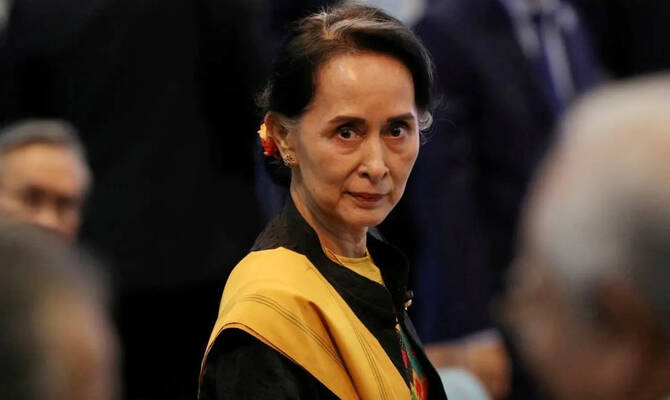
Ousted Myanmar leader Aung San Suu Kyi has been siloed in military detention since a 2021 coup, but her absence looms large over junta-run polls the generals are touting as a return to democracy. (Reuters/File)
Short Url
Updated 11 January 2026
Follow

Sequestered Suu Kyi overshadows military-run Myanmar election

  • Suu Kyi’s reputation abroad has been heavily tarnished over her government’s handling of the Rohingya crisis

YANGON: Ousted Myanmar leader Aung San Suu Kyi has been siloed in military detention since a 2021 coup, but her absence looms large over junta-run polls the generals are touting as a return to democracy.

The Nobel Peace Prize laureate was once the darling of foreign diplomats, with legions of supporters at home and a reputation for redeeming Myanmar from a history of iron-fisted martial rule.

Her followers swept a landslide victory in Myanmar’s last elections in 2020 but the military voided the vote, dissolved her National League for Democracy party and has jailed her in total seclusion.

As she disappeared and a decade-long democratic experiment was halted, activists rose up — first as street protesters and then as guerrilla rebels battling the military in an all-consuming civil war.

Suu Kyi’s reputation abroad has been heavily tarnished over her government’s handling of the Rohingya crisis.

But for her many followers in Myanmar, her name is still a byword for democracy, and her absence on the ballot, an indictment it will be neither free nor fair.

The octogenarian — known in Myanmar as “The Lady” and famed for wearing flowers in her hair — remains under lock and key as her junta jailers hold polls overwriting her 2020 victory. The second of the three-phase election began Sunday, with Suu Kyi’s constituency of Kawhmu outside Yangon being contested by parties cleared to run in the heavily restricted poll.

Suu Kyi has spent around two decades of her life in military detention — but in a striking contradiction, she is the daughter of the founder of Myanmar’s armed forces.

She was born on June 19, 1945, in Japanese-occupied Yangon during the final weeks of WWII.

Her father, Aung San, fought for and against both the British and the Japanese colonizers as he sought to secure independence for his country.



Czech Prime Minister Babiš faces confidence vote as government shifts Ukraine policy

Updated 4 sec ago
Follow

Czech Prime Minister Babiš faces confidence vote as government shifts Ukraine policy

  • “I’d like to make it clear that the Czech Republic and Czech citizens will be first for our government,” Babiš said
  • Babiš has rejected any financial aid for Ukraine and guarantees for EU loans

PRAGUE: The Czech Republic’s new government led by populist Prime Minister Andrej Babiš was set to face a mandatory confidence vote in Parliament over its agenda aimed at steering the country away from supporting Ukraine and rejecting some key European Union policies.
The debate in the 200-seat lower house of Parliament, where the coalition has a majority of 108 seats, began Tuesday. Every new administration must win the vote to govern.
Babiš, previously prime minister in two governments from 2017-2021, and his ANO, or YES, movement, won big in the country’s October election and formed a majority coalition with two small political groups, the Freedom and Direct Democracy anti-migrant party and the right-wing Motorists for Themselves.
The parties, which share admiration for US President Donald Trump, created a 16-member Cabinet.
“I’d like to make it clear that the Czech Republic and Czech citizens will be first for our government,” Babiš said in his speech in the lower house.
The political comeback by Babiš and his new alliance with two small government newcomers are expected to significantly redefine the nation’s foreign and domestic policies.
Unlike the previous pro-Western government, Babiš has rejected any financial aid for Ukraine and guarantees for EU loans to the country fighting the Russian invasion, joining the ranks of Viktor Orbán of Hungary and Robert Fico of Slovakia.
But his government would not abandon a Czech initiative that managed to acquire some 1.8 million much-needed artillery shells for Ukraine only last year on markets outside the EU on condition the Czechs would only administer it but would not contribute money.
The Freedom party sees no future for the Czechs in the EU and NATO, and wants to expel most of 380,000 Ukrainian refugees in the country.
The Motorists, who are in charge of the environment and foreign ministries, rejected the EU Green Deal and proposed revivals of the coal industry.