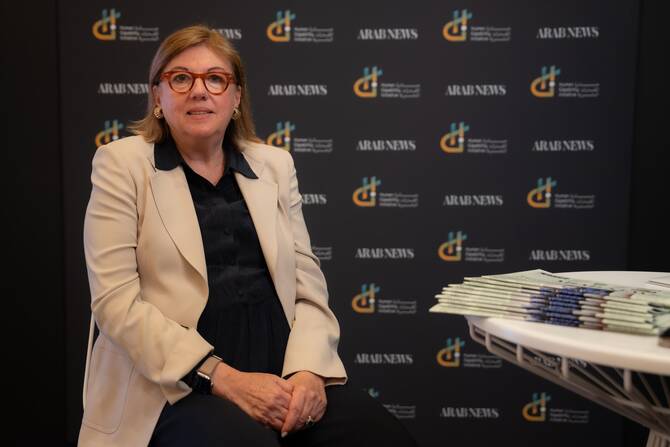

RIYADH: Uzbekistan’s $220 million education reform deal reflects a growing global shift to align schooling systems with economic transformation, according to Global Partnership for Education CEO Laura Frigenti.
Speaking to Arab News on the sidelines of the Human Capability Initiative 2025 in Riyadh, Frigenti said the agreement, signed with the Islamic Development Bank and the Uzbek government, aims to help the country “accelerate that process of transformation.”
Fully aligned with Uzbekistan’s national education strategies, this project aims to enhance the quality and efficiency of the education system while supporting the achievement of the UN’s Sustainable Development Goal 4.
“Uzbekistan is a country that has a very well-functioning, in a way, education system because under the Soviet Union, education was a big priority,” she said.
“At the same time, [it] was a system that was designed thinking about a world that doesn’t exist anymore. And so, because they are moving very quickly at transforming their own education, they do want to have resources to accelerate that process of transformation and that is the sense of, you know, of the project that we signed today,” Frigenti told Arab News.
The $220.25 million “Smart Education” program includes $160.25 million from IsDB, a $40 million grant from GPE, and a $20 million contribution from the Government of Uzbekistan. The project is already under implementation, with early work focused on school construction and partnerships with UNICEF and UNESCO.
“It’s also a project that is part of the process of finding innovative instruments to finance education,” Frigenti said. “Education, as I’m sure you know, is a very expensive type of sector that, until now has been basically mainly funded either through domestic financing or with the development assistance resources.”
Education for growth
Frigenti emphasized that education systems must shift to meet the needs of evolving economies, and focus on producing skills that are needed to make society progress and facilitate process of growth and so on.
Saudi Arabia, she noted, has made significant headway in this area.
“Saudi Arabia has been understanding this connection between skills and economic growth very well and they have invested in this over the past couple of decades significantly,” Frigenti said.
“Other countries need to get to that and so the kind of things that we are trying to do is to see how can this re-alignment of education with the needs of the economy be translated for countries that do not have the same resource base of Saudi Arabia.”
She added: “And this is where we are working on issues related to financing of the sector, efficiency in the administration of the resources, etcetera.”
Women’s workforce gains
Frigenti also highlighted Saudi Arabia’s progress in gender inclusion.
“I think having a very clear political vision that sets a specific target, like 50 percent of the labor force needs to be female, as in the Vision 2030, and then having the ability of designing a set of policies and programs that leads to that results in record time — that is quite an extraordinary result,” she said.
Zooming out, she described the Kingdom’s broader economic transition as strategic and well-resourced.
“Saudi Arabia is a country that has several strong things going for it. First one, there is a clear vision of where the country, you know, needs to go — and the country needs to go toward an economy that is more diversified, that is not depending on fossil fuels and where you know that there is a whole range of new activities that needs to be started and stimulated.”
She added: “The second part is that to be able to get to that different type of economy, you need a different type of skills. You need people that can do different things, people that can work in services, for example, people that can work in manufacturing and so on and so forth.”
The CEO went on to say: “And then you need to have the resources that on one hand create this skill mix and on the other hand, put in place the infrastructures that allow this to happen. That is rather unique.”
Young population
Frigenti sees Saudi Arabia’s youth bulge as a pivotal advantage. “The very young workforce is accessing the labor market and is going through the education system at this time. So all this has been an exceptionally fertile ground for transforming the education system on one side, but the economy on the other in a very quick time.”
She said they had created “a working group, a forum” that brings together ministers of education, heads of major technology companies, and key government players — with Saudi Arabia playing a particularly strong role.
According to her, the Kingdom wanted not only to contribute its experiences but also to learn from others. “Attention to technology and the role it can play in education is something that I feel is going to be very much at the center of the education portion of the Vision 2050,” she said, adding that this would be highly relevant going forward.
She concluded by saying that Saudi Arabia is actively looking to share and absorb best practices globally.
Frigenti also emphasized that Saudi Arabia is eager to engage in a global exchange of best practices — sharing what has worked for them while also learning from successful experiences elsewhere. “They are very keen on having a kind of exchange with the rest of the world around good practice, what works and what doesn’t work,” she said.
“Events like HCI 2025 are just an example,” the CEO concluded.