EU announces $1.7 billion in new aid for Palestinians

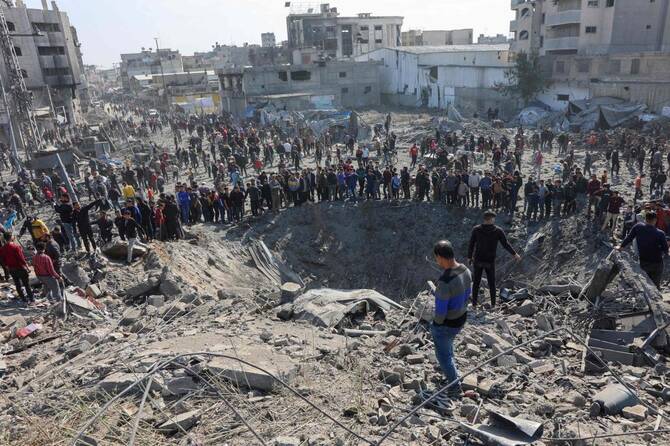
Palestinians gather around a large crater following an Israeli strike on a metalsmith workshop at the Zaytoun neighbouhood in Gaza City on April 13, 2025. (AFP)
Short Url
Updated 14 April 2025
Follow

EU announces $1.7 billion in new aid for Palestinians

LUXEMBOURG: The European Union on Monday announced a new three-year financial support package for the Palestinians worth up to 1.6 billion euros ($1.8 billion).
The fresh aid pledge came just ahead of a meeting between Palestinian prime minister Mohammed Mustafa and EU foreign ministers in Luxembourg.
“We are stepping up our support to the Palestinian people. EUR1.6 billion until 2027 will help stabilize the West Bank and Gaza,” EU foreign policy chief Kaja Kallas wrote on X.
The EU is looking to boost the Palestinian Authority (PA) as Israel has resumed its war in Gaza after a ceasefire largely put a halt to the fighting for two months.
“This will reinforce the PA’s ability to meet the needs of the Palestinian people in the West Bank and prepare it to return to govern Gaza once conditions allow,” Kallas said.
Brussels — the biggest international donor to the Palestinians — said the package would include 620 million euros in grants for the Palestinian Authority.
The funds will be linked to reforms on “fiscal sustainability, democratic governance, private sector development and public infrastructure and services,” the EU said.
The rest will be made up of 576 million euros in grants for projects aimed at helping economic recovery in Gaza, the West Bank and East Jerusalem.
A further 400 million euros in loans would come from the bloc’s lending arm, the European Investment Bank.
The EU’s new package follows on from the previous three-year support plan worth 1.36 billion euros from 2021 to 2024.

Echos Of Civil War
50 years on, Lebanon remains hostage to sectarian rivalries

Enter


keywords

Iraq begins closing Al-Hol camp, 19,000 citizens return home

Updated 8 sec ago
Follow

Iraq begins closing Al-Hol camp, 19,000 citizens return home

  • About 3,000 Iraqis still remain in Al-Hol
  • The camp currently houses around 60,000 people of various nationalities, most of them women and children linked to Daesh fighters

DUBAI: Iraq said it has begun dismantling the Al-Hol camp in northeast Syria, repatriating thousands of its citizens as part of efforts to prevent the site from being used to promote extremist ideology, state news agency INA reported on Wednesday.
The Ministry of Migration and Displacement said around 19,000 Iraqis returned from Al-Hol to their former areas of residence and were reintegrated into local communities, with no security incidents recorded.
Karim Al-Nouri, undersecretary at the ministry, said returnees were subjected to screening and vetting before their transfer to the Al-Amal Community Rehabilitation Center in Al-Jada’a, south of Mosul in Iraq.
“The Ministry of Migration and Displacement is not concerned with security aspect,” Al-Nouri said, adding terrorism cases are handled separately by judiciary.
He said senior Daesh militants recently transferred to Iraq were brought from prisons run by the US-backed Syrian Democratic Forces (SDF), and not from Al-Hol camp.
The most recent group of returnees consists of 281 families, marking the 31st batch received by Iraq so far.
Officials described Al-Hol as a potential security threat, saying the camp has been exploited in the past as a recruitment hub for Daesh and a center for spreading extremism.
The camp currently houses around 60,000 people of various nationalities, most of them women and children linked to Daesh fighters.
Iraqi returnees receive psychological, medical and social support at the Al-Amal center, with assistance from international organizations and the Iraqi health ministry, before returning to their communities, according to the ministry. Those found to have committed crimes are referred to courts.
Al-Nouri said about 3,000 Iraqis still remain in Al-Hol. He added Iraqi detainees are also held in other prisons in Syria, with their cases requiring follow-up by the Ministry of Foreign Affairs.