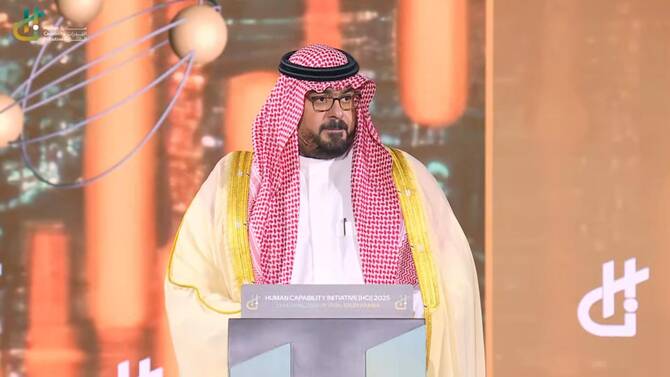

RIYADH: Saudi Arabia must fundamentally transform how it develops its people to remain globally competitive in a rapidly evolving economy, according to a Saudi minister.
During the Human Capability Initiative in Riyadh, Minister of Economy and Planning Faisal Al-Ibrahim emphasized the critical role of talent in developing economies.
“Countries don’t succeed because of fortune. They succeed because of decisions — hard, deliberate, long-term decisions,” Al-Ibrahim said.
“The smartest decision any nation can make in any era under any circumstances is to invest in its people.”
Framing human capital as a core pillar of national strength, Al-Ibrahim described talent — not natural resources — as the true multiplier for growth.
“Land may contain oil, but only people create value. Infrastructure may enable trade, but only talent drives innovation. And technology may open doors, but only a capable workforce can walk through them,” he said, warning that economies failing to reform their education and workforce systems will struggle to compete.
“Human capital is the strongest driver of national wealth in advanced economies. It fuels productivity, and in countries that still rely heavily on natural resources, it is the untapped advantage and the growth multiplier,” he said.
Al-Ibrahim emphasized that while traditional skills and credentials remain vital, they are insufficient without leadership.
“I’m not talking about the formal kind (of leadership) that comes with position or seniority, but the quiet kind that shows up in decisions, merit, and responsibility,” he said.
“We’ve produced engineers who can calculate, developers who can code, analysts who can optimize, but how many can challenge, persuade, inspire?”
He cautioned that the failure to prioritize leadership development would hinder national progress.
“This is not a soft skill, it’s a hard requirement,” Al-Ibrahim stated.
“In a volatile world, leadership is the scarce resource that sets nations apart. And unless we build systems that deliberately grow it, we will keep falling short, even when everything else looks great on paper.”
Citing Crown Prince Mohammed bin Salman as a national model, Al-Ibrahim said that His Royal Highness “Is not only leading reform. He is redefining what leadership means in this era — bold, energetic, laser-focused. He doesn’t manage for the status quo. He moves with vision and urgency, exactly what this moment demands and exactly what we must multiply.”
Five forces for reform
Al-Ibrahim outlined five structural forces driving the urgency for human capital reform.
First, he highlighted that automation and artificial intelligence are no longer future concerns — they are already transforming industries and displacing routine work.
“Education systems built for routine and stability are no longer fit for purpose,” he said.
Second, Al-Ibrahim stressed that “every job is now a digital job,” making digital fluency as fundamental as literacy and numeracy.
“Falling behind in digital skills is not an inconvenience — it is economic jeopardy,” he said.
Third, demographic realities require urgent responses. In countries with aging populations, continuous retraining is essential to sustain output.
In youthful economies like Saudi Arabia, he posed a critical point: “The question is, will youth find systems and jobs that match their potential, or will that potential go unused and eventually be lost?”
Fourth, the job market is evolving beyond degrees. “Employers are no longer hiring credentials. They are hiring capability,” he said.
The mismatch between educational output and labor market demand is “a growth killer.”
Fifth, Al-Ibrahim addressed talent mobility amid global instability.
“High-skilled professionals are looking for stable homes, places they can thrive and build,” he said.
“This is a real opportunity for the Kingdom of Saudi Arabia. If we build attractive environments with clear pathways, inclusive communities, and forward-thinking policies,” he added.
A strategic action plan
To meet these challenges, Al-Ibrahim laid out four strategic actions: realigning education with labor market needs, elevating vocational education, institutionalizing lifelong learning, and fostering deep collaboration between government, business, and academia.
“We must drastically realign education and the economy,” he said.
He added: “Curriculum must be shaped by real labor market data in partnership with employers. Fields like AI, climate tech, logistics, tourism, and digital finance are all expanding—our classrooms should reflect that today, not five years from now.”
Vocational and technical training, he stressed, must be integrated into national strategy.
“Too many systems still treat hands-on careers as a second choice. That is a mistake—and it’s an expensive one,” he said. “Vocational education is economic infrastructure.”
Lifelong learning, Al-Ibrahim said, must become standard policy. “People entering the workforce today will need to re-skill again and again,” he said, calling for co-investment by government and employers to support ongoing learning as a shared responsibility.
Finally, he called for a systemic, long-term approach to collaboration. “No one can do this alone—not government, not business, not academia,” he said.
“When we align incentives, share accountability, and build for the long term, we don’t just produce the skills we need—we produce competitive advantage,” he added.
He highlighted that Saudi Arabia is already moving in this direction under Vision 2030.
“Education systems are reforming. They now emphasize digital skills, entrepreneurship, and critical thinking. Vocational training is expanding. Women’s workforce participation is rising. Young Saudis are reshaping entire sectors,” he said.
“All of this is supported by the Human Capability Development Program — a serious, systems-level investment in national talent.”
He concluded that there is a challenge for policymakers globally. “Do we treat human capability as a headline or as the foundation? Do we prepare people to chase opportunity or to create it?”
Al-Ibrahim reaffirmed the Kingdom’s commitment: “No matter how much we invest in infrastructure or technology, there is no return without the right people to lead it. And those people don’t appear by chance—they appear because we chose early, clearly, and repeatedly to believe in them.”
The second edition of the HCI, running from April 13 - 14 in Riyadh, brings together more than 300 global leaders and attendees from 120 countries to explore solutions for critical gaps in global skills and knowledge.
Held under the patronage of Crown Prince Mohammed bin Salman, the event is hosted by the Human Capability Development Program in collaboration with the Ministry of Education.
With the theme “Beyond Readiness,” HCI 2025 features over 100 panels, a high-level ministerial roundtable, and major international announcements. The event is part of Human Capability and Learning Week, running through April 16.