

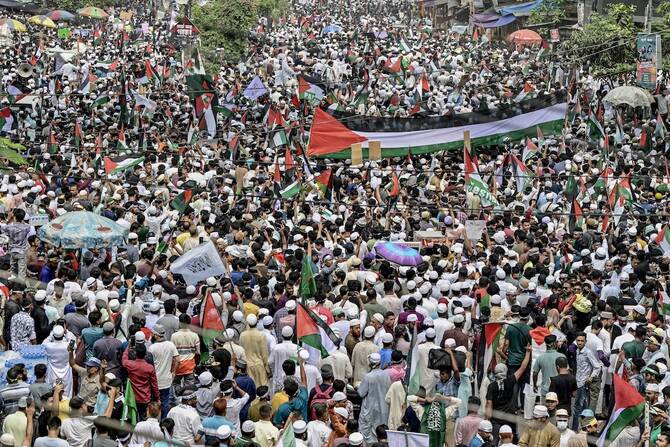

DHAKA: More than 1 million Bangladeshis assembled on the streets of Dhaka on Saturday to join the country’s largest Gaza solidarity rally and take a public oath to boycott products and entities linked to Israel.
Waving the flags of Bangladesh and Palestine and chanting “Free Palestine,” “Stop the Israeli aggression,” and “Boycott Israeli products,” residents of the country’s capital flocked to the Suhrawardy Udyan — the main public space — for the “March for Gaza” demonstration.
Organized by the Palestine Solidarity Movement Bangladesh, the event featured politicians, celebrities, artists, poets and popular social media influencers, who joined in a call on world leaders to bring to justice Israeli Prime Minister Benjamin Netanyahu and others responsible for Israel’s mass killing of Palestinian civilians.
FASTFACT
The protesters called on the Bangladesh government to reinstate the ‘except Israel’ clause in Bangladeshi passports, which had barred nationals from traveling to Israel.
Political leaders present at the event called for international accountability and immediate action to end Israel’s deadly onslaught on Gaza, where over 50,900 people have been killed, 116,000 wounded, and 2 million others face starvation after Israeli forces destroyed most of the region’s infrastructure and buildings, while blocking humanitarian aid from entering.
A joint declaration read during the rally called on the international community to “take effective and collective action to end the genocide,” and especially on Muslim countries to immediately sever all economic, military, and diplomatic relations with Israel and to “impose commercial blockades and sanctions on the Zionist state” and begin active diplomatic efforts to isolate it on the international stage.
“We will boycott every product, company, and force that sustains Israel’s occupation ... We will start from our own homes, leaving an imprint of this pledge in language, history, education, economy, and society,” said the declaration read by Mahmudur Rahman, editor of the Amar Desh daily newspaper, who helped organize the event.
It was the largest Palestine solidarity rally in Bangladesh in recent history.
“More than a million people actually gathered today. According to the police, they have said probably it was 1.1 million,” Rahman told Arab News.
“It was a huge gathering, but it was so peaceful ... This is some sort of example for the entire world. It was peaceful and it was in favor of humanity. Because it’s not only a question of Islam — we were protesting against the inhuman genocide (perpetrated by) the Israeli regime. So, this protest is for the humanity. We have asked the Muslim Ummah to get united to free Palestine.”
The protesters also called on the government to reinstate the “except Israel” clause in Bangladeshi passports, which had barred nationals from traveling to Israel. Even though Bangladesh has no diplomatic relations with Israel, the clause was removed in 2021 by the previous administration of Sheikh Hasina, who was ousted in a popular uprising last year.
Participants at the rally said they already follow many aspects of Saturday’s declaration — especially the boycott call.
“I stopped buying Israeli products from the very beginning of this latest round of Israeli aggression, which started about a year and a half ago. I even stopped buying Coca-Cola, though it’s a very popular and well-known drink here. This is my personal way of protesting against Israel — as an individual,” said Arman Sheikh, a businessman in Dhaka.
“This kind of boycott can definitely make a difference. There’s nothing stronger than the power of the masses.”
Nasrin Begum, a teacher, said she has been trying to avoid global brands for their possible links with Israel, instead choosing local alternatives.
“Before purchasing cosmetics, now I always google about their origin. If anything in my search shows a connection to Israel, I avoid those products,” she said.
“It’s not very difficult to find a suitable substitute for Israeli-linked goods. It’s an open market economy. We can get any products from anywhere in the world. It’s all about our mindset and determination. I wouldn’t be able to forgive myself if I continued purchasing Israeli-linked goods after all the atrocities they are committing.”


