

UN: 36 Israeli strikes in Gaza killed ‘only women and children’

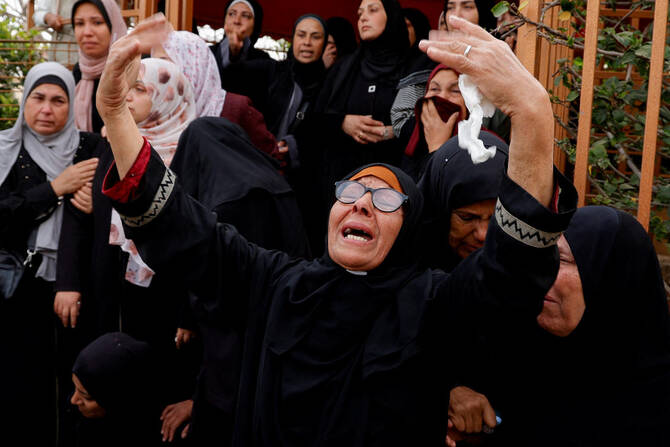
Women mourn Palestinians killed in Israeli strikes in Khan Younis in the southern Gaza Strip on April 9, 2025. (Reuters)
Short Url
Updated 11 April 2025
Follow

UN: 36 Israeli strikes in Gaza killed ‘only women and children’

  • Family of 10 killed in Israeli airstrike on Friday
  • UN rights office spokesperson warns the military strikes across Gaza were ‘leaving nowhere safe’

GAZA: Dozens of Israeli air strikes on Gaza have killed “only women and children” after a ceasefire collapsed, the UN said, as an Israeli attack in the territory’s south on Friday left a family of 10 dead.
A UN rights office report also warned that expanding Israeli evacuation orders were resulting in the “forcible transfer” of people into ever-shrinking areas, raising “real concern as to the future viability of Palestinians as a group in Gaza.”
Israel’s military said it was looking into the attack that killed members of the same family in Khan Yunis, southern Gaza, adding separately that it had struck approximately 40 “terror targets” across the territory over the past day.
Israel resumed its Gaza strikes on March 18, ending a two-month ceasefire with Hamas.
Since then, more than 1,500 people have been killed, according to the health ministry in the Hamas-run territory to which Israel cut off aid more than a month ago.
“Ten people, including seven children, were brought to the hospital as martyrs following an Israeli air strike that targeted the Farra family home in central Khan Yunis,” civil defense spokesperson Mahmud Bassal told AFP.
AFP footage of the aftermath showed several bodies wrapped in white shrouds and blankets, and footage of the house showed mangled concrete slabs and twisted metal.

Turkish President Recep Tayyip Erdogan lashed denounced Israel, saying: “If this is not barbarism, I ask you, what is it?“
Early Friday, Israel’s military issued an evacuation warning to residents of several areas east of Gaza City ahead of a new offensive there.
The UN decried the impact of the ongoing Israeli strikes, finding that “a large percentage of fatalities are children and women.”
“Between 18 March and 9 April 2025, there were some 224 incidents of Israeli strikes on residential buildings and tents for internally displaced people,” the UN human rights office said in Geneva.
“In some 36 strikes about which the UN Human Rights Office corroborated information, the fatalities recorded so far were only women and children.”
Israel’s military has repeatedly said Palestinian militants often hide among civilians, a charge Hamas denies.
UN rights office spokeswoman Ravina Shamdasani also raised concerns over “the denial of access to basic necessities within Gaza and the repeated suggestion that Gazans should leave the territory entirely.”
Saudi Foreign Minister Faisal bin Farhan, after meeting regional counterparts in Turkiye, urged “maximum pressure to ensure” aid is delivered into Gaza.
The war broke out after Hamas’s October 7, 2023 attack on Israel resulted in the deaths of 1,218 people, mostly civilians, according to an AFP tally based on Israeli official figures.
Militants also took 251 hostages, 58 of whom are still held in Gaza, including 34 the Israeli military says are dead.
Gaza’s health ministry said Friday at least 1,542 Palestinians have been killed since March 18, taking the overall death toll since the war began to 50,912.


A truce brokered by the United States, Egypt and Qatar that took effect on January 19 and lasted until March 17 saw the return of 33 Israeli hostages, eight of them in coffins, in exchange for around 1,800 Palestinian prisoners.
In a Passover holiday message, Israeli Prime Minister Benjamin Netanyahu reiterated his pledge to bring the remaining captives home.
He spoke after US President Donald Trump suggested progress in hostage release talks, telling a cabinet meeting on Thursday that “we’re getting close to getting them back.”
Trump’s envoy Steve Witkoff was also quoted in an Israeli media report as saying “a very serious deal is taking shape, it’s a matter of days.”
Israeli media reported Friday that Egypt and Israel had exchanged draft documents on a ceasefire-hostage release deal.
The Times of Israel said Egypt’s proposal would mean eight living hostages and eight bodies released in exchange for a truce of between 40 and 70 days and a large number of Palestinian prisoner releases.
A senior Hamas leader who declined to be identified told journalists the group had “not received any new ceasefire offer.”
“The movement is open to any new proposal that would achieve a ceasefire, withdraw the occupation’s forces, and end the suffering of the Palestinian people.”
In his message for Passover — a holiday celebrating the biblical liberation of the Israelites from slavery in Egypt — Netanyahu said that “together we will return our hostages.”
He has insisted that increased military pressure is the only way to get the captives home.


Syria moves military reinforcements east of Aleppo after telling Kurds to withdraw

Updated 3 sec ago
Follow

Syria moves military reinforcements east of Aleppo after telling Kurds to withdraw

ALEPPO: Syria’s army was moving reinforcements east of Aleppo city on Wednesday, a day after it told Kurdish forces to withdraw from the area following deadly clashes last week.
The deployment comes as Syria’s Islamist-led government seeks to extend its authority across the country, but progress has stalled on integrating the Kurds’ de facto autonomous administration and forces into the central government under a deal reached in March.
The United States, which for years has supported Kurdish fighters but also backs Syria’s new authorities, urged all parties to “avoid actions that could further escalate tensions” in a statement by the US military’s Central Command chief Admiral Brad Cooper.
On Tuesday, Syrian state television published an army statement with a map declaring a large area east of Aleppo city a “closed military zone” and said “all armed groups in this area must withdraw to east of the Euphrates” River.
The area, controlled by Kurdish forces, extends from near Deir Hafer, around 50 kilometers (30 miles) from Aleppo, to the Euphrates about 30 kilometers further east, as well as toward the south.
State news agency SANA published images on Wednesday showing military reinforcements en route from the coastal province of Latakia, while a military source on the ground, requesting anonymity, said reinforcements were arriving from both Latakia and the Damascus region.
Both sides reported limited skirmishes overnight.
An AFP correspondent on the outskirts of Deir Hafer reported hearing intermittent artillery shelling on Wednesday, which the military source said was due to government targeting of positions belonging to the US-backed, Kurdish-led Syrian Democratic Forces.

’Declaration of war’

The SDF controls swathes of the country’s oil-rich north and northeast, much of which it captured during Syria’s civil war and the fight against the Daesh group.
On Monday, Syria accused the SDF of sending reinforcements to Deir Hafer and said it would send its own personnel there in response.
Kurdish forces on Tuesday denied any build-up of their personnel and accused the government of attacking the town, while state television said SDF sniper fire there killed one person.
Cooper urged “a durable diplomatic resolution through dialogue.”
Elham Ahmad, a senior official in the Kurdish administration, said that government forces were “preparing themselves for another attack.”
“The real intention is a full-scale attack” against Kurdish-held areas, she told an online press conference, accusing the government of having made a “declaration of war” and breaking the March agreement on integrating Kurdish forces.
Syria’s government took full control of Aleppo city over the weekend after capturing its Kurdish-majority Sheikh Maqsud and Ashrafiyeh neighborhoods and evacuating fighters there to Kurdish-controlled areas in the northeast.
Both sides traded blame over who started the violence last week that killed dozens of people and displaced tens of thousands.

PKK, Turkiye

On Tuesday in Qamishli, the main Kurdish city in the country’s northeast, thousands of people demonstrated against the Aleppo violence, with some burning pictures of Syrian President Ahmed Al-Sharaa, an AFP correspondent said, while shops were shut in a general strike.
Some protesters carried Kurdish flags and banners in support of the SDF.
“Leave, Jolani!” they shouted, referring to President Sharaa by his former nom de guerre, Abu Mohammed Al-Jolani.
“This government has not honored its commitments toward any Syrians,” said cafe owner Joudi Ali.
Other protesters burned portraits of Turkish Foreign Minister Hakan Fidan, whose country has lauded the Syrian government’s Aleppo operation “against terrorist organizations.”
Turkiye has long been hostile to the SDF, seeing it as an extension of the Kurdistan Workers’ Party (PKK) and a major threat along its southern border.
Last year, the PKK announced an end to its long-running armed struggle against the Turkish state and began destroying its weapons, but Ankara has insisted that the move include armed Kurdish groups in Syria.
On Tuesday, the PKK called the “attack on the Kurdish neighborhoods in Aleppo” an attempt to sabotage peace efforts between it and Ankara.
A day earlier, Ankara’s ruling party levelled the same accusation against Kurdish fighters.
The Britain-based Syrian Observatory for Human Rights reported 45 civilians and 60 soldiers and fighters from both sides killed in the Aleppo violence.
Aleppo civil defense official Faysal Mohammad said Tuesday that 50 bodies had been recovered from the Kurdish-majority neighborhoods after the fighting.