

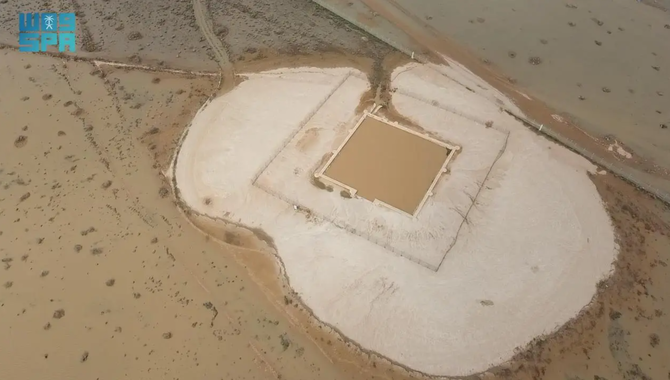


RIYADH: An ancient pond that served as a source of water for travelers along the Hijaz-Iraq trade route has been filled with water following the recent rainfall in northern Saudi Arabia.
The Al-Jumaimiyah pond, which is a historic feature of the Northern Borders Province, has been filled to a level rarely seen, reported the Saudi Press Agency.
The pond was built about 1,300 years ago in the Abbasid era, and was placed in its location to collect rainwater for travelers.
It formed part of a sophisticated water system designed to meet the needs of pilgrim caravans by harnessing the natural flow of valleys, flood channels and the limited water sources available at the time.
It is able to store water for extended periods, and up to a year in some cases.
The pond is considered one of the most prominent landmarks along the historic Zubaida Trail, named after the wife of the Abbasid Caliph Harun Al-Rashid.
The trail constituted one of the most important historic pilgrimage routes, with stations spaced about 50 km apart.
Located at the heart of a circular basin, Al-Jumaimiyah pond is 30 sq. meters. It is enclosed by two walls, with the interior wall at ground level and the exterior wall about 60 cm higher.
A flight of 13 steps is located at the center of the eastern wall, descending into the pond, while the structure is reinforced externally with cylindrical supports. It exceeds 6 meters in depth.
The pond stands as an example of the ingenuity of water engineering planning in Islamic civilization.
It is also a human legacy and an environmental resource, reflecting humanity’s adaptation to the desert environment over centuries.


